




Four Computing teams competed in the inaugural Red Team Hackathon Series last weekend, earning three podium finishes in a highly competitive field.
Hosted at UBC, the event brought together teams from BCIT, UBC, and SFU to tackle the defence tech challenge Find My Force'.
The hackathon is part of a new initiative designed to connect student talent with real-world defence technology challenges.
Interested in having a team of computing students work on your tech challenge? Learn more about ISSP
"Most companies talk about innovation," said Kevin Toderel, CEO of Remote Robotic Systems and one of the event organizers. "We prefer to create the environment where it actually happens. That's exactly what we're doing with the Red Team Hackathon series - putting real challenges in front of talented teams and backing it with a $20,000 prize pool to turn ideas into working solutions."
Inside the Find My Force' challenge
The Find My Force hackathon focused on a real-world defence technology problem: building a system capable of detecting, classifying, and locating radio-frequency (RF) emitters that originate from devices such as radios, drones, or other electronic systems.
Teams worked with simulated signals intelligence data to determine whether transmissions came from friendly, civilian, or potentially hostile systems, helping operators quickly identify potential threats. To do this, teams trained Machine Learning (ML) models to classify radio-frequency signals and implemented geolocation algorithms using data such as Received Signal Strength Indicator (RSSI), In-phase and Quadrature (I/Q) data, and Time Difference of Arrival (TDoA).
The challenge unfolded over several days. Teams received the initial problem description on Wednesday and began developing their ideas immediately. On Saturday morning, they received the final dataset and had until late afternoon to complete their prototype before presenting to the judges that evening.
"The Red Team Hack at UBC was fast-paced and technically dense," said Dr. Bill Klug, retired BCIT Computing faculty, who attended the event. "Approximately fifty teams applied to present at the event, but only ten were chosen, including four teams from BCIT. Each team was given only five minutes to make their pitches to a team of three technically astute and entrepreneurial savvy judges."
Strong results for BCIT teams
BCIT teams performed exceptionally well, securing three spots on the podium.
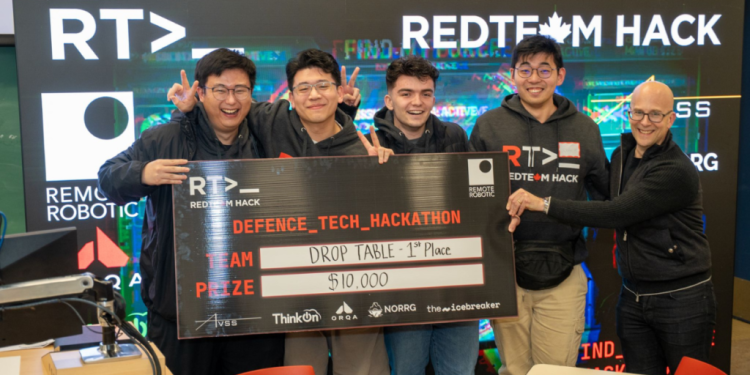
Team Drop Table - made up of Computer Information Technology (CIT) Diploma students Marco Yu, Bruce Weng, Jackson Fleming, Kevin Hu, and Gaston Roxas (not pictured) - took first place, and a $10,000 prize, earning a spot in the Red Team Hackathon Grand Final in Ottawa this November.
"This was our first hackathon," said Drop Team member Marco Yu, "and it was so much fun trying out different algorithms, seeing what worked, and learning something new with every iteration."
The team built a working prototype in just six hours, despite the topic being outside their usual area of study.
Team member Kevin Hu said the experience pushed the group to adapt. "Many advanced topics were unfamiliar to us. However, that did not stop us from trying our best, and because of our eagerness and ability to learn, collaborate as a team and handle stressful situations effectively, we were able to integrate everything into an operational dashboard. We're so excited to be competing in the Grand Finals in Ottawa this November!"
Two BCIT teams earn third place
Two additional BCIT teams - Team N Squared and Cerberus Gate - consisting mostly of Computer Systems Technology (CST) Diploma students, each earned third-place finishes.
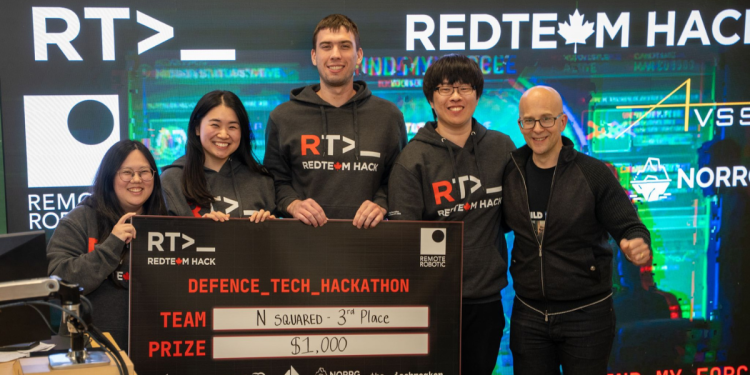
Team members Patricia Lo, Irene Cheung, Daylen Smith and Cai Yan
Cai Yan from Team N Squared explained the focus of their project: "For this National DefTech Innovation Challenge, we built a secure system that tracked, identified and verified emitters in real-time."
Team member Irene Cheung added: "Seeing everything come together under time pressure and actually work was incredibly rewarding."
Another BCIT team, Cerberus Gate, also finished in third place and won the Best Dressed Award.
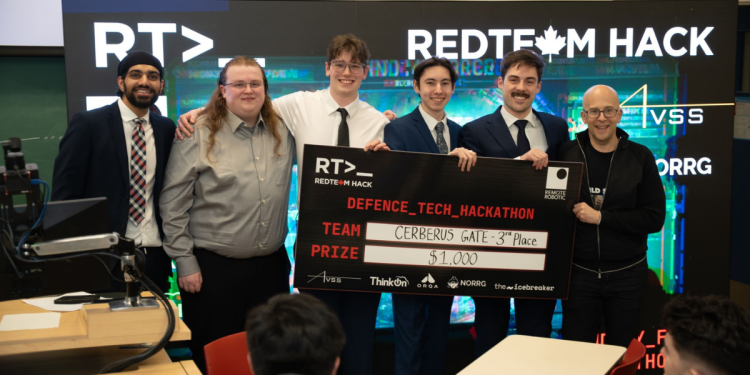
Team members Bhavnoor Saroya, Ryan Fiset, Mitchell Schaeffer, Braeden Sowinski and Nícolas Agostini
Braeden Sowinski described part of the technical approach behind their solution: "We trained several small Convolutional Neural Network models to classify detected signals, identifying signal types and modulation schemes to help better understand the emitters being observed."
"Late nights, rapid prototyping, and a lot of problem solving turned an idea into a working system in just a few days," said Nícolas Agostini from team Cerberus Gate. "It was exciting to build a prototype that classifies RF signals, identifies modulation schemes, and estimates emitter locations."
Daylen Smith from N Squared concluded: "It's one thing to build these systems in a vacuum, but seeing them work in a live, event-driven environment was a fantastic experience."
For more information

3700 Willingdon Avenue
Burnaby British Columbia
Canada V5G 3H2
www.bcit.ca/


