




Humber Polytechnic students are reimagining what transit hubs on Humber campuses can be as part of a course that teaches systems thinking.
Routes of Change: Student-Led Systems Innovation for Accessible, Equitable Urban Transit had students exploring Toronto's transit system through a systems thinking lens as part of a pilot partnership between the Faculty of Liberal Arts & Sciences and the Toronto Transit Commission (TTC). Through research rides, guest speakers and team analysis, students in the Thinking in Systems: The Transit Edition (Understanding Complex Transit Systems and What We Can Do To Make Them Better) course run by Elinor Bray-Collins and Sarah Armenia worked in teams to examine the rider experience and the complex challenges facing transit.
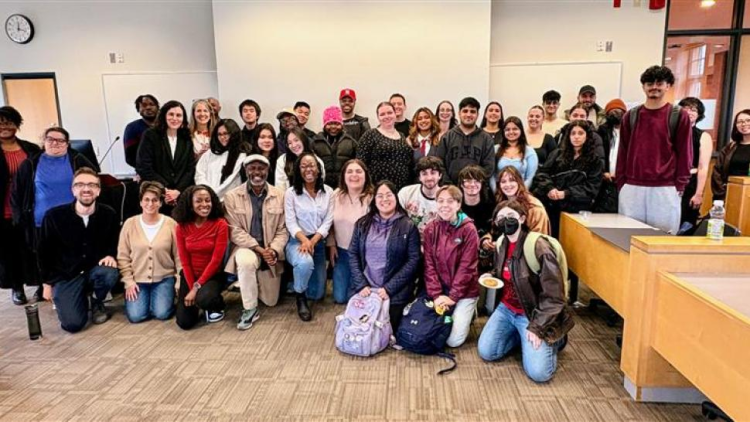
It was an opportunity for students to learn about systems thinking by looking at a real-world example of a complex system that many of them are moving through regularly.
As part of the project, the teams presented their ideas for improving Humber's transit hubs with a focus on better experiences for the institution's diverse transit users.
Third-year Bachelor of Creative and Professional Writing student Caroline Tuccinardi was part of the team that delivered Gotta Cache em All: A Humber Bus Stop Geocache. Also part of the team was Abigail Vincze, Samantha Pernada and Piper Canniff.
"When you're standing at the bus stops, there's not much to do but wait for the bus or doomscroll on your phone," said Tuccinardi. "We felt that it would be nice to reflect the creative side of our campus and inspire people while they wait."
What the team came up with was to include poems written by Humber students on posters at the bus stops. Also included on the posters are QR codes that can be scanned to show the locations of all the stops that have poems.
Tuccinardi said Humber has a lot of talented writers, and the project was a way to share that talent with both Humber and the wider community.
Tuccinardi said she learned a great deal about systems thinking through the project while also developing research and teamwork skills.
Marlon Merraro, director of the TTC's Accessibility, Equity and Inclusion Unit, was there for the student presentations and was impressed.
"Partnerships like this show the power of bringing academic learning into real-world civic spaces," said Merraro. "Humber students are applying creativity, critical thinking, and systems perspectives to everyday transit challenges while gaining firsthand experience in public service. The students' creativity, brilliance, and solution focused projects demonstrated the expertise and value they bring to this work. I was immensely proud to learn and explore with an amazing group of people. Humber should be very proud. When post-secondary institutions and city builders work together, we create opportunities for meaningful learning that strengthens our academic institutions, the city and more importantly the communities we serve."
Bachelor of Behavioural Science student Maheen Rida and her project partner Hector Torres Menendez proposed FLOW. She said one of the biggest issues Humber students have at North Campus is navigating the bus stops. Based on her own personal experience and what she heard from students in her role as a senior peer mentor with First Year Experience is that it can be confusing. Some accidentally stand at the wrong stop or inadvertently get on the wrong bus.
FLOW aims to address that by offering a kiosk that directs users to follow a brightly coloured path to ensure they get to the correct stop. For those who are visually impaired, the paths would have different textures to follow.
"We're really proud of this and we know that hospitals and other transit systems around the world use this so we know that it works," she said. "There are thousands and thousands of students who are new to North Campus each semester and we feel this is something that could be really helpful for them."
She said that it can be tough for people to ask strangers for help - there might be a language barrier or social anxiety or simply no one there to speak with. This idea is simple but also one that would be practical and useful for students and could be implemented fairly easily at low cost.


