




The University of Toronto's Lawson Climate Institute - U of T's tri-campus, multidisciplinary flagship climate initiative - has appointed a director: renowned climate change ecologist Julia Baum.
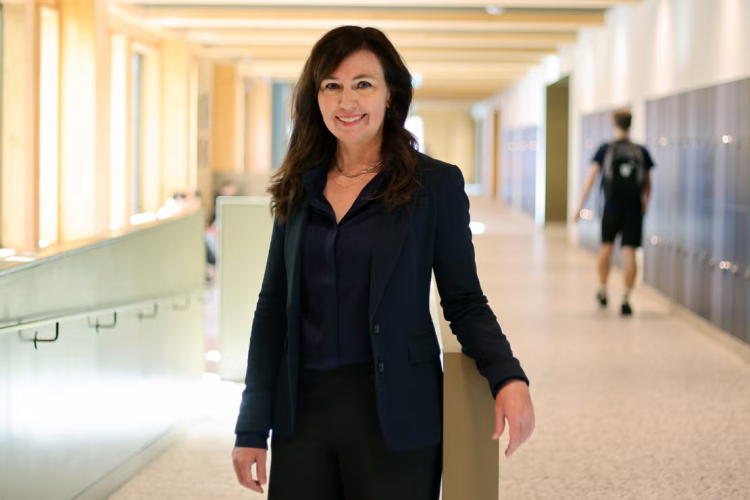
(photo by Diana Tyszko)
Launched in April 2025 and named for Brian Lawson and Joannah Lawson in recognition of their foundational $60-million donation, the Lawson Climate Institute advances the technologies, policies and incentives needed to help Canada and the world make the global transition to net zero, utilizes the university as a living lab for sustainability solutions and prepares tomorrow's climate and sustainability leaders through wide-ranging educational initiatives and scholarships. The institute builds on U of T's multi-faceted leadership in sustainability including initiatives such as Climate Positive Energy, a U of T institutional strategic initiative.
An important milestone
Baum will lead the Lawson Institute as it leverages a growing multidisciplinary team spanning all three campuses and involving 11 faculties, 69 departments and 269 faculty members - a breadth of expertise that reflects U of T's consistent ranking as one of the top three most sustainable universities on Earth.
"Having spent decades studying how climate change is reshaping ecosystems, and building transdisciplinary climate solutions training and research programs, I am thrilled to be taking on this role at the Lawson Climate Institute," says Baum, whose term begins on Jan. 1, 2027. "The urgency of the climate crisis and its underlying inequities demand change. Universities have a critical role to play in helping navigate society towards a climate-positive future, and there is no better university to demonstrate this than U of T. The Lawson Climate Institute is the platform from which to deliver real-world climate solutions at the scale and speed Canada and the world need."
Baum, who comes to U of T from the University of Victoria, is an expert in coral reef ecology, ocean climate change impacts and natural climate solutions. In her research, she uses statistical modelling, fieldwork and molecular analyses to advance understanding of the ecological impacts of climate change in the ocean and to inform effective climate policy. At U of T, Baum will hold faculty appointments in the School of the Environment and department of ecology and evolutionary biology in the Faculty of Arts & Science.
"We are delighted to welcome Professor Julia Baum to U of T and we congratulate her on her appointment as the director of the Lawson Climate Institute," says Melanie Woodin, president of U of T. "With her outstanding, diverse record in climate-focused research and knowledge translation, she is extremely well equipped to lead the institute in tackling the complex global challenge of climate change and sustainability through policy, education and technological solutions. On behalf of the university, I also want to take this opportunity to thank Professor David Sinton for his very effective service as the institute's interim director."
Building on a strong foundation
Under Sinton, the Lawson Climate Institute met and exceeded several crucial milestones in its first year, including initiating recruitment of endowed Lawson Chairs; collaborating with government and industry partners; launching the first cohort of Lawson Scholars, a network of students and researchers across disciplines; funding multidisciplinary research projects in technology, policy and climate finance; and initiating projects that employ U of T campuses, buildings, operations and communities as real-world testbeds for climate solutions.
"With Professor Baum's vision and leadership, we are certain the institute will continue to fulfill its goal of developing practical climate solutions and advancing the technologies and policies needed for Canada to achieve net-zero emissions by 2050," says Professor Stephen Wright, dean of the Faculty of Arts & Science. "We are extremely excited that Professor Baum is joining our faculty."
"Professor Julia Baum's appointment is an exciting milestone for the University of Toronto's broader climate mission," says Professor Christopher Yip, dean of the Faculty of Applied Science & Engineering. "Through the Lawson Climate Institute, we have a unique opportunity to bring together expertise from engineering, the natural sciences, social sciences and other fields to advance research, education and real-world impact. Professor Baum's leadership will help further strengthen the institute's role as a catalyst for interdisciplinary climate innovation."
A career dedicated to climate solutions
Baum received her bachelor of science from McGill University and her master of science and PhD from Dalhousie University. Prior to joining U of T, she spent 15 years at the University of Victoria, where she rose from assistant to full professor and President's Chair for the Faculty of Science. At UVic, she also served as director of Coastal Climate Solutions Leaders, a transdisciplinary graduate training program, and as Special Advisor, Climate, advising the university on strategic climate initiatives.
Baum has received numerous awards for her research, including an Alfred P. Sloan Research Fellow in Ocean Sciences in 2011, a Pew Fellow in Marine Conservation in 2017, an NSERC E.W.R. Steacie Memorial Fellow in 2018 and the Rosenstiel Award in 2025.
Earlier this year, she was named a lead author for the United Nations Intergovernmental Panel on Climate Change (IPCC) report on carbon dioxide removal, carbon capture, utilization and storage for national greenhouse gas inventories.
"As one of the world's top research universities and a world leader in sustainability, U of T has the strengths - and matches my ambition - to meet the moment and rise to the challenge of the climate crisis," says Baum. "Thanks to Brian and Joannah Lawson's exceptional generosity, U of T has the most serious climate opportunity of any Canadian university. Together we will help the world reach net zero."


