




As communities across Canada prepare to mark the National Day for Truth and Reconciliation, Capilano University (CapU) continues to advance the commitments outlined in Chenchenstway, the university's framework for reconciliACTION and learning. Through ongoing efforts to Indigenize and decolonize education, CapU is strengthening culturally grounded supports that foster belonging, connection and success for Indigenous learners.
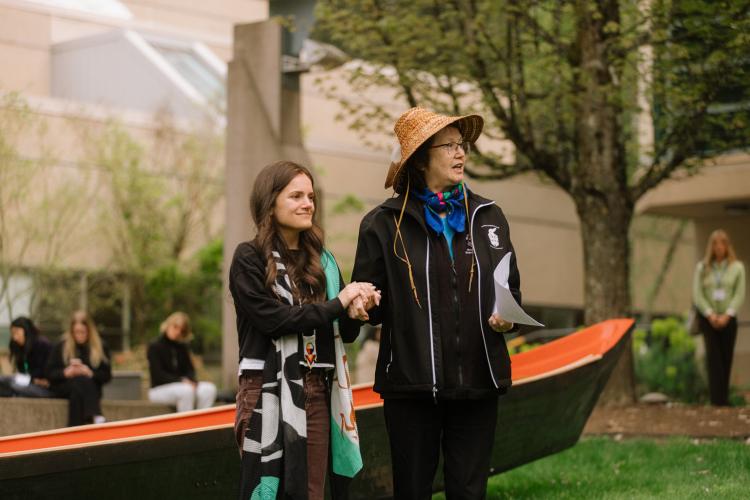
Fourth-year Bachelor Motion Picture Arts student and Kéxwusm-áyakn Student Centre Ambassador Sam Damm (left) with Elder Rose Nahanee (right) at CapU's legacy canoe awakening ceremony in April of this year.
Thanks to a significant gift from the Isabel Bader Charitable Trust, CapU's Indigenous education & affairs department will expand initiatives that support Indigenous students from recruitment and transition to university through graduation and beyond. The investment will help strengthen opportunities for cultural connection, community, academic achievement and holistic well-being throughout the student journey.
"When Indigenous students see themselves reflected in their learning environments and feel connected to culture, community and one another, they are better positioned to achieve their goals and realize their potential," said Stephanie Merinuk, interim director, Indigenous education & affairs at Capilano University. "This generous gift will strengthen opportunities for Indigenous learners to succeed while honouring the knowledge, traditions and perspectives they bring to our university community."
The investment will enhance a holistic suite of programs and services designed to foster belonging, cultural connection, academic success and community engagement for Indigenous students. Funding will support student success and cultural workshops, professional development opportunities, community events, revitalization of the medicine and food garden, an emergency fund for Indigenous students and the university's first reconciliation research project.
The funding arrives at a pivotal time as post-secondary institutions work to address systemic barriers that continue to affect Indigenous learners. While access to education is essential, meaningful student success also requires spaces where Indigenous students feel seen, respected and empowered to bring their whole selves and ancestral knowledge into their educational experience.
"Meaningful reconciliation is built through sustained action and strong partnerships," said Jennifer Bryan, director, philanthropy & alumni relations. "We are deeply grateful to the Isabel Bader Charitable Trust for investing in Indigenous student success and helping us advance the commitments outlined in Chenchenstway by strengthening supports for Indigenous learners and creating more opportunities for them to thrive academically, personally and culturally."
The trust was established in 2022 to continue the philanthropic legacy of Isabel Overton Bader, an educator and philanthropist whose work reflected a deep commitment to Indigenous and immigrant communities, education, youth and families, as well as the arts. Through a select number of annual grants, the trust supports initiatives that align with Bader's vision of creating opportunity, strengthening communities and improving lives.
The partnership will help ensure Indigenous students have access to culturally grounded supports, community, ceremony and resources that promote belonging and well-being throughout their educational journey. It will also support culturally significant initiatives such as CapU's inaugural Indigenous graduation ceremony, centred in the practice of esémkwu, which affirms an Indigenous student's academic achievement as a sacred milestone. Bringing together graduates, families, Elders and community members, the ceremony will mark a significant moment in the university's commitment to honouring Indigenous ways of celebrating achievement.
By investing in Indigenous learner success, the Isabel Bader Charitable Trust is contributing to a future where Indigenous students are empowered to pursue their goals, celebrate their identities and graduate as leaders in their communities and professions.
For more information

2055 Purcell Way
North Vancouver British Columbia
Canada V7J 3H5
www.capilanou.ca/


