




For the second straight year, the Dry Bean Breeding and Computational Biology Program in the Ontario Agricultural College is feeding families in need by donating beans to the Guelph Food Bank.
The research team grows hundreds of thousands bean plants each year, working with producers and industry groups to select varieties with good yield, quality and disease resistance. But only a few varieties are selected for further breeding.
"We don't want the beans we've grown to go to waste," says Dr. Mohsen Yoosefzadeh Najafabadi, who runs the program. "This is a great way to support our community and offer healthy, nutritious food."
Beans provide 35,000 meals
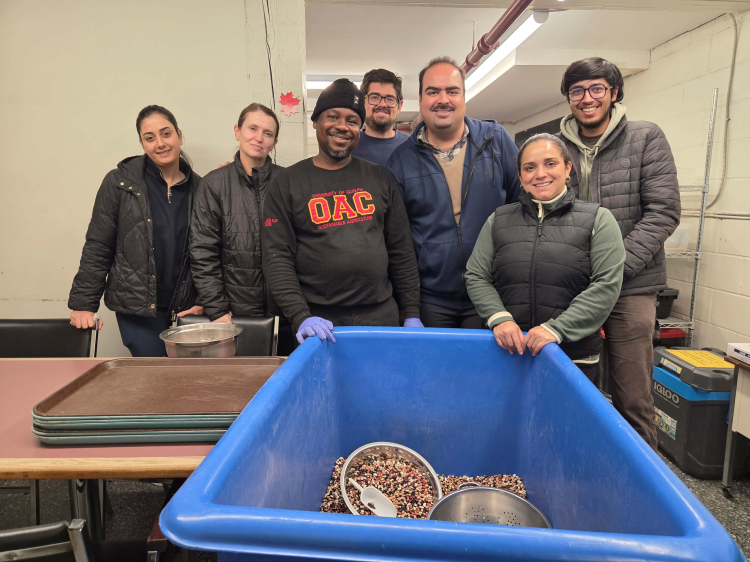
The team from the Dry Bean Breeding and Computational Biology Program helped sort the beans for the Guelph Food Bank
The team made a similar bean donation last year, totalling more than 5,500 pounds (2,500 kilograms) of beans. The food bank said those beans lasted for 8.5 months, providing 35,000 meals. This year, the team collected 10 to 15% more beans from the fields.
"We're not just a university; we're part of a community," says Dr. Mazyar Fallah, vice-president (research and innovation). "The Dry Bean Breeding and Computational Biology Program exemplifies this principle with their donation."
The beans were harvested, dried and cleaned by the dry bean team earlier this year. Once they were ready to eat, researchers, students and volunteers headed to the Guelph Food Bank to bag and sort this year's donation.
"This donation shows what we're about: research that goes beyond the lab and the field and makes a real difference in people's lives," says Dr. John Cranfield, dean of OAC. "I'm incredibly proud of the Dry Bean Breading and Computational Biology Program for making sure the beans they grow feed families in our own community."
The beans will now find their way into households, providing an important source of protein, iron, fibre and more. At a time when meat and other proteins are often expensive, the beans provide a great alternative.
"Beans really are a superfood," Yoosefzadeh Najafabadi says. "They are often overlooked because they're so small, but they're so good for human health."
This year's donation comes on the heels of the development of a new super bean designed with the help of artificial intelligence. Yoosefzadeh Najafabadi developed BeanGPT, an extensive database to suggest the best crosses for a particular growing area. The platform focuses on creating the best bean, meaning the donations are all optimized to offer the best meals to people in need.
The donation was recently covered by CTV Kitchener.


