




The Office of the Auditor General has completed its independent audit report on Memorial University's consolidated financial statements for 2025-26 and issued a clean (unqualified) audit opinion.
The Board of Regents approved the statements at a special meeting on July 21 and are available online, along with a companion document, 2025-26 Memorial University Financial Statement Highlights. The materials were posted earlier today, Aug. 13, immediately following the completion of the year-end audit process.
Memorial's consolidated financial statements include five separate funds. The operating fund, which supports the university's day-to-day academic and administrative activities, is the primary focus of Memorial's annual budgeting process.
For 2025-26, Memorial operated within a Board-approved operating budget of $468.6 million, excluding the Faculty of Medicine. As a result of significant effort across the institution, Memorial ended 2025-26 with a modest operating fund surplus of $2.7 million.
It ensures the university remains in compliance with the Memorial University Act, which requires the university to operate within a balanced budget. It is a governance requisite and reflects the university's commitment to long-term financial sustainability.
Progress towards the 2025-26 expenditure reduction target
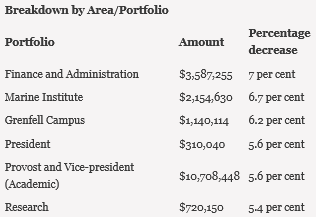
In May 2025, the Board of Regents approved a 2025-26 operating budget that included a required base expenditure reduction of $20.85 million to maintain a balanced budget by aligning projected spending with projected revenue.
By the end of the fiscal year, Memorial implemented $18.6 million in operating cost reductions, including $7.3 million in non-salary operating reductions, $7.5 million in staff-related savings and $3.8 million in faculty-related savings. The reductions were achieved through a combination of operational efficiencies, organizational restructuring, vacancy eliminations, attrition and targeted workforce reductions.
Examples are included below.
- The closure of the Office of Public Engagement in St. John's and the Harris Centre.
- Savings associated with the closure of the Office of the Chief Risk Officer in 2024.
- The elimination of funding for the Teaching and Learning Framework and Public Engagement Framework.
- Workforce adjustments achieved through attrition, retirement and the identification of redundancies across all employee groups. These measures include changes affecting leadership and management, staff and faculty positions. In total, 20 staff positions were made redundant, five staff positions were eliminated through attrition (meaning the positions were not refilled following employee departures),and 55 vacant staff positions were deleted. Thirty-nine vacant faculty positions were deleted and nine faculty positions were eliminated through attrition. Additional changes in the employee complement also occurred during this time through contracts ending, some of which can be attributed to budget reductions and others to natural project cycles.
- Reductions in operating expenditures, including travel, printing, supplies, startup funding and other discretionary spending.
The Office of the Auditor General has completed its independent audit report on Memorial University's consolidated financial statements for 2025-26 and issued a clean (unqualified) audit opinion.
The Board of Regents approved the statements at a special meeting on July 21 and are available online, along with a companion document, 2025-26 Memorial University Financial Statement Highlights. The materials were posted earlier today, Aug. 13, immediately following the completion of the year-end audit process.
Memorial's consolidated financial statements include five separate funds. The operating fund, which supports the university's day-to-day academic and administrative activities, is the primary focus of Memorial's annual budgeting process.
For 2025-26, Memorial operated within a Board-approved operating budget of $468.6 million, excluding the Faculty of Medicine. As a result of significant effort across the institution, Memorial ended 2025-26 with a modest operating fund surplus of $2.7 million.
It ensures the university remains in compliance with the Memorial University Act, which requires the university to operate within a balanced budget. It is a governance requisite and reflects the university's commitment to long-term financial sustainability.
Progress towards the 2025-26 expenditure reduction target
In May 2025, the Board of Regents approved a 2025-26 operating budget that included a required base expenditure reduction of $20.85 million to maintain a balanced budget by aligning projected spending with projected revenue.
By the end of the fiscal year, Memorial implemented $18.6 million in operating cost reductions, including $7.3 million in non-salary operating reductions, $7.5 million in staff-related savings and $3.8 million in faculty-related savings. The reductions were achieved through a combination of operational efficiencies, organizational restructuring, vacancy eliminations, attrition and targeted workforce reductions.
Examples are included below.
- The closure of the Office of Public Engagement in St. John's and the Harris Centre.
- Savings associated with the closure of the Office of the Chief Risk Officer in 2024.
- The elimination of funding for the Teaching and Learning Framework and Public Engagement Framework.
- Workforce adjustments achieved through attrition, retirement and the identification of redundancies across all employee groups. These measures include changes affecting leadership and management, staff and faculty positions. In total, 20 staff positions were made redundant, five staff positions were eliminated through attrition (meaning the positions were not refilled following employee departures),and 55 vacant staff positions were deleted. Thirty-nine vacant faculty positions were deleted and nine faculty positions were eliminated through attrition. Additional changes in the employee complement also occurred during this time through contracts ending, some of which can be attributed to budget reductions and others to natural project cycles.
- Reductions in operating expenditures, including travel, printing, supplies, startup funding and other discretionary spending.
For more information

230 Elizabeth Avenue
St. John's Newfoundland
Canada A1C 5S7
www.mun.ca


