




Last week, students from James Hill Elementary School, Township of Langley staff, Langley Environmental Partners Society (LEPS), and community volunteers came together to plant nearly 900 native trees, shrubs and groundcover plants at James Hill Park as part of the Township's largest mini forest project to date.
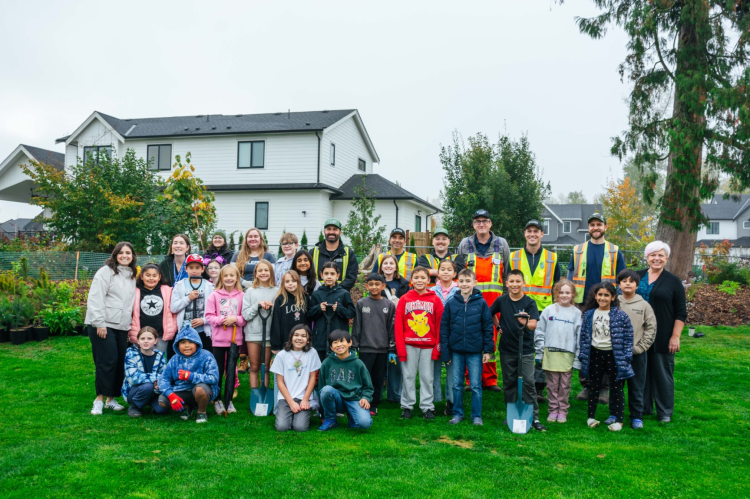
The planting marks an important step in restoring a site that was once part of a larger forested area. Following nearby development, only a small strip of forest remained, leaving the trees increasingly exposed to strong winds and storms. Over time, significant tree failures created safety concerns, leading to the removal of most of the remaining trees.
To restore the natural landscape, the Township of Langley partnered with Langley Environmental Partners Society (LEPS) to establish a new mini forest using the Miyawaki method. This approach involves densely planting a diverse mix of native trees, shrubs and groundcover species to help forests establish and grow taller more quickly while developing in a way that closely resembles a naturally occurring ecosystem.
"This project started almost a year ago, when I did a training course on what mini forests are and how to do them," said Dan Pulsifer, Township of Langley Trees employee leading the project. "This site came to mind right away as a spot where I knew that we had a forest and then lost it, making it the perfect site for us to plant a mini forest."
Pulsifer and the project team then worked with LEPS and James Hill Elementary to coordinate the planting, bring in soil, and prepare the site. "Now we're finally here. We're planting trees. I'm looking forward to seeing what it looks like in 20 to 30 years when we have a forest again," he said.
Once established, the mini forest will provide habitat for wildlife, enhance biodiversity, and contribute to a healthier urban tree canopy for years to come. With nearly 900 plants, James Hill Park is the Township's largest mini forest to date, expanding on earlier mini forest projects at Derek Doubleday Arboretum with 300 plants in 2023, and Gloucester Park with 330 plants in 2025.
The project was made possible through grants provided to the Township of Langley and LEPS from Growing Canada's Community Canopies (GCCC) and the TD Friends of the Environment Foundation.


