




For something that affects so many people, menstruation isn't always an easy topic. A commitment to menstrual equity on campus is helping change that, one free product and conversation at a time.
Telaina Wallace, health promotion specialist at MRU, began the effort in 2021 when she read about Thompson Rivers University providing free menstrual products in all of its campus washrooms. Inspired by the initiative, Wallace began researching period poverty and the barriers people face in accessing menstrual products. What she discovered reinforced her belief that relatively small changes can make a big difference.
"Inclusion and equitable access to services and supports are things that have always been important to me and guide many of my approaches to my work," she says.
At the time, MRU had traditional coin-operated dispensers for pads and tampons in the women's washrooms. Free products were also available through the Students' Association of Mount Royal University (SAMRU) and Wellness Services, but accessing them meant knowing where to go and potentially having to ask someone. For people already facing financial pressure or stigma surrounding menstruation, those extra steps could become significant barriers.
Wallace saw an opportunity to make access simpler, more equitable and more inclusive.
Expanding access and removing barriers
In March 2023, MRU approved a plan to expand access to free menstrual products across campus. Implemented that summer, the initiative replaced coin-operated dispensers with no-cost options and expanded product availability in campus washrooms, including all-gender and single-stall facilities.
The change shows a broader understanding of menstrual equity, which Wallace defines as guaranteeing everyone who menstruates has fair access to products and safe, clean facilities, without shame or financial hardship. For students already balancing tuition, rent, groceries and other expenses, purchasing menstrual products can be an added financial strain. Without reliable access, some may resort to using unsuitable products, wearing products longer than recommended or missing classes, work and social activities altogether.
Having products readily available where they're needed removes the inconvenience and potential embarrassment of searching for supplies. It also acknowledges that menstrual products aren't exclusively needed in women's spaces.
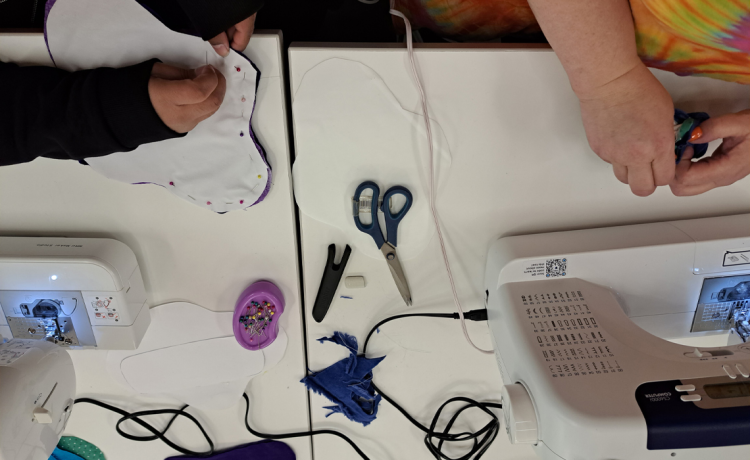
Participants practice sewing skills while crafting washable cloth pads during a workshop.
"Anyone, of any gender might need to access period products," Wallace says.
A universal approach also benefits people who may be accessing supplies for family members, friends or others in their care. Research suggests the need is substantial. A survey conducted at Wilfrid Laurier University in 2019 involving 379 respondents, found that 38 per cent struggled to afford the menstrual products they needed, while more than 77 per cent had experienced being on campus without adequate supplies.
For Wallace, these figures illustrate why menstrual equity is about more than the products themselves. It's about giving people the opportunity to participate fully in academic, professional and personal life.
Sustainable solutions that go beyond campus
While providing free disposable products is an important step, Wallace also wanted MRU's approach to address longer-term affordability and environmental sustainability.
"Disposable pads and tampons in the bathrooms felt like a band-aid' approach to something that might be a more chronic problem for some people," she says.
Unlike disposable products, reusable menstrual cups, discs and cloth pads can last for years with proper care, reducing both ongoing expenses and the amount of landfill waste. In winter of 2022, MRU's Healthy Campus Team began offering free Diva Cups and Diva Discs. Since then, the program has distributed more than 250 reusable products and evolved in response to participant feedback. The goal is to provide choice while giving people options they can use both on and off campus.
Knowing that MRU's Library Maker Studio had sewing machines and offered sewing instruction, Wallace approached the team about collaborating on workshops teaching people to make their own reusable pads. With a small budget for fabric and materials, the first sessions launched in fall 2023. The beginner-friendly workshops give participants an opportunity to learn basic sewing skills while making washable cloth pads they can keep or donate to SAMRU.
Inclusion and equitable access to services and supports are things that have always been important to me.Telaina Wallace
What began as a practical way to address affordability has also become an unexpected opportunity for connection. During the workshops, participants work side by side, learning to sew while sharing experiences and sometimes a few laughs about a subject that can still carry considerable stigma.
"There is something about working with your hands while having conversations that just make them easier," Wallace says. "We share stories and experiences and realize that many other people have had those same experiences too. I really enjoy watching people connect."
For Wallace, these moments represent an important, if unanticipated, outcome of the program. The workshops create space for conversations that might otherwise never happen, helping participants recognize mutual experiences and become more comfortable discussing menstrual health. She hopes participants take away not only a reusable product and the skills to make more, but also a greater understanding of period poverty and its impacts.
Although MRU has made significant progress, Wallace believes awareness remains essential. Menstruation can carry physical, financial and emotional challenges that aren't always visible to others. And while periods may not be a common topic of everyday conversation, that doesn't diminish their impact.
"I'd like students and employees to understand that although periods are not a common topic for people to be drawn towards talking about or sharing about, it doesn't mean they aren't having real impacts on someone's life," she says.


