




"Act boldly, care deeply, and lead with purpose."
Those are the tenets of Bolder Together: Setting the Course for 2031, McMaster's strategic plan for the next five years.
McMaster President Susan Tighe introduced the plan to faculty, staff, learners and external partners at the official launch event at L.R. Wilson Concert Hall, which was filled to capacity. A livestream of the event also generated more than 870 views.
She said the plan will produce concrete outcomes by following an implementation plan that sets the entire university on a "floor of excellence" the starting point for everything that happens at McMaster.
"We are going to be coming back to you, our community, to get some input on our activities," said Tighe. "Bolder Together is something that is going to be part of our culture. People need to see it, understand it, experience it."
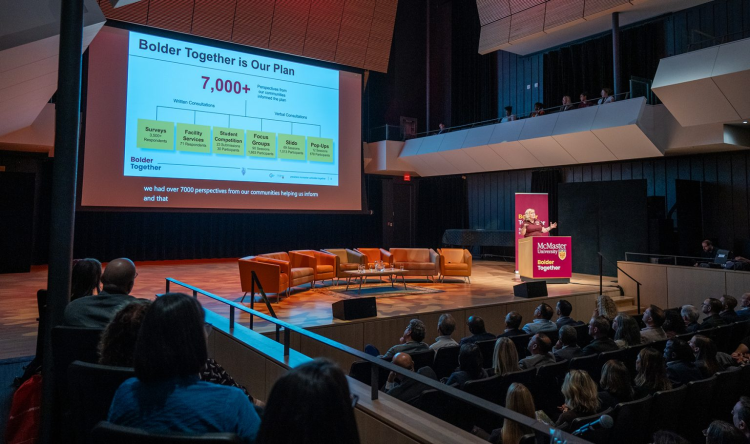
President Susan Tighe tells those gathered for the Bolder Together launched how the strategic plan came together through community consultation.
The plan will feature prominently in everyday life at McMaster, the president said.
"We're not unveiling a document that's simply going to sit on a shelf," said Tighe. "This is a living document. This is a plan. And it's a plan that all of us here at McMaster will participate in."
Members of the community who contributed to the plan joined the launch event for a series of four panels, each focusing on one of the four institutional priorities that will guide McMaster over the next five years.
Amplifying our impact
At a time when the world's geopolitical tensions, climate disasters and economic uncertainty form what he called a "poly-crisis," vice provost International Bonny Ibhawoh said there is also a "poly-opportunity."
The values that are foundational to Bolder Together - excellence, inclusion, agility, collaboration, curiosity and transparency - are under pressure, he said.
"This is a unique opportunity to reaffirm those values, and McMaster is very well placed to do that," said Ibhawoh. "We already do great work across 70 research centres and 30 unique research platforms. What remains is for us to amplify that work and link it more intentionally to the challenges that the world confronts."
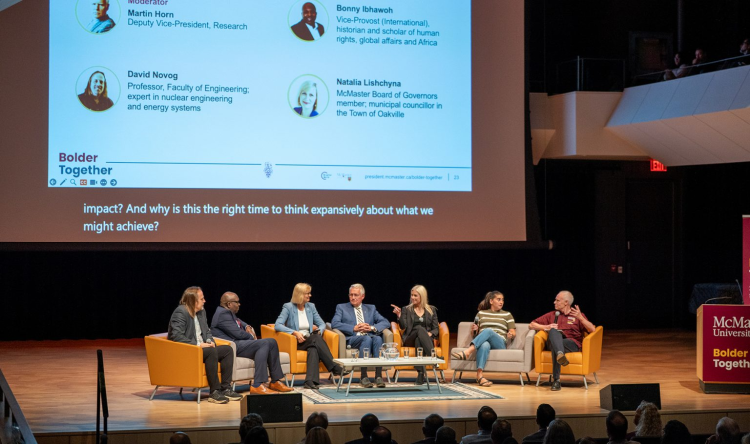
From left: Panelists David Novog, professor, faculty of Engineering; Bonny Ibhawoh, vice-provost, International; Natalia Lishchyna, McMaster board of governors member; John Kelton, Executive Director, DeGroote Heersink Hub for Innovation and Entrepreneurship; Jennifer Heisz, professor of Kinesiology, interim director of the McCall MacBain Kinesiology and Healthspan Institute; Sarah-Kay Walker, PhD candidate specializing in Organizational Behaviour and Human Resource Management; Indigenous scholar and researcher; with moderator Martin Horn, deputy vice-president, Research.
Research that transforms lives
McMaster is known for excellent research, but translating that research into real-world impact is essential to the university's success, said Jennifer Heisz, professor of Kinesiology and interim director of the McCall MacBain Kinesiology and Healthspan Institute.
While the traditional focus of research has been generating new knowledge, researchers also need to accelerate the application of that knowledge to improve the lives of others, Heisz said.
"In the NeuroFit Lab, we're doing research on exercise for brain health. We're looking at the mechanism, but alongside that, we're teaching people how to exercise to improve their memory and reduce their dementia risk," said Heisz. "It's this marriage of the two within the same ecosystem that I think is so exciting about the plan."
Learner-centred education
Seeing that the university is prioritizing the experiences and input of learners in its five-year plan is encouraging to Alex Leake, a second-year student at McMaster's Wilson College of Leadership and Civic Engagement.
"The pace of change in our world is accelerating, and we need to evolve the learner experience to keep up with that," said Leake. "Our learning environment is going to be the most productive when it explores the spaces that fall between disciplines, and we work collaboratively together to really create change in those spaces."
As a member of Wilson College's inaugural class, Leake said she valued having the opportunity to provide feedback about the first-year experience and then seeing that feedback implemented for new students this year.
"I think centering learners in education really instills confidence in them and puts the focus back onto them," she said.
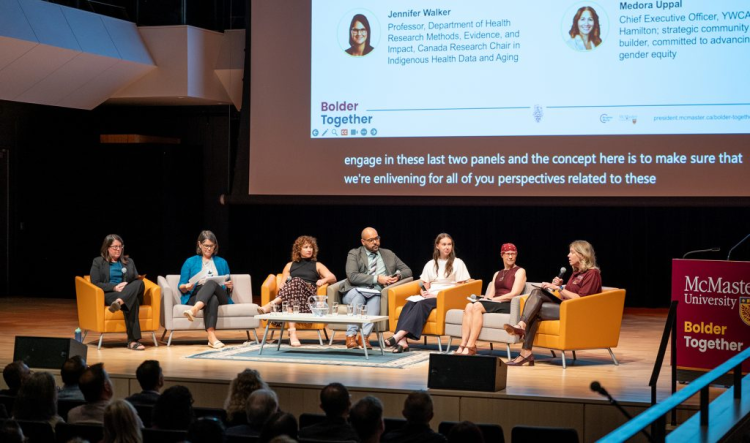
From left: Panelists Paula Hearn, Associate Director, AccessMac Program; Jennifer Walker, professor, department of Health Research Methods, Evidence and Impact; Medora Uppal, CEO, YWCA Hamilton; Mohammad Salhia, senior director, McMaster Continuing Education; Alex Leake, undergraduate student, Wilson College; Kim Dej, vice-provost, Teaching and Learning; with moderator Maureen MacDonald, provost and vice-president, Academic.
Inclusive communities where all can flourish
Ensuring McMaster's relationship with the wider community remains strong means fostering connections with smaller organizations and the real people who live in Hamilton, said Medora Uppal, CEO of YWCA Hamilton.
"McMaster is a wonderful place where there is deep thinking happening and innovation, but we don't need academia to tell us how to solve our problems, or what our problems are," said Uppal.
"What Hamilton needs is access to the rich resources, tools and knowledge you have, to solve our own problems alongside McMaster. It is about partnership in a real way. It is not about being led by McMaster, it is allowing community to lead McMaster forward."
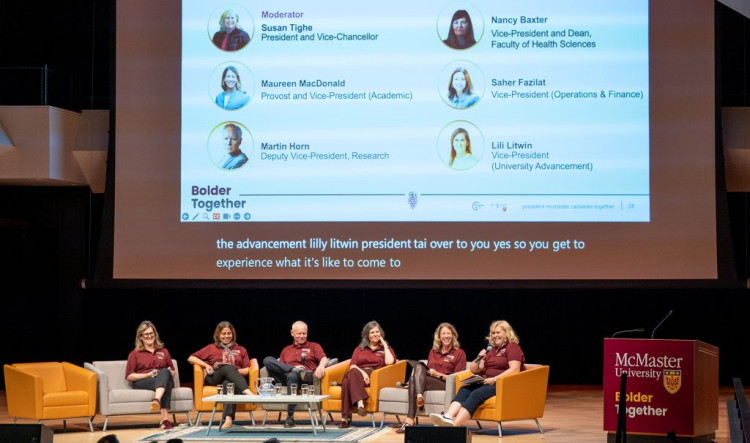
From left: Lili Litwin, vice-president, University Advancement; Saher Fazilat, vice-president, Operations and Finance; Martin Horn, deputy vice-president, Research; Nancy Baxter, vice-president and dean, Faculty of Health Sciences; Maureen MacDonald, provost and vice-president, Academic; Susan Tighe, president and vice-chancellor.
The university's five-year road map is supported by four foundational concepts: Indigenous reconciliation, operational excellence, environmental stewardship and bold thinking.
Those concepts mirror the principles of peace, trust and friendship, which vice-provost, Indigenous Beverly Jacobs said are the basic principles of a healthy relationship, as portrayed by the Haudenosaunee two-row wampum belt.
"I can see those principles throughout the whole framework of the strategic plan," said Jacobs. "For a relationship to work, we have to work together in peace, we have to trust each other, and we have to be friends with each other."
The strategic plan's launch event opened with the Haudenosaunee Thanksgiving address, recited by Derek Sandy, faith keeper at Lower Cayuga Longhouse. Incorporating the traditional address into McMaster's colonially informed practice demonstrated the university's commitment to reconciliation and honouring Indigenous ways of being, Jacobs said.
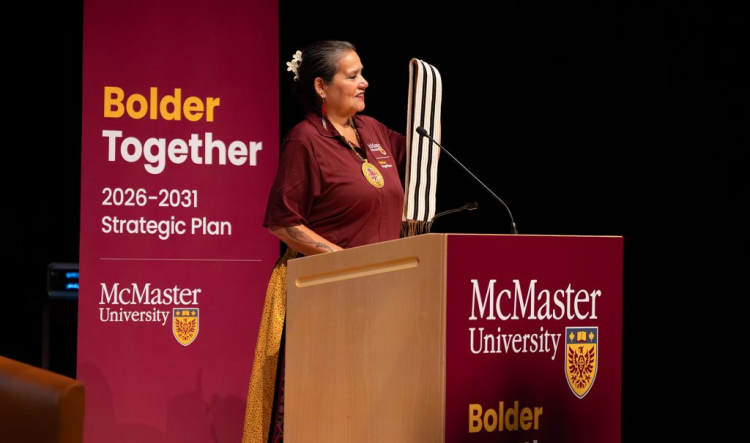
Beverly Jacobs, vice-provost, Indigenous, holds up the Haudenosaunee two-row wampum belt.
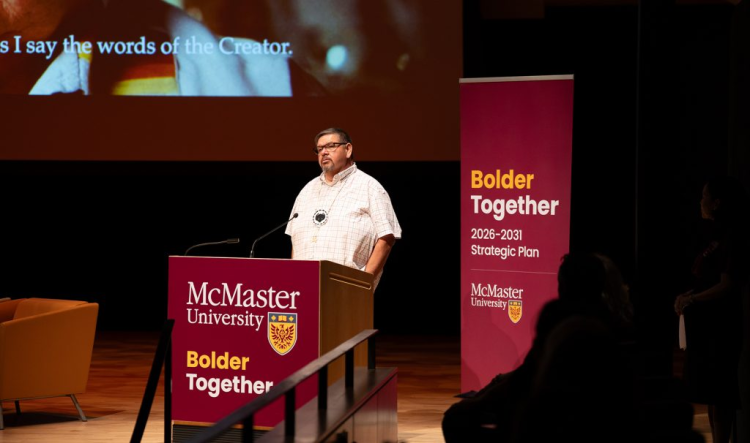
Derek Sandy, faithkeeper at Lower Cayuga Longhouse, delivers the Thanksgiving address.
To get the ball rolling on the plan, a dedicated Metrics and Implementation Team has been created to define how McMaster will use Bolder Together and track and measure its success.
One of the first steps in the implementation has been to make the plan's call to action visible by posting it as a massive banner on the brick face of Gilmour Hall. Tighe said she hopes the visual reminder will prompt the McMaster community to act on it every day.
"Be bold, McMaster."


