



As he breathed in the brisk Arctic air, Jonas Stankevicius couldn't help but take a moment to soak in his surroundings.
Aboard the I/B Oden for the 2025 Canada-Sweden Arctic Ocean Expedition, the Schulich School of Engineering PhD student was one of six early career researchers from Canadian universities getting the ultimate hands-on learning experience.
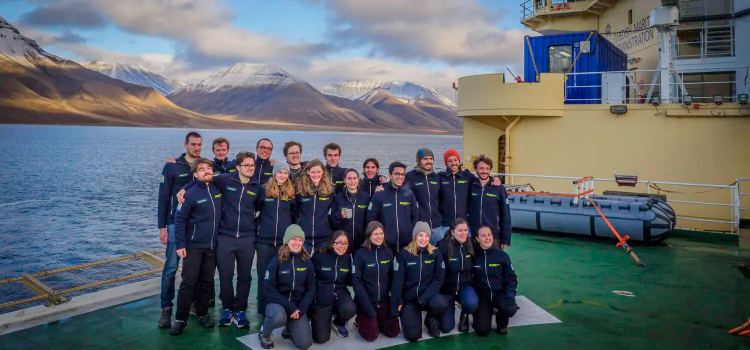
Everyone involved with the 2025 Canada-Sweden Arctic Ocean Expedition smile for a group photo at the end of their journey. Photo Courtesy Jonas Stankevicius
Thanks to the support from the Marine Environmental Observation, Prediction and Response Network (MEOPAR), Stankevicius spent six weeks last summer learning about life at the North Pole while performing seabed mapping research in the Arctic Ocean.
As someone who spends a lot of time in front of a screen as a computational hydrologist focused on Great Slave Lake, he says being surrounded by ice as far as the eye could see, as well as a few polar bears, was nothing short of profound.
"Sea-floor mapping is being done 24 hours a day and then whenever the boat stops, everyone just drops what they're doing and starts taking samples," Stankevicius says. "Just seeing the sheer scale of the ice and the ocean is something that you can't really appreciate from looking at images or maps."
He hopes sharing his story will also inspire future engineering students to take advantage of unique opportunities.
From speedway to waterway
If you had told Stankevicius a few years ago that he would be standing on the Earth's northernmost point, he might have laughed at you.
Originally from Lithuania, he earned his bachelor's degree in motorsport engineering at the University of Huddersfield in the U.K. in 2014, as his dream was to design Formula One race cars.
Stankevicius spent a few years designing engine components, cooling systems and turbochargers for a handful of companies in the U.K. before deciding to change things up.
He came to the University of Calgary in 2022 to enrol in the Schulich School of Engineering's Environmental Engineering program, where his interest was piqued taking a sustainable water systems course with Drs. Qi Zhou and Alain Pietroniro, both PhD.
"It kind of relates back to what I studied back in my bachelor's working on fluid dynamics," Stankevicius says. "I studied thermodynamics, which essentially governs the energy and water cycle of lakes and the circulation within it, so it felt like a really good fit."
Out from behind the computer screen
Zhou says he thought it would be a great opportunity for Stankevicius to see a new part of the world and see the real-world implication of what he otherwise has only seen on a computer screen.
"I want students to get more exposure to this kind of thing because they sometimes don't understand the challenges associated with field work and the need for good data for their models," Zhou says. "I think it's really good to see something that's real and much, much bigger than what they study."
The added bonus, in his eyes, was that the Canada-Sweden Expedition was "like a small United Nations on a ship," allowing plenty of idea sharing and multidisciplinary networking while exploring our changing climate.
A new perspective on climate change
Stankevicius says he was really impressed by the array of knowledge aboard the ship.
Not only were the students collecting samples and analyzing data, but he says professors provided more than 30 hours of lectures, group presentations and individual assessments as part of Arctic Research School 2025, an aspect of the 2025 Canada-Sweden Arctic Ocean Expedition.
Participating students earned European Credit Transfer and Accumulation System credits as they learned about the Arctic ecosystem, including oceanography and atmospheric phenomena.
Stankevicius, who passed his PhD candidacy upon returning to UCalgary and is working towards receiving his doctorate soon, says the expedition provided him with a new perspective on how climate change has an impact beyond the Great Slave Lake region or even the Arctic.
"I'm hoping we will help open people's eyes and get them to understand how to adapt to climate change," he says. "This expedition left a really deep impression on me."
Applications are open for the 2026 Canada-Sweden Arctic Ocean Expedition until Jan. 11.


