



For centuries, astronomers have been observing celestial bodies and trying to understand the mysteries of the night sky. Dr. Jo-Anne Brown, PhD'02, wants to map an invisible force of the Milky Way galaxy: its magnetic field.
"Without a magnetic field, the galaxy would collapse in on itself due to gravity," says Brown, a professor in the Department of Physics and Astronomy at the University of Calgary.
"We need to know what the magnetic field of the galaxy looks like now, so we can create accurate models that predict how it will evolve."
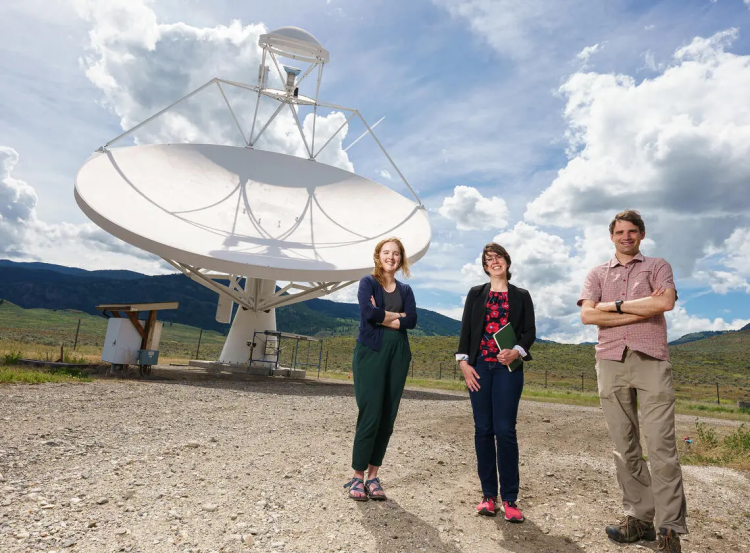
Researchers, from left, Rebecca Booth, Anna Ordog and Alex Hill next to the telescope used to collect the data for their study. Photo Credit: National Research Council of Canada/ Conseil National de Recherches Canada
This month, Brown and a team of researchers have published two papers in The Astrophysical Journal and The Astrophysical Journal Supplement Series. Their discoveries include a complete dataset, which will be used by astronomers globally, and a new model that will inform theories for how the magnetic field of the Milky Way evolved.
The group used a new telescope at the Dominion Radio Astrophysical Observatory in B.C., a National Research Council Canada facility, to map the northern sky across different radio frequencies.
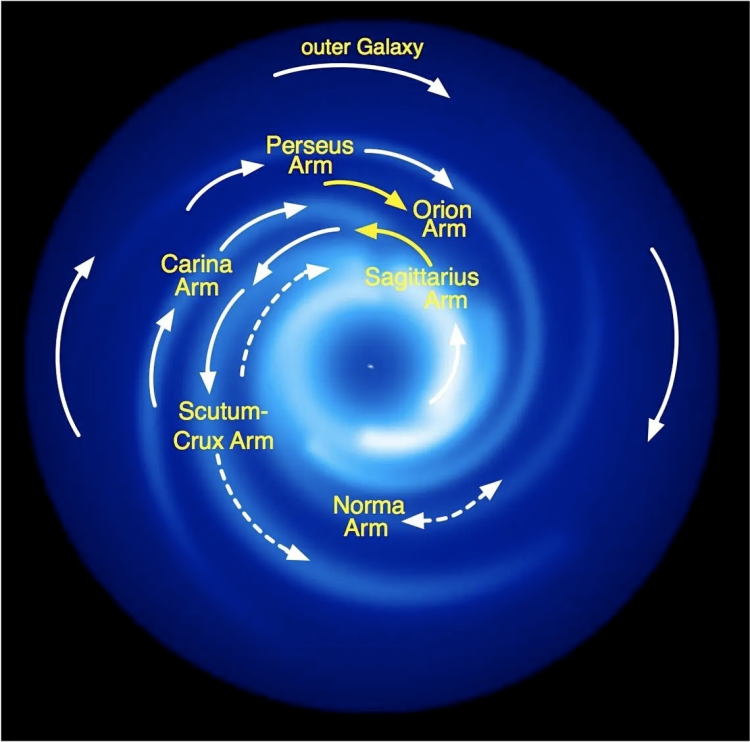
Diagram of the Milky Way galaxy, showing the reversed magnetic field from the Sagittarius Arm. Photo Credit: Jo-Anne Brown, PhD, OR Fig. 11 from Van Eck et al. 2011.
"The broad coverage really lets you get at the details about the magnetic field structure," says Dr. Anna Ordog, BSc'09 (Applied Mathematics), BSc'09 (Physics), BA'13, MSc'16, PhD'20, and lead author of the first of the two studies.
The result is a comprehensive, high-quality dataset, captured as part of the Global Magneto-Ionic Medium Survey (GMIMS) project that maps the magnetic field of the Milky Way galaxy.
The data that was collected involved tracking an effect known as Faraday rotation.
"You can think of it like refraction. A straw in a glass of water looks bent because of how light interacts with matter," says Rebecca Booth, BEd'07, MSc'21, a PhD candidate working with Brown and lead author of the second study. "Faraday rotation is a similar concept, but it's electrons and magnetic fields in space interacting with radio waves."
Booth's work in the second study looked at a unique feature in the Milky Way galaxy the Sagittarius Arm, which has a reversed magnetic field.
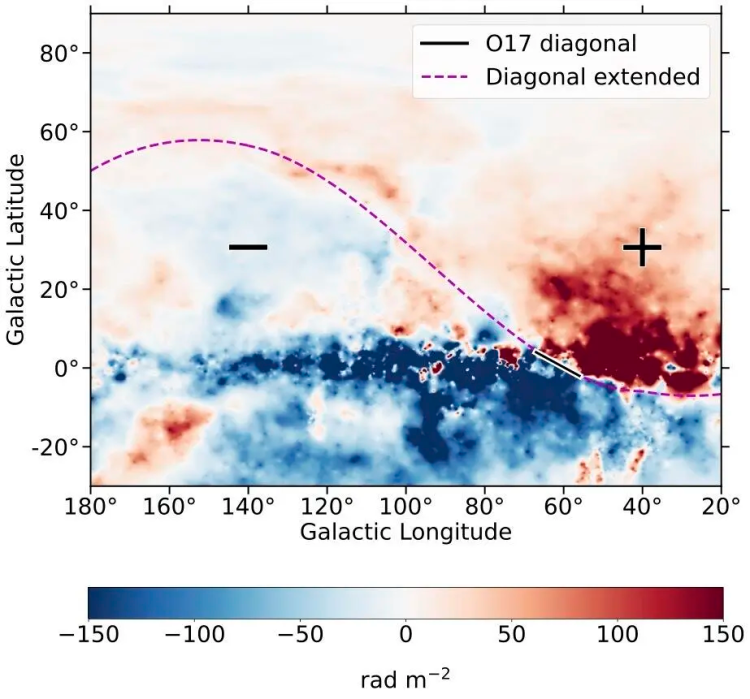
Data showing the diagonal magnetic field. Photo Credit: Rebecca Booth
"If you could look at the galaxy from above, the overall magnetic field is going clockwise," says Brown. "But, in the Sagittarius Arm, it's going counterclockwise. We didn't understand how the transition occurred. Then one day, Anna brought in some data, and I went, 'O.M.G., the reversal's diagonal!'"
Booth followed up on Ordog's discovery using the dataset.
"My work presents a new three-dimensional model for the magnetic field reversal. From Earth, this would appear as the diagonal that we observe in the data," Booth explains.


