




For the first time in the wild, researchers have shown plant populations can evolve quickly enough to rebound from extreme drought -- a rare ray of hope in an oft gloomy climate landscape.
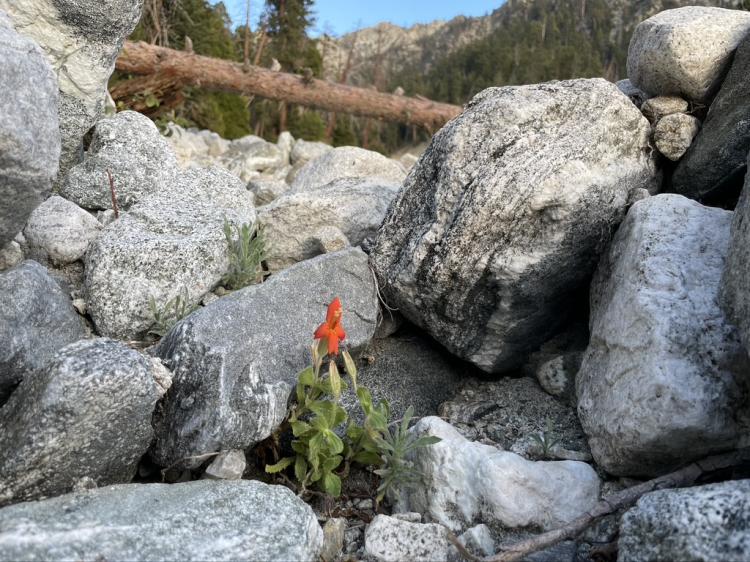
Scarlet monkeyflower plant in natural habitat. (Photo credit: Seema Sheth)
Published on March 12 in Science researchers from UBC and Cornell tracked the scarlet monkeyflower -- a common western North American wildflower widely used in evolutionary research -- in Oregon and California for more than a decade. They analyzed the genetics of leaf and seed samples before and during a four-year drought that started in 2012.
"Essentially what we found is that the populations that recovered are also the populations that evolved the fastest," said first author Dr. Daniel Anstett, assistant professor of plant biology at Cornell University, who conducted the research as a postdoctoral fellow at UBC.
For instance, plant populations that evolved the fastest had more genetic markers associated with hot, dry environments, and their descendants lost less water from their leaves while capturing carbon through photosynthesis.
The findings document what scientists call "evolutionary rescue" -- when genetic adaptation allows populations to avoid extinction under severe environmental stress.
"The concern has been that climate change is happening too fast and its changes are too big for evolution to keep up, like running on a treadmill that continues to speed up even as you increase your pace," said senior author Dr. Amy Angert, professor in the UBC departments of botany and zoology. "Our research shows that for monkeyflower, and likely similar wild plants, they can indeed keep pace and rescue' themselves from extreme climates by evolving."
Climate genetics
To demonstrate evolutionary rescue in the wild, researchers needed to show three things: population decline due to climate, rapid evolution through genetic change, and population recovery thanks to this change.
Dr. Angert's team began monitoring monkeyflower populations in 2010, before the most extreme drought in more than 10,000 years would begin in California in 2012. As the numbers dwindled, they realized that they had a time capsule, in the form of stored leaves and seeds collected pre-drought. They established a genetic baseline by sequencing whole genomes from all 55 populations and identified genetic variations associated with climate differences across the species' range.
When drought hit, populations shrank and some went extinct, but others recovered.
They found that three of the populations fared particularly well - those with the most adaption at those genetic climate-associated sites. Indeed, when modeling growth after the drought, the team found that plants needed these climate-related genetic markers in order to recover.
"The plants that evolved fastest for drought recovered the fastest," said Dr. Angert. "And the ones that entered the drought with the right genetic variation were the ones that pulled themselves out of it the best."
"That's the crystal ball we can use to predict into the future," said Dr. Anstett. "Identifying the genes involved in this evolution would help us understand what traits allow populations to survive these extended drought periods."
Rethinking climate models
The findings suggest some current projection models may overestimate plant population decline by not accounting for rapid evolutionary change.
The research could also inform conservation planning for wild plant species, including endangered populations.
Dr. Angert's lab has continued studying monkeyflower populations from 2017 to present to find out how they are faring after recovery, and Dr. Anstett's lab is examining whether their recent evolution helps or hinders responses to future climate events.
Does life find a way?
Researchers caution there is no guarantee that the genetic changes observed during this drought will prove beneficial over the long term.
While the findings are encouraging for abundant and short-lived species like monkeyflower, the Canadian salmonberry or huckleberry, not all plants will be able to rapidly evolve.
"Not all species will be able to pull themselves up by their own bootstraps," said Dr. Angert. "The question becomes, which species are going to be like the monkeyflower, and which species are going to be more like Douglas fir or red cedar?"


