




Effectively supporting women with reintegration into society after incarceration isn't an area that's widely researched. This is why a group of Justice Studies and Psychology students from the University of Guelph-Humber (U of GH), in partnership with EFry Hope and Help for Women, collaborated on conducting research on this topic over the course of 12 weeks for an independent study course, under advisor Dr. Laura MacDiarmid.
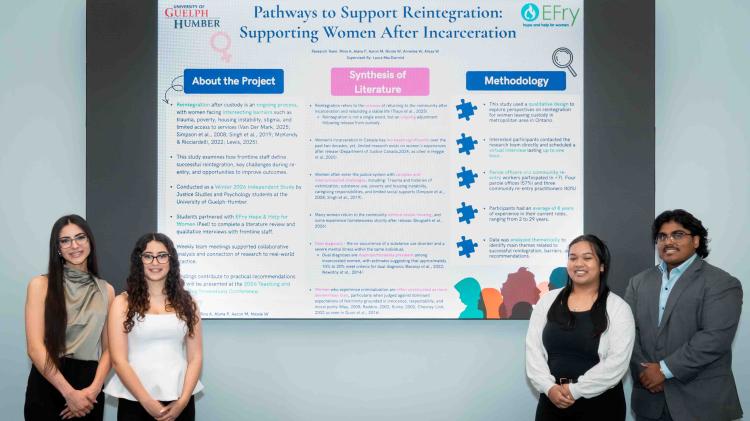
Mina Alfarag, Nicole Wassef, Alana Pelay, and Aaron Mariathas
A section of the group presented their research, "Pathways to Support Reintegration: Supporting Women After Incarceration," at the 2026 Crime Prevention Through Environmental Design (CPTED) Canada National Conference, where they shared their work with industry professionals. The group comprised Justice Studies students Aaron Mariathas, Alana Pelay, Mina Alfarag, and Nicole Wassef, and Psychology students Alissa Witter and Annelise Williams.
Several other groups of U of GH Justice students also had this valuable opportunity to showcase their undergraduate projects.
"I've spoken to [formerly incarcerated women] and they said, Well, it doesn't matter because at the end of the day, we're criminals.' But that's not how I see them. I want the rest of the world to understand that they are really struggling, and they all ended up in their position for a reason," Alfarag said.
The group conducted qualitative research, including a literature review of existing studies and interviews with seven frontline professionals including four parole officers and three community re-entry practitioners. They found that women tend to face many barriers to reintegration due to the stigma of having a criminal record. Other barriers include a lack of housing, mental health and substance abuse, and a lack of financial stability and employment.
Ultimately, the group found that a major reason women commit crimes is due to mental health problems and substance use. Based off the research, their recommendations are to increase housing supports post-release, improve mental health and substance use treatments, enhance planning from custody to re-entering the community, and focus on breaking down systemic barriers for women - while being mindful of the different responsibilities that women have, such as motherhood.
The collaborative effort between Justice Studies students and Psychology students allowed them to take a holistic approach to the research. Justice students are more familiar with the workings of the justice system itself, while Psychology students have a stronger grasp on the mental health element and research techniques.
Dr. MacDiarmid, who the students met with weekly for guidance, said the research is significant because its focus was co-developed with a community partner. This reflects a community-engaged approach to the work, she said. Alfarag and Wassef emphasized the instrumental role Dr. MacDiarmid played in supporting their project; she provided guidance and advice, while allowing the students to get hands-on experience, such as supervising their interviews but not interjecting.
"Opportunities like this are relatively rare in course-based settings, where students can collaborate meaningfully with community organizations while contributing to applied research," Dr. MacDiarmid said.
Due to the significance of their findings, Wassef said that the group was approached by an individual working in housing for reintegrating men and women after incarceration, who asked questions about their insights and recommendations to share with his organization. Even before graduating from U of GH, the students' research is already making an impact in the field, which Wassef said was one of their goals.
"In addition to presenting their findings to EFry Hope Help for Women, sharing this work at the CPTED conference enables the findings to be mobilized to a broader audience. It also supports students in strengthening their communication and research translation skills across academic and non-academic contexts," Dr. MacDiarmid said.
Alfarag aspires to become a lawyer and feels this project could illustrate her dedication to the field and set her apart during law school applications through the skills she gained in conducting qualitative interviews, synthesizing literature, etc.
"It wasn't just a group project to us. It was something that we're really proud of and we want everyone to see," Alfarag said.
Explore the University of Guelph-Humber's Justice Studies program here, and our Psychology program here.
For more information

207 Humber College Blvd
Etobicoke Ontario
Canada M9W 5L7
www.guelphhumber.ca


