




Repositioning residents, assisting with transfers, and helping with daily care are routine parts of long-term care.
Performed repeatedly throughout a shift, these physically demanding tasks can place significant strain on the body and contribute to injury, fatigue, and burnout among workers.

Dr. Wayne Albert, a professor in UNB's Faculty of Kinesiology, is partnering with the Université de Moncton to examine the physical demands of caregiving and identify ways to improve safety in long-term care settings.
To address this challenge, researchers from the University of New Brunswick and the Université de Moncton are leading a major research initiative to improve safety in the long-term care sector.
Leading the project on behalf of UNB is Dr. Wayne Albert, a professor in the Faculty of Kinesiology whose research focuses on ergonomics and occupational biomechanics. He is working alongside Dr. Michelle Cardoso, associate professor and Research Chair in Healthcare and Ergonomics at Université de Moncton.
Researchers have been collaborating on this work for the past three years. Now, with $1.6 million in combined funding from WorkSafeNB, Mitacs, the New Brunswick Continuing Care Safety Association, and ResearchNB, they can expand the project and develop new evidence-based solutions to support the sector.
"We already know that patient handling is physically demanding work," said Albert. "For the first time, we're quantifying those demands and gaining a clearer picture of the workload caregivers experience every day."
The project comes at a time when long-term care facilities across Canada are facing growing pressures. An aging population is increasing demand for care, while staffing shortages continue to strain an already stretched workforce.
Albert said the challenges facing long-term care have come into sharper focus in recent years, particularly following the COVID-19 pandemic.
"The healthcare system is under tremendous pressure, and long-term care is no exception," he said. "We're seeing increased demand for care, staffing shortages, and higher rates of workplace injuries. Those factors are colliding in a way that's making this an increasingly challenging environment for caregivers."
Quantifying the demands of caregiving
The team is using a combination of laboratory testing and real-world observation to better understand the physical challenges caregivers face on the job.
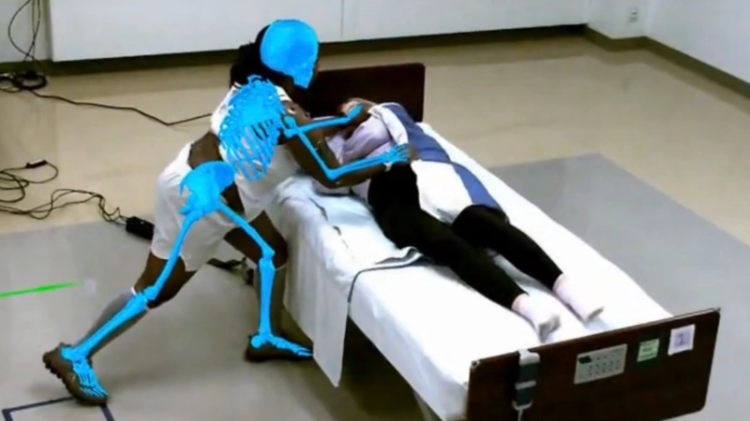
Using state-of-the-art motion-capture technology, researchers analyze how caregivers perform common tasks and create biomechanical models that measure stress on the body.
To better understand the realities of caregiving, the team expanded the project beyond the lab and into long-term care settings, following caregivers throughout entire shifts and examining how fatigue affects movement patterns and techniques over the course of a workday.
"When we combine that information with measurements of the physical demands associated with those tasks, we get a much better understanding of what a typical shift looks like for a caregiver," said Albert.
Exploring new technologies and solutions
The researchers are also evaluating emerging technologies that could make caregiving safer and less physically demanding.
As part of this work, members of the research team travelled to Denmark to learn about innovative technologies being used in long-term care environments that are not yet available in Canada.
"European beds and North American beds are designed quite differently," said Albert. "We're exploring ways to adapt the VENDLET turning system technology for use in Canada, including a universal mounting system that would allow them to be used with a range of beds and equipment. That's an important part of the project."
The team is also evaluating the VENDLET system, an assistive technology that helps turn and reposition residents in bed. By replacing traditional bed rails with a motorized turning system, the technology could reduce strain on caregivers during routine patient-handling tasks.
"We're studying how these technologies function in confined spaces. Resident rooms are often quite small, and manoeuvring equipment can be challenging. We want to ensure these solutions are practical and effective in real-world long-term care settings," he said.
Insights gained through that work will help inform the next phase of the project, which will expand its research into additional areas, including patient transfers, workplace training effectiveness, barriers to implementing safe-handling practices, and the development of national guidelines for safe patient handling in long-term care settings.
From research to real-world impact
The project is built around four key pillars: epidemiology, ergonomic evaluation training and technological interventions, and knowledge transfer. For Albert, ensuring the findings reach frontline workers is one of the most important aspects of the work.
"That's why we've partnered with organizations such as WorkSafeNB and the New Brunswick Continuing Care Safety Association," he said.
"They're helping ensure this information reaches frontline workers and that training is implemented where it's needed most. There's no value in generating knowledge if the people who can benefit from it never see the results."
The project brings together an interdisciplinary team, including graduate and undergraduate students, postdoctoral researchers, healthcare organizations, and workplace safety partners from across the province.
Albert said New Brunswick's mix of urban and rural communities, along with long-term care facilities of varying sizes, makes the province an ideal setting for the research.
"We're well positioned in New Brunswick to use this as a living lab," he said.
"The diversity of facilities and communities gives us an opportunity to develop recommendations that can have an impact not only here in New Brunswick, but across Canada."


