




Today, as CEO and co-founder of Syncere, Tan is working with fellow co-founder and Faculty of Applied Science & Engineering PhD alumnus Angus Fung to reimagine the future of domestic robots by making them feel as familiar and commonplace as a floor lamp.
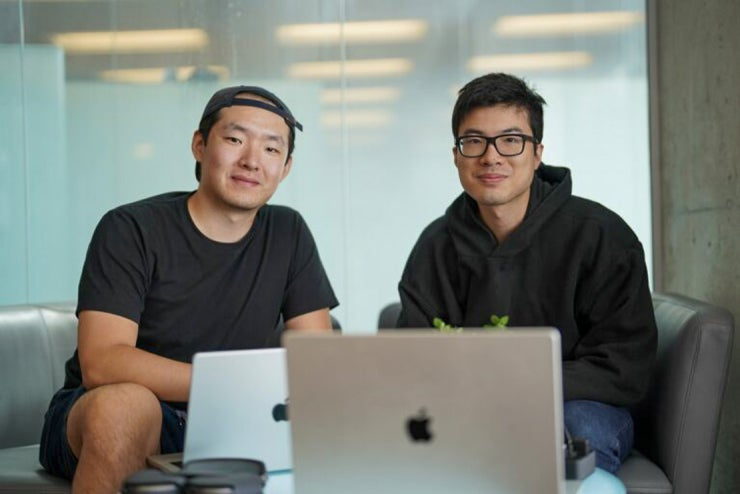
U of T Engineering PhD graduates Aaron Tan, left, and Angus Fung, right, co-founded home-robotics startup Syncere (photo courtesy of Aaron Tan)
As graduate students in Professor Goldie Nejat's Autonomous Systems and Biomechatronics (ASB) Lab, Tan and Fung studied how robots could function alongside humans.
"During our PhDs, we focused on the question of how robots could coexist and interact with humans in a way that's socially acceptable, compliant and safe," says Tan.
"We always knew we wanted to start a company, but we just didn't know what it would be until we started testing our ideas."
The duo first began their entrepreneurial journey building humanoid robots. But after deploying early prototypes in homes and hotels, they quickly learned that potential customers weren't ready to share their personal space with systems that had originally been designed for industrial settings.
"Many customers shared that existing home robots are too clunky and intrusive," Tan says. "So it was important to us that the next product we developed would be thoughtfully designed and blend seamlessly into the home environment so we could reduce barriers to adoption."
An unexpected moment of inspiration arrived while Tan was watching the movie Beauty and the Beast with his wife.
"There's this scene in the movie where the furniture comes to life in the castle. It got me thinking: Instead of bringing industrial-looking robots into homes, why not start with something that already belongs there - like furniture - and work backwards?"
This insight led to Syncere's flagship product: Lume, a robotic floor lamp that folds laundry.
When not in use, Lume functions like any other floor lamp, but when activated by voice or a smartphone app, it reveals robotic arms and a camera, folds laundry on nearby surfaces and then returns back to its lamp form once its task is completed.
Tan says it's the first robot of its kind intentionally designed to look like a luxury household appliance.
"We also want to give people back the most valuable thing they have, which is time, without making them feel like we're adding a robot to their home," says Tan. "Like a dishwasher or laundry machine, they all have their place in the home and only act when you want them to - they stay out of the way and aren't proactive or equipped with general intelligence. With Lume, it's important to us that the homeowner is fully in control and can decide when they need the robot to act."
The technology behind Lume uses imitation and reinforcement learning to teach the robot how to fold clothes based on human behaviour. Safety is also embedded directly into the design through compliant motor controls, 360-degree awareness, fabric on joints to avoid pinch points, and mechanical shutters that conceal its sensors when not in use.
These features ensure the robot locks itself in place if it detects a nearby obstruction or activity from a human or animal, and that its working area consists only of laundry before it activates.
"We know that the biggest challenge for robots in the home is that the home is very unconstrained and unstructured," says Tan. "People from all ages and backgrounds coexist in the same space, so what we're trying to do is structure the problem so the robot is placed in a fixed location in the home, like a bedroom or laundry room. On our office whiteboard, we wrote, a Lume in every room' - that's our goal."
Lume has generated buzz in Silicon Valley since it launched last year. Tan says he shared a concept video of the chore-helping robot on X in July that received over four million views and drew the attention of tech magnates. The success of the video also helped Tan close a US$3.5 million pre-seed round in under two weeks.
While Lume currently focuses only on laundry folding, the team one day envisions an app store where users can add new capabilities - from gift wrapping and bed-making to ironing, meal-prepping and even health-care tasks like massages and exams.
"Our mission is to build beautiful, design-forward intelligent robots that blend seamlessly into human-centric environments," says Tan. "So we decided to build a robot that is minimally intrusive to people's space and habits. If it looks familiar and does one application really, really well, people might be more willing to trust and adopt it, and then it becomes easier to add new features."
While the company is currently based in Palo Alto, Calif., the eight-person team is Canadian - and Tan and Fung have plans to open a Canadian office in Toronto within the next year as demand grows.
"Syncere is very much a team effort and a U of T effort," says Tan.
"Our team currently consists of U of T alumni from bachelor's degrees all the way to PhDs working across hardware, software and research."
The startup is actively hiring in multiple roles and is looking for U of T students and alumni to join the team.
"If you're a technical person or a creative person, we want to hear from you - we want to show the world what U of T robotics engineers can accomplish."


