




People taking the escalators in Polytechnique Montréal's Pierre-Lassonde et Claudette-Mackay-Lassonde pavilions will soon notice something unusual behind a large glass wall: autonomous mobile robots moving in sync, simulating the operations of a simple yet highly instructive automated warehouse. Welcome to the Intelligent Cyber-Physical Systems (I-CPS) Lab - a space where the industry of tomorrow is already coming to life. Step inside this distinctive laboratory and you'll discover a clear mission: helping Quebec's SMEs boost their productivity by making smarter use of digital technologies.
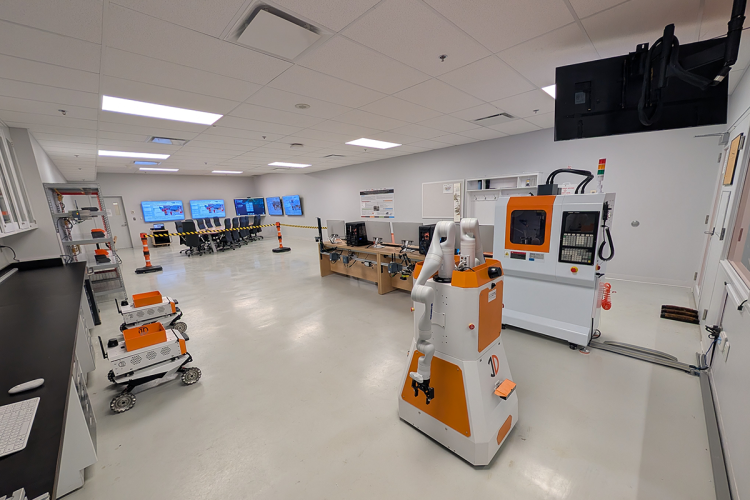
Polytechnique Montréal's Intelligent Cyber-Physical Systems (I-CPS) Lab brings together specialists from multiple fields to support Québec SMEs as they boost productivity through digital transformation. (Photo: I-CPS Lab)
The moment visitors walk through the door, it's clear this is no ordinary lab. There are no benches or optical tables here. Instead, a machining unit sits near the entrance, while a short distance away, autonomous mobile robots wait quietly to be set into motion.
Soon, a robotic arm will pick up a freshly machined part and place it onto a mobile transport robot. From there, the part will travel through identification and quality control stations before ultimately reaching its destination. Then the process begins again, as a new part is produced.
What emerges is a carefully choreographed dance of machines one that would quickly fall apart without its conductor: a programmable logic controller, or PLC. Tucked away in a corner, this compact computer continuously processes real-time data coming from every piece of equipment in the system.
Vibration, temperature, position - along with a host of other signals - give it a complete, up-to-the-minute picture of what's happening across the production line. It constantly reassesses operations, anticipates bottlenecks, refines its models, and sends out instructions to keep everything running smoothly. If something goes wrong - whether a breakdown or an unexpected delay - the system instantly adjusts to keep production on track.
It's an impressive setup - one that many Quebec SMEs would likely envy.
Because in reality, even as many companies have begun adopting automation, the promise of Industry 4.0 remains out of reach for many of them. A major issue persists: their systems still tend to operate in silos.
Robots carry out their tasks, sensors collect data, but that information isn't shared or used in a coordinated way across the entire operation. As a result, there's no real system-wide optimization.
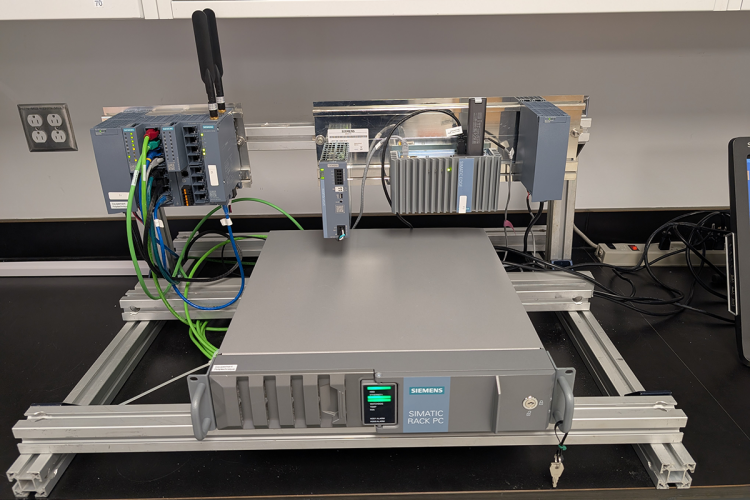
At the heart of the laboratory is its API - the system's "brain" - which gathers data from a connected communications network linking all laboratory equipment. It then issues commands to streamline the operations of an industrial system, such as an automated warehouse. (Photo: I-CPS Lab)
"If something unexpected happens, the entire process becomes fragile," explains Soumaya Yacout, a full professor in Polytechnique Montréal's Department of Mathematics and Industrial Engineering. "And in some cases, the impact is felt directly by the client."
Take a simple example. A robot detects that its battery has dropped below a critical level and immediately stops what it's doing to recharge. From the robot's perspective, that makes perfect sense. But across the broader system, it can trigger a chain reaction - delaying subsequent steps and potentially affecting delivery deadlines set in contracts.
"The robot is making the right decision for itself," says Professor Yacout. "But not necessarily for the system as a whole, because it doesn't have that overall view."
Beyond these disruptions, the lack of visibility creates ongoing uncertainty for SMEs. In many cases, human operators are still required to step in and manage processes that could otherwise be automated. As a result, companies often underestimate their actual production capacity and may even turn down business out of concern they won't be able to deliver on time.
This is exactly the kind of challenge the I-CPS Lab is designed to tackle.
A "brain" to connect, understand and act
To address this fragmentation, the team at Polytechnique Montréal has built a system where all equipment is interconnected and managed through a centralized digital "brain."
"All our equipment is fitted with sensors - measuring things like vibration, temperature and position and those data streams are brought together in one place," explains Professor Yacout. "The goal is to create a true intelligent cyber-physical system."
At the core of this approach is the PLC, which goes far beyond monitoring. It interprets what's happening and actively responds.
If part of the process slows down or breaks down altogether, the system can quickly redirect operations, reassign tasks or trigger alternative scenarios to keep production flowing.
"At the end of the day, what matters is that the product is delivered on time and meets quality expectations - no matter what happens within the system," says Yacout.

Professor Soumaya Yacout.
Another key component is the digital twin - a real-time virtual replica of the physical system. This allows researchers to monitor operations as they unfold and test different scenarios before applying them in real life.
They can simulate breakdowns, delays or changes in demand, evaluate the impact, and fine-tune their approach accordingly. Over time, more and more of these decisions could be automated.
"Artificial intelligence will come later to allow machine learning," Professor Yacout adds. "It's really the icing on the cake."
Beyond the infrastructure itself, the initiative also reflects a new way of doing research. About a dozen students from a range of disciplines including industrial engineering, robotics, computer science, mechanical engineering and electrical engineering are already working together in the lab. Faculty members from the Department of Electrical Engineering, the Department of Computer and Software Engineering, the Department of Mathematics and Industrial Engineering, and the Department of Mechanical Engineering are also contributing to the initiative.
"Today, solutions don't come from a single discipline anymore," says Professor Yacout. "We need people working together across engineering fields to build these kinds of systems."
A province-wide effort
While the I-CPS Lab is based at Polytechnique Montréal, it's part of a much larger initiative: the Céosnet network, which brings together six Quebec universities along with two College Centers for the Transfer of Technology (CCTT).
The networ is co-led by administrative director Mohamed Cheriet, professor in the Deptartment of Systems Engineering at the École de technologie supérieure (ÉTS), and scientific director Prof. Soumaya Yacout, with Ali Adibe, a researcher and lecturer at Polytechnique and ÉTS, managing the network's coordination.
In addition to Polytechnique and ÉTS, the network includes Concordia University, Université de Sherbrooke, Université Laval, and Université du Québec à Montréal, as well as Jacobb (at John Abbott College) and Productique Québec (at Cégep de Sherbrooke).
Each institution is developing its own experimental setup - or "node" - focused on a specific area of expertise. The long-term goal is to connect these nodes into a distributed network capable of simulating complete value chains across Quebec.
"Eventually, we want to link all these nodes together," says Yacout. "That will allow us to model full production systems - including transportation - at a provincial scale."
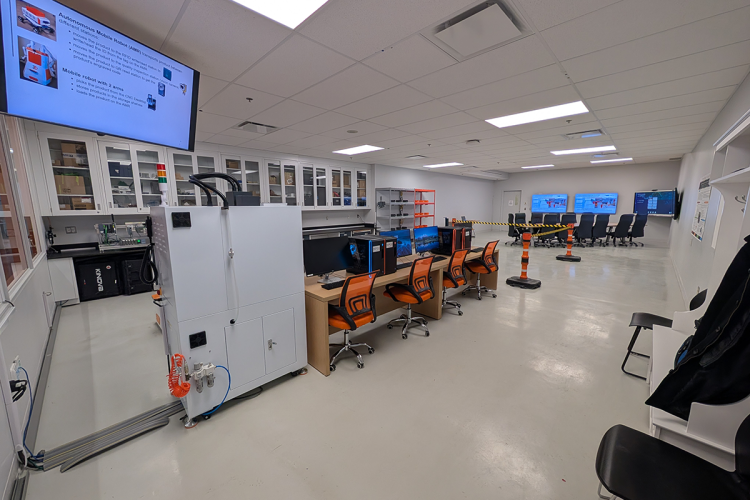
Inside its protective casing, the machining tool produces parts "ordered" online by simulated customers. These parts are then routed to their final "destination" through a fully automated sequence of steps. (Photo: I-CPS Lab)
In practical terms, a product created in one laboratory could move through another facility and be tracked in real time every step of the way much like today's complex supply chains.
The initiative is supported by a $12-million investment from the Canada Foundation for Innovation (CFI) and the Government of Québec, along with more than $3 million in CREATE funding from the Natural Sciences and Engineering Research Council of Canada (NSERC) to support the training of nearly 400 highly qualified personnel in Industry 4.0 manufacturing systems.
The network has already partnered with Solutions Serafin, a company specializing in the maintenance of heavy-duty electric bus. Working across the nodes of Polytechnique Montréal's I-CPS Lab and the Synchromedia Lab at ÉTS, researchers have applied their approach to real-world challenges such as battery management and service continuity.
As supply chains grow more complex and interconnected, this collaborative, systems-based approach could fundamentally change how organizations plan, run and optimize their operations.
Professor Yacout will present the Intelligent Cyber-Physical Systems Lab during two upcoming webinars on May 26 (in French) and May 27 (in English).
To register:
Learn more
Professor Soumaya Yacout expertise
Mathematics and Industrial Engineering Department website
For more information

2500, Chemin de Polytechnique, Bureau A-201, 2e étage
Montréal Québec
Canada H3C 3A7
www.polymtl.ca


