A recent Lethbridge Polytechnic graduate has taken his classroom research to a national platform, presenting his findings on first responder health at a major conference.
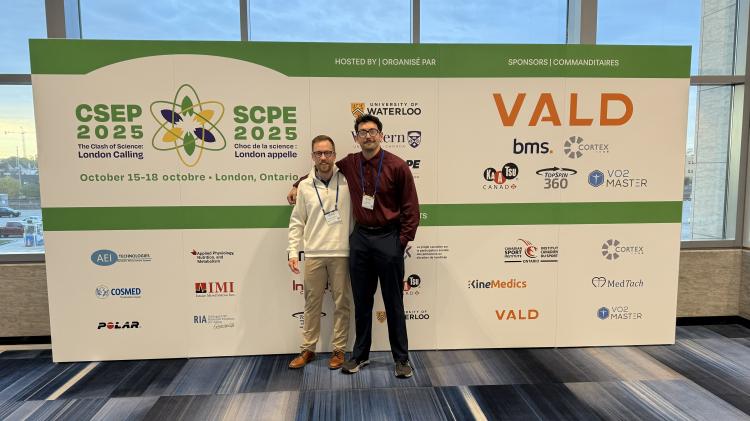
Tyler and Simon at CSEP
Tyler Duffy (Exercise Science 2025) was in London, Ont. in October presenting at the Canadian Society for Exercise Physiology (CSEP) national conference. There, he shared his research that explored the physical and cognitive demands placed on firefighters.
"[We] looked at simple cognitive tasks, like reaction times and processing speed, as well as complex tasks, like decision making," says Duffy. "These are vital for first responders who find themselves in highly tense situations without the ability to fully process their surroundings, all while being close to dangerous environments.
"We found that these acute occupational stressors usually negatively affected performance, especially in complex cognitive tasks, though some studies found no impact or even improvement in simple tasks. The results were interesting, and even led us to discover that experienced groups, such as firefighters, could see more performance decline than non-experienced groups, which highlights the need for further research into resilience and cognitive recovery."
Duffy attended the conference alongside Dr. Simon Schaerz, an instructor in the polytechnic's Centre for Health and Wellness, who guided him through the research process. Schaerz says seeing students present at this level is a testament to their drive and dedication to applied learning at the polytechnic.
"Tyler possesses a genuine curiosity that drives him to dig deeper than the surface level of physiology," says Schaerz. "Watching him take that enthusiasm from the classroom to a national platform like CSEP is why we value applied research, as it empowers students to realize their work has real-world impact."
Duffy started his journey of learning human physiology at a young age and pursued that passion when he began studying university-level kinesiology. After his first year, he started to question if it was the right fit for him.
"Being a hyperactive kid, I learned that I could retain information better when I was exhausted from playing sports," says Duffy. "The physiology behind exercise fascinated me, but initially I felt lost when I was in school. I wanted to stay in the field, so when I learned about the polytechnic's Exercise Science program -- with its hands-on and applied focus -- I decided to make the switch. It turned out to be one of the best decisions I've ever made."
Duffy says presenting at CSEP was a nerve-wracking but ultimately rewarding experience. Scheduled to present on the second-to-last day, he realized once he took the stage that his preparation at the polytechnic had paid off.
"My biggest takeaway was realizing just how much I don't know," says Duffy. "The conference opened my eyes to how many different directions I could take in this field. It felt like standing at a crossroads, seeing multiple paths I could explore."
Now working as an independent personal trainer in Lethbridge, Duffy says he appreciates being able to apply what he's learned - both from school and research - to real-world situations with clients.
"Looking ahead, I want to create educational resources that help people understand their bodies and brains better -- making fitness and physiology accessible to everyone."
Duffy's full research write up can be found at: researchgate.net/publication/396594140_The_ Cognitive_Consequences_of_Acute_Stress_and_Physical_Exertion_in_Firefighters_A_Scoping_Review.
Lethbridge Polytechnic offers Exercise Science as a two-year diploma program, featuring 45 hours of practicum experience and transfer agreements with the Universities of Lethbridge and Regina. To learn more, click here.