

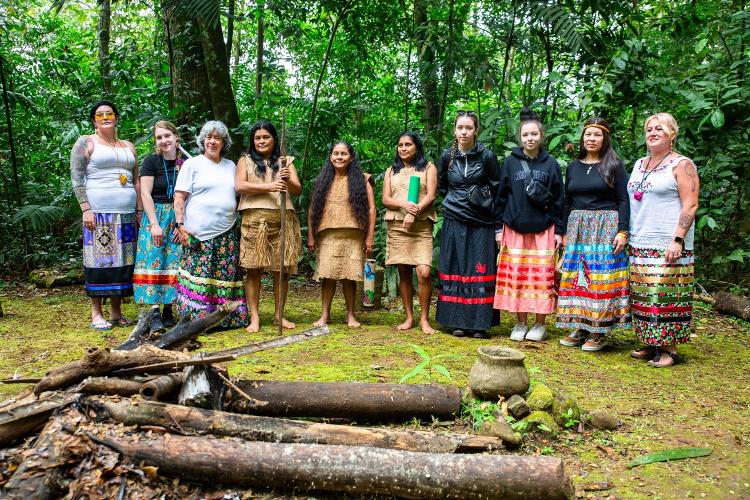
The First Peoples' Centre at Canadore College has worked alongside the Maleku community in Costa Rica to support their efforts to preserve their language for future generations. Through the use of Artificial Intelligence (AI), the project has supported language documentation and translation tools that help strengthen access to the Maleku language for community members.
"I am very grateful to Canadore College and everyone who helped us provide this service to the Maleku Indigenous community of Costa Rica," said Jessenia Vázquez Quesada, Maleku College Partner. "I feel very proud and satisfied because it wasn't just an app; it was a bridge to preserve a language, an identity, and a living history. We will work with members of the Maleku community to implement the application and ensure everyone has access, especially the children in the various schools they attend," said Vázquez Quesada.
"This project was important to the Maleku community because it supported their efforts to preserve and carry their language forward for future generations," said Sarah Julian, Director, First Peoples' Centre and Indigenous Engagement. "It also demonstrates what is possible when Indigenous communities lead and technology follows. The work was built on relationships, trust, and community control, and guided by the same principles that shape our work with Indigenous communities at home."
"This partnership affirmed that those approaches translate across contexts and provide a strong foundation to continue supporting Indigenous language and knowledge initiatives as living, ongoing work, guided by communities and responsive to their priorities," said Julian.
This initiative began nearly two years ago with an initial visit to Costa Rica by a small group of Canadore College students. Building on this early engagement, a second group travelled to the region in March 2024 with financial support from the Global Skills Opportunity Fund, a program supported by Colleges and Institutes Canada. During the visit, students participated in Maleku cultural practices, developed meaningful community relationships, and gained a deeper understanding of the community's priorities and long-term goals.
The project highlights Camb.ai's AI-powered speech and translation technology, which enables content dubbing in more than 140 languages through proprietary artificial intelligence models. This innovative platform is widely adopted across multiple sectors, including the film industry for dialogue translation. The students leveraged the advanced translation technology to deliver real-time translations in the Maleku language, contributing to the preservation and sharing of the community's linguistic and cultural heritage.
"Collaborating with Canadore College and the Maleku community has reinforced why we build language technology in the first place: to ensure that even the rarest and most vulnerable languages have a place in the digital future," said Akshat Prakash, Camb.ai co-founder. "Now that the Maleku language project is complete, it feels deeply humbling to have been part of something so meaningful. This project goes far beyond technology; it is about preserving identity, culture, and a living history that might have otherwise been lost."
"Language is a major element of personal and community identity and is a reflection of the shared history of the people who speak it," said Shawn Chorney, Vice President Strategic Infrastructure, Indigenous and Learner Services. "Our Team had an opportunity to deploy external grant funding and college learners and staff in support of applied learning, immersive community impact activities, and cultural immersion. The result is a model that can now be deployed to prevent other at-risk Indigenous languages from being lost to time."
Credit photo to Canadore College
For more information

100 College Drive, P.O. Box 5001
North Bay Ontario
Canada P1B 8K9
www.canadorecollege.ca