Three Environmental Technology students are putting the finishing touches on capstone projects to present at this year's Applied Research Student Showcase on May 4. This final work by Tom Clark, Van Khoa Dinh and Prajwal Chaudhari puts each student one step closer to goals they've had from day one.
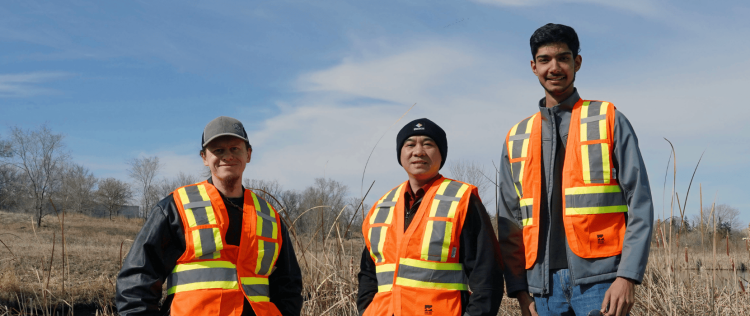
Image credit: Saskatchewan Polytechnic
Career mobility and the desire for hands-on learning in a field with impact were key drivers for these students when choosing their program at Saskatchewan Polytechnic. For Clark, Environmental Technology was the bridge he needed to take previous education and work experience and turn it into a practical career closer to home. With a biology degree and a few years of field work under his belt, the Regina resident knew that adding a diploma in environmental technology to his resume, along with practical skills, would widen his field of potential employers.
"My family, friends and girlfriend are in Regina," Clark says. "This credential will allow me to apply what I've learned to get a job here, and that's important."
Staying true to his background and interests, Clark's capstone project has an ecology focus. His project combines a review of scientific literature with field observations and geospatial analysis, examining how beaver dams influence the suitability of overwintering habitat for Northern Leopard Frogs within Opimihaw Creek at Wanuskewin Heritage Park in Saskatoon, Saskatchewan.
"My instructor suggested a species that has felt the impact of farming and wetland reduction. The habitat at Wanuskewin is very good, but infrastructure issues with the dams has caused ponding in certain areas, flooding bridges and pathways."
Wanuskewin has been working on ways to let more water through and welcomed Clark as a student researcher. Clark's final report recommends maintaining active beaver dams while implementing targeted mitigation measures, including installation of pond levellers and phased and adaptive dam management strategies. As a project partner, Wanuskewin can choose to use some of his ideas, though Clark notes that capstone projects are exploratory in nature. "Mostly, the capstone is for my learning. It would be great to see them take some of my work and implement it. It's been an interesting project."
Chaudhari chose the Environmental Technology program for its co-operative education component. His combined interests in engineering and the environment made the program a natural fit and has allowed him to explore his interest in water.
"I like working with water," says Chaudhari, "so I've made an effort to pursue water-related projects and co-op work terms. Environmental Technologists have lots of different career path options. With my diploma, I'll also be able to pursue my Technology Professionals Saskatchewan (TPSK) designation, which will allow me to seek a water-related career in a variety of places."
Chaudhari's capstone took him to the Smith Creek Watershed in southeast Saskatchewan, where he has been mapping and quantifying wetland. His report evaluates changes in wetland surface area for the region between 2000 and 2025 to better understand the potential influence of agricultural land use on wetland persistence.
"I made a series of GIS maps to quantify changes in wetland surface area over time," he says, "and it shows a 60-70 per cent reduction over the period studied. I then looked at predicting how it will affect waterfowl."
Chaudhari worked with project partner Ducks Unlimited, who provided historical data and reports to support his analysis. "My project suggests remedies" he says, "and one is Ducks Unlimited buying the land or paying the farmers who own wetland for the difference in crops they lose if they allow the wetland to remain intact."
Like Chaudhari, Dinh's path to Sask Polytech demonstrates a desire to lay down new roots for career success. Having worked for over 18 years in his home country of Vietnam, Dinh moved with his family to Canada in 2023. With a background in biochemistry and an MBA, he chose Environmental Technology to create opportunities in a new country.
"I'm chasing the dream of a different life for my family" says Dinh. "It's very challenging to start again but I knew I wasn't starting from zero," he explains. "I have high-value skills to bring to the workforce in Canada. This program is helping me level up my skills in standard operating procedures and teamwork, which are essential."
During a co-operative education work term with the Ministry of Environment's Air Protection branch, Dinh set up a rapid-deployment air quality station (RAQS) now one of six used to monitor air quality in the province near the Co-op Refinery outside Regina. He gained permission to use the project for his capstone research, which evaluates industrial and wildfire contributions to air quality in northeast Regina.
"My project monitored air quality, including pollutants, micro-particles and ozone," says Dinh. "I have been synthesizing data in my report to show the source of the contaminants."
All three students earned Applied Research Scholarships to support their efforts a benefit their instructors and program head promoted along with other opportunities throughout their program.
"Our program head, Kaya Forest, has been very proactive in sharing opportunities with us," says Dinh. "I wanted to challenge myself so I applied for everything."
That, it seems, has paid off for the hard-working student, who will begin a full-time position after graduation with MPE, a national professional engineering consulting firm where he undertook his second co-operative education work term.
Clark and Chaudhari both have applications in with potential employers and are excited to move ahead with careers in environmental technology. "The opportunities are here," says Clark. "I'm feeling confident in the job market."
Learn more about Sask Polytech's Environmental Technology program!
Saskatchewan Polytechnic is signatory to the SDG Accord. Sustainable Development Goal alignment is one of the ways Sask Polytech is leading the rise of polytechnic education.
For more information

400 - 119 4th Avenue South
Saskatoon Saskatchewan
Canada S7K 5X2
www.saskpolytech.ca