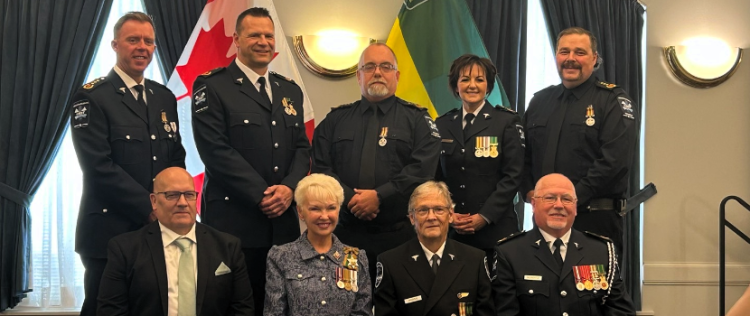
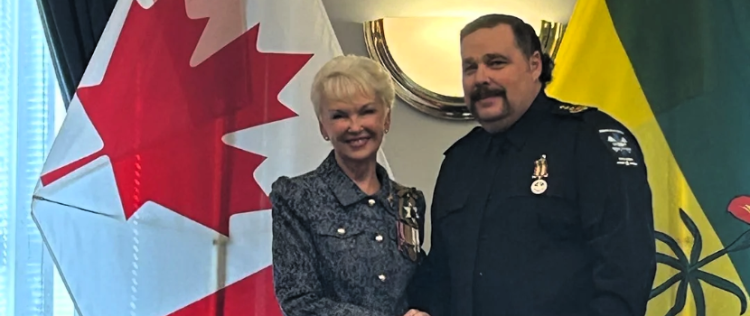
Saskatchewan Polytechnic alumnus Chad Sander may have started his career with saving lives in mind, but he's never expected a medal for his efforts. The paramedic of nearly 25 years was awarded an Emergency Medical Services Exemplary Service Medal by Canada's Governor General this past June. Thinking back, he's still surprised.
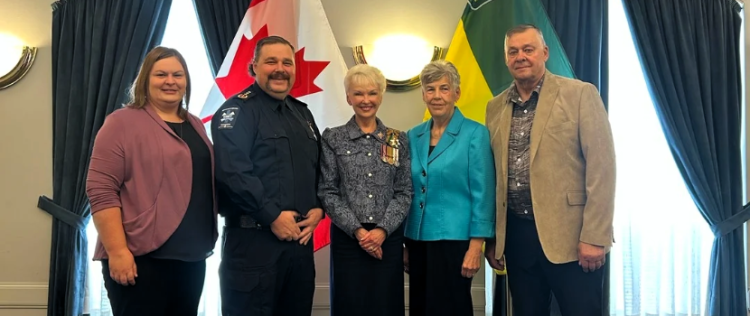
Image credit: Chad Sander
"You don't do the job for accolades," says Sander. "Lots of people work really hard and don't get a medal."
Angela Sereda, Medavie Health Service's senior operations manager and Sander's leader, thinks he is exactly who should receive an honour of this kind, which is why she nominated him.
"Chad is humble, unselfish and always goes above and beyond to be a kind citizen in his everyday life," says Sereda. "These qualities are why I encouraged him to move into a more specialized role in community care a couple of years ago. Chad leads by example and sets the bar quite high for what paramedics can be and can do. He makes the choice every day to put community first."
Paramedicine has expanded in the last decade or so, broadening from the 911 responder role most people know to new career pathways that deliver integrative medical support within the community.
"Primary, intermediate, advanced and critical care paramedics are the front line," explains Sereda. "They do acute care, responding to 911 emergencies assessing, treating and transporting to hospital. Community paramedicine goes beyond this model to meet and treat people where they are, often keeping them from going to emergency wards unnecessarily."
Paramedics with two years of experience at any level can apply to Sask Polytech's Community Paramedic advanced certificate program, where an additional 18 months of training prepares them for community-based practice including geriatric care, chronic disease management, palliative care, and mental health and addictions.
For Sander, making the decision to transition his career was an evolution. "911 paramedicine is a bit of a young person's game," he says. "I'd seen and done it all, working rural in North Battleford and Tisdale, then urban in Saskatoon. I got to the point where I was able to figure out a case in about five questions. Getting into community care paramedicine was a good opportunity to learn something new. It's a different pace and more relational."
With encouragement from Sereda and his family, Sander applied for a specialized role in withdrawal management through Medavie's mobile integrative health (MIH) unit, with the intention of completing further education while on the job.
"It can be hard to take a 911 paramedic and put them into community paramedicine," says Sereda. "At Medavie, we believe that support through higher education sets our team up for success doing specialized work."
"Saskatchewan Polytechnic has been leading the way with the Community Paramedic advanced certificate program," says Sereda, "and Medavie is putting community care into practice across the province."
Sander enrolled in in the certificate program through a Medavie return-for-service arrangement, completing his coursework, practicum and labs as part of the four-year agreement. "I thought the school chapter of my life was done but it was good to get back into it," he says. "Taking further training also rekindled relationships within the industry and has been good for my career."
Sereda knew that choosing the right employee for the new withdrawal management role was important. "It's not for everybody," she says. "Community paramedicine takes a personalized approach. Dealing with addictions requires non-judgement, a huge degree of empathy and a willingness to go above and beyond to help meet the needs of a client in the moment. People who work in this field dive into the social determinants of health, taking a preventative approach to health care. Chad and other community paramedics offer the long-term supports people need for success."
Community paramedicine is still relatively new in the province and though there are protocols, much of Sander's work has been developing the withdrawal management program while doing the job himself. Working with a nurse-practitioner mentor, Sander has increased his knowledge about addictions and withdrawal management. Promoted to a supervisory role last year, he now leads the withdrawal management division's programs and has set up new programs in Yorkton and other smaller centres across the province.
The practical skills gained since making the move to community care paramedicine are a significant part of what makes Sander and the program he runs a success. A combination of formal upskilling and on-the-job learning helped him to develop his role, branching out to create a new system of care within the province.
Sander's softer skills, though his humbleness, selflessness, willingness to put others first are what shone through in Sereda's nomination letter to the Governor General's awards committee.
"I've never thought of myself in that way," says Sander. "I guess I'm relatable and that helps me to be a good paramedic. I come from a farm background. Our family is supportive you drop everything to help. That came from my mom and my dad."
"When you visit someone's home on their worst day you need to make them comfortable in about two minutes," says Sanders. "Never judge anyone. You're not in their shoes. You don't know what they've been through. They need a hand up; they don't need to be told. I'm there as a tool, as an assist to help them move forward."
Sander doesn't just walk this walk at work. Sereda's nomination ended with the story of a life-changing stem cell donation he made seven years ago.
"I did a cheek swab with a bunch of others at work and matched with someone who needed a transplant in Ottawa," says Sander. "It's a bit of a process and has its risks but I didn't think too hard about it. I was able to help, so I helped. It feels good to know my cells could give someone else a chance at life." Sander met his recipient in 2024 and the two have gone on to connect regularly on what they consider his new birthday.
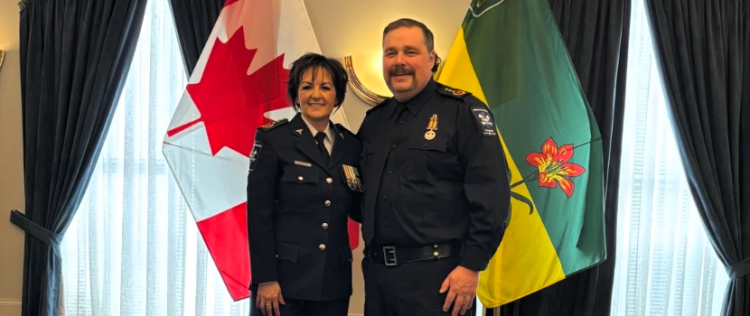
"That's who Chad is," says Sereda. "He'll do anything for anybody through whatever journey they're going through. Not everybody gets a medal but that's why he deserves one. I was happy to be a part of making that happen."
"It was really special to have my family at the ceremony to see what I've accomplished," says Sander. "I really look up to my mom. She's been a driver in my education, encouraging me throughout my career."
"All those nights I couldn't be home or family events I missed there's praise at the end of that. Recognition for commitment to the industry is a big deal."
Learn more about the Community Paramedic advanced certificate program.
For more information

400 - 119 4th Avenue South
Saskatoon Saskatchewan
Canada S7K 5X2
www.saskpolytech.ca