At the Waterloo Region District School Board, the belief that identity and social location should never predict outcomes is not just a statement, it is a call to action.
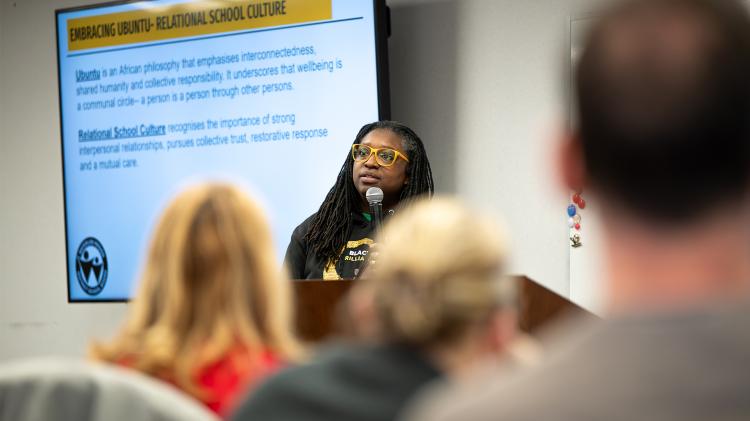
Through the Dismantling Anti-Black Racism (DABR) initiative, WRDSB educators, administrators, and school communities are engaging in deep learning and reflection to address anti-Black racism at both individual and institutional levels. At its core, DABR is about centring humanity, honouring lived experiences, and creating the conditions where Black-identifying students, parents, families, caregivers and staff are able to flourish.
This work is grounded in the expectations set out by the Ministry of Education to provide professional development focused on anti-Black racism, the Ontario Human Rights Commission's Dreams Delayed: Addressing Systemic Anti-Black Racism and Discrimination in Ontario's Public Education System report and aligns with the Ontario College of Teachers' Professional Advisory on Anti-Black Racism, reinforcing our shared responsibility to create equitable, identity affirming learning environments.
DABR is a two-year, opt-in program, combining centralized learning sessions with in-school support. This structure ensures educators are supported beyond initial learning, creating the conditions to embed new understandings into daily practice and school culture. In the first year of the two-year program, participating educators focus on foundational learning, unlearning, and engaging with guiding questions such as:
- What does it mean to be Black in Canada?
- What does it mean to be Black in the classroom?
- Understanding colonialism and anti-Black racism: How do colonialism and anti-Black racism shape experiences?
- Examining how both show up individually and institutionally in schools: How do these realities show up individually and institutionally in schools?
- Naming how the education system was originally designed and who it was designed to serve: How was the education system designed, and who was it designed to serve?
Through this learning, educators are challenged to reconsider approaches that have historically shaped schooling. Educators are invited to embrace Afrocentric and culturally relevant ways of knowing, being, and learning so education can truly serve all students. As one secondary teacher reflected:
"The DABR program has been the best professional development that I have been a part of. I've gained a better understanding of how students are entering my classroom every day, and I am much more aware of the space I am creating for them."
DABR begins with a commitment to learning and building educator capacity. Educators are invited to reflect on whose identities have been historically centred in schools and whose have not. A central focus of the work is developing meaningful knowledge of the identities and communities Black students belong to, and committing to truly knowing each student: who they are, who they want to be and how educators can honour their futures.
Educators focus on intentional relationship building with students, grounded in care, curiosity, and accountability, recognizing that teaching requires ongoing self-reflection and learning. Everyone brings their own lived experiences into the classroom and this awareness encourages us to learn from diverse perspectives to create better learning environments for all students.
Through facilitated learning and active inquiry, participants examine the building blocks of relationship-centred schools, including psychological safety, identity affirming spaces, high expectations rooted in care, and shared responsibility for collective success. As one elementary school principal shared:
"Being part of this program is both affirming and exciting. It gives us the opportunity to see the great work we're already doing and make small tweaks to make it better. We've also built strong connections with one of our feeder schools, working together to create belonging for students and families."
The impact of DABR is felt not only in classrooms, but across entire school communities. A DABR educator shared, "I am lucky enough to receive those unexpected emails from a teacher, student, family member, or community partner, who experienced an educator who went through DABR and did something differently that shifted the experience they were having. That's how I know the work is making a difference and we are seeing improved outcomes for Black students."
At its heart, DABR is about holding every child's humanity at the centre, acknowledging the historical, social, and political realities that shape Black students' experiences, and ensuring their voices lead the work.
Through DABR, the WRDSB is actively creating schools where identity is affirmed, culture is honoured, expectations are high, and communities are strengthened in ways that benefit all students.