Although the majority of new Canadians participating in the English as an additional language program tend to be in the urban areas, there are also significant numbers in other jurisdictions as well.
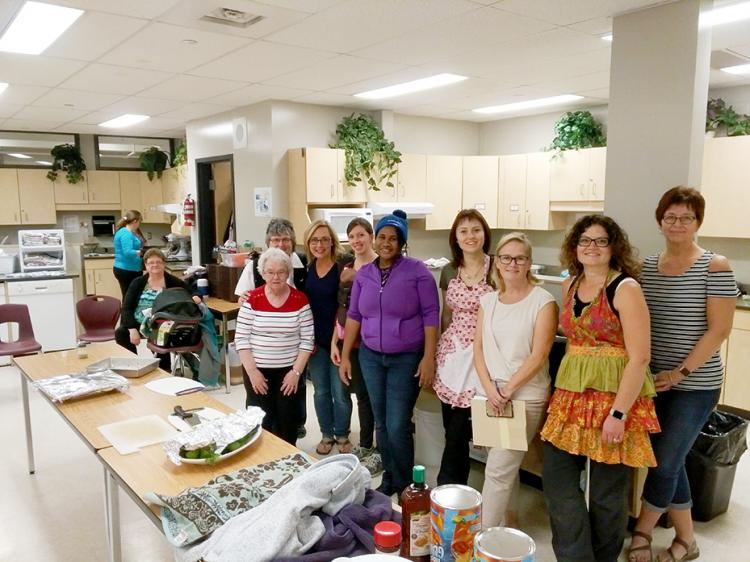
There were all sorts of volunteers from the community that helped make this potluck supper a great success as a way to help EAL students and their families connect with their new surroundings.
Consider for example, the Prairie Spirit School Division, where approximately 700 students are enrolled in EAL this fall. Admittedly, many are in such bedroom communities as Warman and Martensville as well as Rosthern.
Distance wise, the aforementioned communities aren't far from Saskatoon, but talking to Cheryl Redekopp and Liz Harrison, EAL facilitators for Prairie Spirit, you quickly realize their reality is different. That's for students and teachers alike. The result is that Redekopp and Harrison have to wear a variety of hats.
Harrison noted that within Prairie Spirit, the distances between communities in some cases is significant. It can mean small pockets of newly arrived students find themselves in unfamiliar surroundings without knowledge of English or precious little in the way of a social network.
This means that when time permits and schedules can be worked out, it's not uncommon for the facilitators to drive a student from Langham to Warman so that they can at least somewhat help ease the transition to new surroundings.
"We don't have settlement workers like in the larger cities. So, if we want parental engagement, it's on us to reach out and there may be some initial reluctance because of the language barrier. But, it's part of our role to support students and teachers," Redekopp said while chatting in their office at Warman High School.
Both were still basking in the success of the special Thanksgiving meal that had been arranged with the considerable help of community and staff volunteers, which meant the event didn't cost Prairie Spirit a cent. There were more than 100 family members in attendance from as many as 10 different countries.
Labelling that as an important first step in reaching out to families who live in these respective communities, Redekopp is hopeful it will provide the sort of comfort level that can make the connection that much stronger.
"Budgets are tight for school divisions and we understand that, so in the end we have to think outside the box if we want this to work. The community has already shown they are ready to step up and so that's been great to see."
As Harrison said, "our cultural intelligence goes up every time and besides it's just a lot of fun. It's all about being more culturally intelligent. You certainly gain an appreciation into how it can be hard to navigate the new surroundings for these families."
The notion of being culturally intelligent has become a recurring focus for Prairie Spirit and that has involved professional development opportunities for teachers and also students.
Redekopp noted that the hope is to have conversations among students who might not have had that sort of interaction with some of their peers from their previous country of origin.
"Our plan going forward is twofold and events like the dinner will hopefully be the starting point where students and families have conversations and want to know more about the different cultures maybe during lunch hour. We're also hoping this will help draw out parents."
"We want to encourage that diversity among our students and to not be afraid to ask questions in a respectful way. We've already seen some examples that will hopefully help build community. We're always trying to tweak things because everyone benefits from that," Harrison said.
While this is Harrison's second year as an EAL facilitator, her previous experience of having worked with First Nations and Métis students through a partnership between Prairie Spirit and Muskeg Lake Cree Nation and Mistawasis First Nation was ideal preparation. Currently, she also works with the Hutterian schools in the division.
Redekopp has been involved since the initiative was started in 2008 and has seen her role increase from a 0.2 position to the current full-time situation.
During that time she is pleased to see how teachers' comfort levels have grown exponentially with the aid of the EAL team and also the valuable response from the universities in terms of providing professional development opportunities
to better prepare aspiring educators.
So, while there's no doubt there are considerable challenges, both agree that their involvement has been highly rejuvenating in what they describe as the latter years of their educational careers.
"There are some immense challenges but it's important work and somebody needs to do it. We want our students and communities to be engaged and to embrace cultural diversity so it's exciting to be on the cutting edge and to be able to chart this course. These are like our own kids and we've just learned so much. There's never a dull moment," Harrison recounted.
Redekopp said she has found it beautiful to see the success stories. "We're on a learning edge and we get to be advocates for real change and we don't take that lightly. We have an opportunity to leave a legacy with this program."
For more information

2317 Arlington Ave
Saskatoon Saskatchewan
Canada S7J 2H8
www.stf.sk.ca