


The carbon pump transports carbon from the ocean surface to the deep ocean by physical and biological processes, where it is sequestered for long time periods.
The ocean has absorbed 90 per cent of the heat from human-induced global warming through the carbon pump.
In response, the ocean has a reduced capacity to buffer human impact, exacerbating climate change.
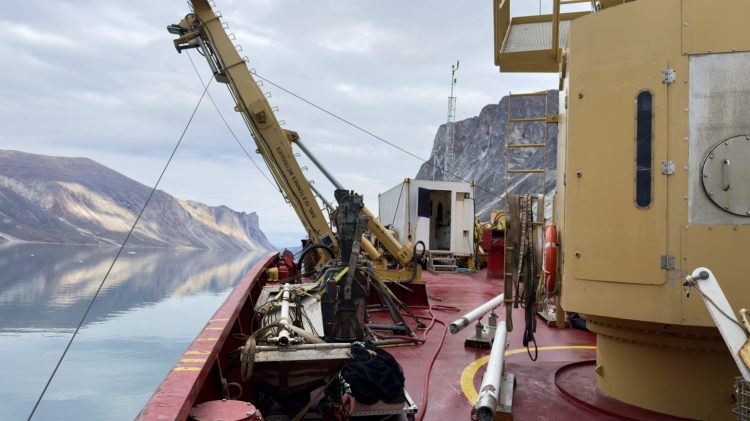
The CCGS Amundsen icebreaker navigating Coronation Fjord in Auyuittuq National Park, Nunavut, during a 2025 expedition. Photo: Gustavo Yunda-Guarin
The connected polar and subpolar environments of the Northwest Atlantic are a major contributor to global ocean carbon uptake and storage.
A new project, Transforming Climate Action, aims to understand the role of the North Atlantic in the global carbon cycle.
Largest grant for all four institutions
Funded by the Canada First Research Excellence Fund, the seven-year project, valued at $397 million, is the largest research grant that any of the four universities has received.
Together with our colleagues, students and post-doctoral scholars, we are investigating the carbon cycle and the biological carbon pump by taking measurements on research vessels Amundsen, L'Atalante and Coriolis.
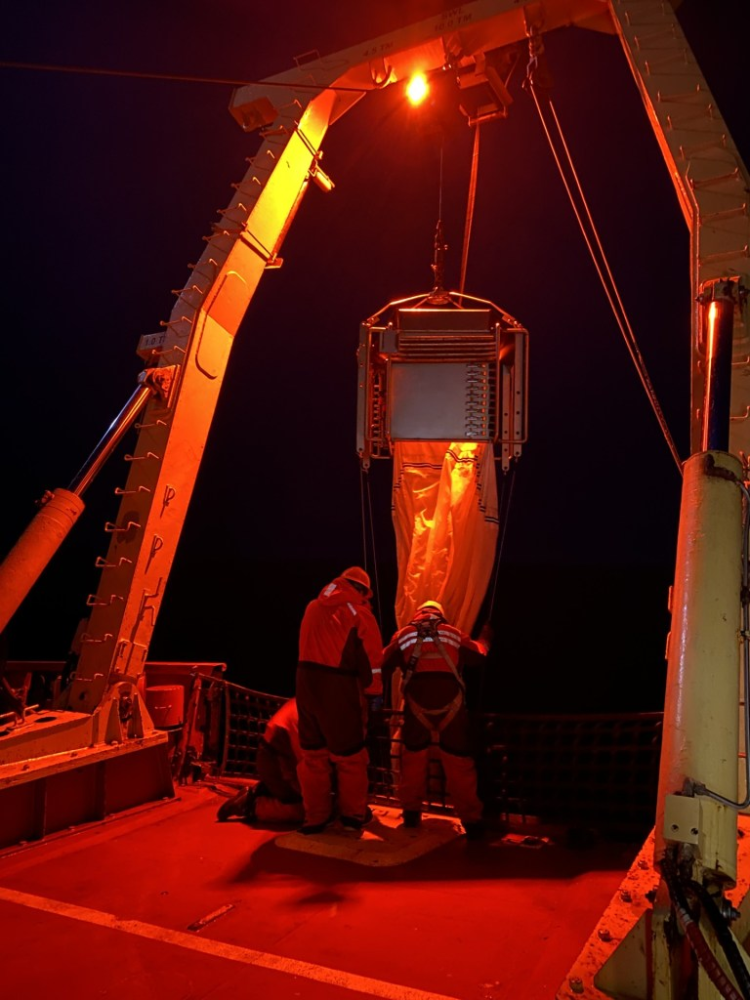
The red light reduces the effect of the Amundsen's lights on the behaviour of the organisms being sampled. A multinet is used to examine how zooplankton communities change throughout the water column. Photo: Charlotte Matthews
We also represent ocean processes in numerical models and synthesize observational data to quantify the carbon cycle and the biological carbon pump.
From our team at the Fisheries and Marine Institute, PhD student Charlotte Matthews is researching carbon transported by mesopelagic migrants in the Labrador Sea and eastern Canadian Arctic through the use of active acoustics, respiration estimates and bioenergetic modelling frameworks.
PhD student Ana Júlia Alves de Lima is investigating energy flow through marine ecosystems and the biological carbon pump in the Northwest Atlantic.
Post-doctoral fellow Dr. Gustavo Yunda-Guarin is tracing the origin and storage of nutrients in Arctic marine ecosystems to quantify carbon and lipid transfer within pelagic food webs using biomarkers.
Postdoctoral fellow Dr. Marine Ballutaud is quantifying biogeochemical and ecosystem processes to reduce uncertainty in the carbon cycle and biological carbon pump.
Dive deep on a large scale
Through Transforming Climate Action, early-career researchers have the opportunity to participate in workshops, training schools and networking events across the four universities.
The project has brought researchers together across the region to understand the role of the North Atlantic and Baffin Bay in climate change.
We have established new collaborations and are excited for the opportunity to dive deeper at the large scale required to tackle this complex and important question.
It is our hope that the project will have a meaningful impact on the global issue of climate change.
For more information

230 Elizabeth Avenue
St. John's Newfoundland
Canada A1C 5S7
www.mun.ca