


Current and former USask staff and faculty discuss the steps taken to prevent the Y2K crisis on campus a quarter century ago.
Ahead of the year 2000, the University of Saskatchewan (USask) was facing a potential digital crisis.
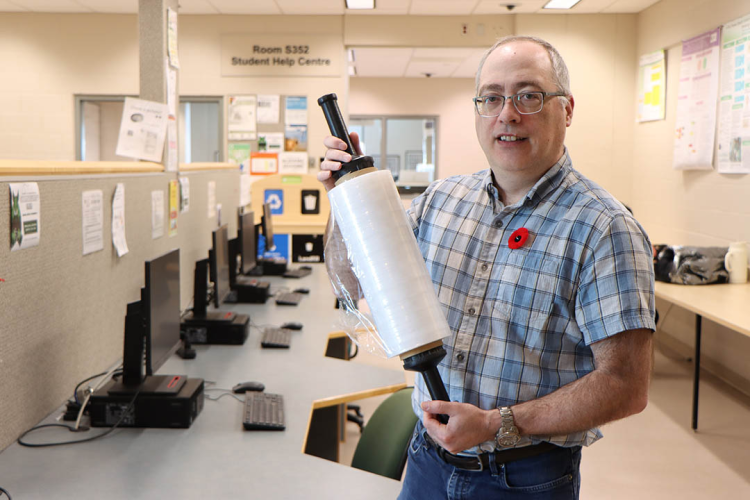
USask's Greg Oster of the Department of Computer Science holds one of the rolls of plastic that was on hand a quarter of a century ago in case needed to wrap and protect computer equipment during Y2K. (Photo: Kristen McEwen)
Much like the rest of the world, computer applications on campus were under threat of serious malfunction when clocks turned from 11:59 pm on Dec. 31, 1999, to midnight on Jan. 1, 2000.
One of the failsafe options to protect campus computers against the impending Year 2000 problem (Y2K) was an industrial sized roll of plastic wrap.
Greg Oster (BComm'92, MSc'95), currently the technical team lead in the Department of Computer Science, reflected on his role in Y2K preparations. In 1996, Oster was a research assistant in the department.
"(One of the) big concerns was sprinklers were going to go off, and we were going to have to wrap all of our systems (in plastic wrap)," Oster recalled.
Oster added that the department still has an additional two full rolls of plastic wrap from that year. Now, they're used to wrap unneeded computer equipment sent to surplus or storage.
Plastic wrap wasn't part of the plan to combat the Year 2000 problem (Y2K) by the President's Y2K Task Force at USask. The task force was established in 1998 to "plan, organize, direct and monitor responses to Y2K challenges."
The task force included about six to eight people, including Dr. Robert Kavanagh (BE'64, MSc'66, PhD), who was associate vice-president for Information Technology Services at USask at the time. Kavanagh graduated from USask in 1966 and returned as a faculty member in the Department of Computer Science from 1971 to 2000. He also directed campus-wide computer systems management from 1978 to his retirement.
"By that time, almost all the university buildings their physical, environment, temperature airflow those were all controlled by computers," he said.

Dr. Robert Kavanagh (PhD) was associate vice-president for Information Technology Services at USask back in 1999 and a member of the President's Y2K Task Force at USask. (Photo: Kristen McEwen)
The Year 2000 problem was a potential crisis built into every computer in the world.
Computer memory in the 1960s and 1970s was very expensive. In 1975, mass storage was purchased in the form of cabinets about the size of a dishwasher, Kavanagh said.
"Each cabinet had a stack of discs, like records, about 20 of them," he said.
One cabinet would have 150 megabytes of storage. The average price was $30,000 in 1975, about $150,000 in 2025 dollars. To have the amount of storage in a smartphone today, it would need a room measured in size by acres and electric power roughly as much as Saskatchewan now uses in the entire province, he added.
"(In those early days), one of the ways that people could minimize their need for mass storage was to only store dates with two digits instead of four," Kavanagh said.
To save memory space, computer programmers decided to save only the last two digits of each year 1975 would be saved as '75, 1976 would save as '76, and so on.
In 1999, instead of turning to the year 2000, all dates would automatically turn to the year 1900.
It would have serious consequences for many systems at the university and globally financial, human resources, inventory, and building environment control, Kavanagh said. He recalled that the task force went through all computer systems on campus and found a few problems, which were easily fixed such as the financial system.
The university had a system called CCMS (Central Control and Monitoring System) that had a monitoring base in each building. It would monitor and control all aspects of air quality and heating in the buildings.
The task force came across a not-so-easily resolved issue in the Agriculture Building. Much like today, research laboratories had extensively environmentally controlled rooms for growing things, Kavanagh said.
They determined that the computers in those laboratories would no longer control the environment in the rooms because of Y2K. The system failure could cause labs to overheat or not provide enough humidity and destroy research information.
Kavanagh said the problem had to be turned back to the third party supplier. The problem was fixed in time.
The task force combed through all the systems it could, to look at the source code to see how the dates could be restored to locate vulnerabilities, Kavanagh said.
According to an archived USask webpage about the Y2K Project, anywhere between 400 and 700 people on campus invested time to ensure the university was prepared for Y2K.
Oster was one of those people. He recalled receiving requests to manually update each computer with a floppy disk kit.
He would take the floppy disk with the updated information, reboot each computer, and the floppy would update the system clock. They would run a compliance test on the computer to see if it could roll the clock to the year 2000.
"If the date said Jan. 1, 2000, you were good. If it said the date was 1970 or 1900, you were going to have a problem," Oster said.
Few computers experienced issues with updates, he added.
With members of university facilities management and security services staff on standby, USask experienced no disruptions or computer services on Jan. 1, 2000, according to an On Campus News article published, Jan. 7, 2000.
By the end of January 2000, no critical failures were reported. A few non-critical failures were fixed, including an incorrect date stamp by a fax machine, a Word 11 software glitch, two minor failures pertaining to steam plant operations, and varying issues regarding desktop computers on campus.
To see how the President's Y2K Task Force responded to the Y2K problem, visit a list of archived On Campus News articles from September 1998 to Jan. 21, 2000.
"When the clock ticked over to 2000, it was an amazing non-event worldwide because lots of people had done what we were doing which was to thoroughly analyze their systems to see if they had any problems and fix them before the New Year," Kavanagh said.
For more information

105 Administration Place
Saskatoon Saskatchewan
Canada S7N 5A2
www.usask.ca