The decline of the bull trout, Alberta's provincial fish, has long been a point of concern for Indigenous communities, conservationists, and scientists. The apex predators, once abundant in southern Alberta, have disappeared from more than 20 per cent of their habitat, and the population has sharply decreased by 50 per cent over the last few decades.
What would it take for this threatened species to make a comeback? Dr. Steven Vamosi, PhD, and Dr. Benjamin Barst, PhD, researchers in the Faculty of Science, want to find out.
With the support of a grant from the Government of Canada's Environmental Damages Fund (EDF), and guidance from local Indigenous communities, Vamosi and Barst will spend the next five years monitoring sites along the Bow and Oldman rivers to assess their suitability for a return of the bull trout - and ideally, help them get there.
Funding for Vamosi and Barst's project, announced by the Honourable Julie Dabrusin, Minister of Environment, Climate Change and Nature on Monday, Dec. 15, is one of five ongoing EDF-funded projects at UCalgary. Learn more about our EDF projects at the end of this article.
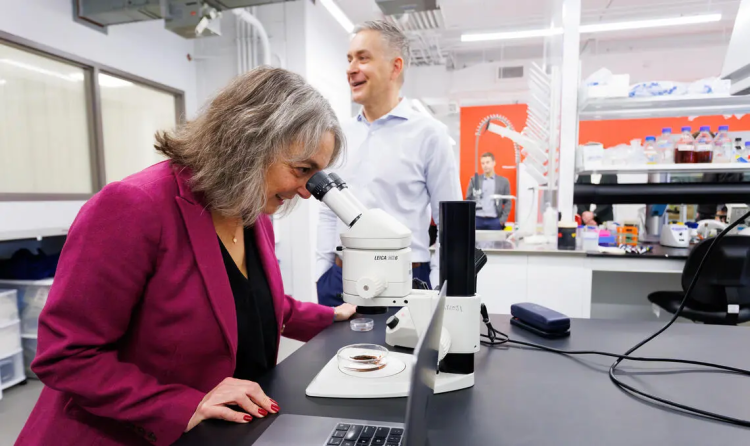
Julie Dabrusin, left, Minister of Environment, Climate Change and Nature, looks through a microscope while visiting a showcase of UCalgary's ongoing Environmental Damages Fund projects.Photo Courtesy: Riley Brandt, University of Calgary
Identifying a suitable habitat for a bull trout return
"Bull trout need the four Cs' to flourish," says Vamosi, professor in the Department of Biological Sciences. "They need clear, cool, connected and complex waterways."
Vamosi cites urbanization, increased logging and mining, higher temperatures, and pollutants as factors that make water murky, warmer, more obstructed and overall, less hospitable.
At six sites along each river, Vamosi, Barst, and their team of students will assess suitability to sustain a return of the bull trout. Vamosi will focus on ecological diversity, examining macroinvertebrate populations as indicators of food web quality. Barst will focus on water quality and contaminants, including sediment and trace elements such as selenium, mercury, and lead.
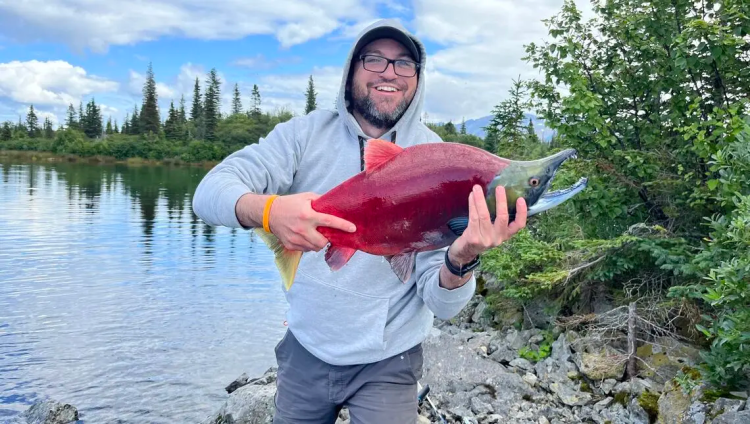
Faculty of Science researcher Benjamin Barst, holding a sockeye salmon. Photo Courtesy Benjamin Barst
Greater insights through collaboration with Indigenous communities
Working in collaboration with partners from Mînî Thnî (representing Bearspaw, Chiniki, and Goodstoney First Nations), and the Siksika, Piikani, and Kainai First Nations, the research team will hone the monitoring program with respect for cultural protocols and in service of each community. Vamosi emphasizes that greater insights are gained when weaving together Indigenous knowledge and Western science.
"Each community will likely have different interests," he says. "They might identify factors that we hadn't thought of measuring; they may have different uses for the data, or their priorities may evolve over the five years. We will be meeting regularly to exchange knowledge and discuss our findings, to make sure that communities know what data they're getting, and that it's usable for them. This is meant to be a partnership."
The team hopes that the project will be a catalyst for continued collaboration with Indigenous communities, to co-create new knowledge and insights to address pressing environmental challenges.
Bringing the population back
"Once bull trout are wiped out of a location, they're not likely to make it back there without help," says Barst, assistant professor in the Departments of Biological Sciences and Earth, Energy and Environment. "The environmental stressors on the Bow and Oldman rivers are only growing, and we need to try to re-establish the population if we can."
It's possible that some of the sites the team monitors could be suitable for bull trout, but that they just aren't inhabiting the area at this time.
"When we've identified a potential good habitat, we're going to translocate fertilized embryos and see if we can get fish to hatch in those new locations," Barst explains.
To do this, Barst will be deploying specialized incubation boxes that capture photographs of bull trout as they develop in their early stages of life. The small, clear boxes were developed with collaborator Dr. Jeff Morris, PhD (Biodiversity Research Institute), and have cameras mounted on one side, and a 3D printed grid holding the bull trout embryos on the other. If the experiment is successful, the embryos will eventually develop into fry, and swim out of the boxes into the river.
When complete, the project will have generated valuable insights into the protection and restoration of habitats and bull trout populations.
"The bull trout can't wait," says Vamosi. "We have to act."
Federal support through the Environmental Damages Fund
The EDF invests in projects that restore the environment and conserve wildlife and habitats in a scientifically sound, cost-effective, and technically feasible way.
"For 30 years, the Environmental Damages Fund has shown us that even when nature is harmed, there's a path forward one that leads to healing and restoration," said the Honourable Julie Dabrusin. "It is encouraging to see how communities across Canada have turned accountability into action, transforming penalties from environmental infractions into impactful projects that protect the environment and conserve wildlife and their habitats. Today's investment continues that legacy, and I'm inspired by the people behind these initiatives who are making a real difference for our environment today and for future generations."
"At the University of Calgary, we are committed to the responsible stewardship of our natural environment through scientifically sound and community-engaged research," says Dr. Ed McCauley, president and vice-chancellor.
UCalgary's ongoing EDF-funded projects are:
- Catalyzing Community Climate Action - Dr. Julie Drolet, PhD, Faculty of Social Work
- Calgary Urban Methane Emissions Measurement Testbed (CURMET) - Dr. Chris Hugenholtz, PhD, Faculty of Arts
- Assessing Sustainable, Equitable, and Rapidly Deployable Carbon Dioxide Removal Technologies - Dr. Sean McCoy, PhD, Schulich School of Engineering
- Canadian Climate Policy Partnership (C2P2) - Dr. Jennifer Winter, PhD, Faculty of Arts and School of Public Policy