


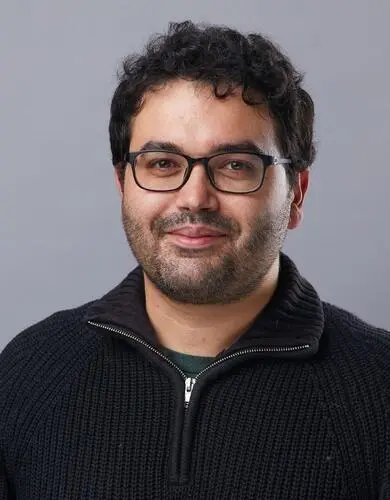
Yani Ioannou. Photo Courtesy Yani Ioannou
Dr. Yani Ioannou, PhD, an assistant professor and Schulich research chair in the Department of Electrical and Software Engineering at the Schulich School of Engineering, is leading a new Canada-France research collaboration to address these challenges. Ioannou will partner with Dr. Umut Simsekli, PhD, from the National Institute for Research in Digital Science and Technology (INRIA) and the École Normale Supérieure, Computer Science Department (ENS) in Paris to improve generative AI models.
"International partnerships strengthen the UCalgary research community and accelerate innovation," says Dr. William Ghali, vice-president (research). "Improving efficiency and fairness in AI is essential for the future of responsible and safe technology. We're excited to see Dr. Ioannou leading this conversation on a global stage."
Tackling efficiency in modern AI
"The biggest challenge with current AI technology is the enormous amount of energy these models use," says Ioannou, who also leads the Calgary Machine Learning Lab. "They're highly inefficient to train and run."
Today's generative AI systems demand vast computational and environmental resources. Training them can cost millions of dollars and require thousands of graphics processing units running for months, limiting access to who can use them.
"Only major tech companies can afford to train these large models," says Ioannou.
While techniques exist to compress small AI models for faster operation, they do not work well with today's large models. The research team will investigate why large models are difficult to compress. By understanding what happens inside these systems during training, the team aims to design new approaches that reduce energy use, cost and environmental impact without sacrificing performance.
Improving training methods and reducing costs can create broader access to AI research for scientists, startups and smaller companies, fostering a more collaborative and innovative landscape.
Understanding the impact on fairness
The team will also study how training and compression techniques influence fairness. Because AI models learn from real-world, human-generated data, they can reflect societal biases. While fairness in AI is an active area of research, few researchers have examined how efficiency efforts may unintentionally alter model behaviour.
"All the methods we use to make models more efficient can also affect fairness. They can potentially make models less fair or change how they behave," says Ioannou.
Their project was funded by the Natural Sciences and Engineering Research Council of Canada (NSERC) and France's National Research Agency (ANR), with supplemental support from IVADO, a Quebec-based non-profit consortium dedicated to responsible AI.
Opportunities for students and international collaboration
The project will create unique opportunities for UCalgary and ENS students, including recruitment, international exchanges and joint training programs.
At the end of the three-year grant, UCalgary will host a workshop bringing together AI experts from Canada and internationally to share key findings and to foster new research collaborations.
Bridging theory and practice
A key strength of the project is the partnership with Simsekli, who specializes in the mathematical foundations of how AI systems learn from real-world data. His research complements Ioannou's practical work designing efficient AI systems from an engineering perspective.
"Bringing these strengths together is really exciting," says Ioannou. "That's often where the biggest leaps in research come from."
"AI already affects almost every part of people's lives. Understanding how these models work, improving accessibility, and ensuring they treat people fairly is crucial for industry, research and society."
Dr. Yani Ioannou, PhD, is an assistant professor and Schulich Research Chair in the Department of Electrical and Software Engineering at the Schulich School of Engineering (SSE). He also leads the Calgary Machine Learning Lab.
Ioannou's project, GHOST - Generative modelling, Heavy tails, Outliers, Sparse Training, is funded through the Canada-France call for proposals on AI, a joint research initiative from the Natural Sciences and Engineering Research Council of Canada (NSERC) and France's National Research Agency (ANR), which conducted the peer-review process. It was one of only 10 projects selected for funding in the competition. The project also received supplemental funding from IVADO, a Quebec-based non-profit consortium dedicated to responsible AI.