After more than three decades studying forests in western Canada and excursions from Australia to Russia, Dr. Phil Burton has come to believe that the way forests are managed needs a fundamental rethink.
A Professor Emeritus at UNBC, Burton spent much of his career examining how ecosystems respond to disturbance, from wildfires and insect outbreaks to logging and climate change. Those experiences form the backbone of his new book, Resilient Forest Management, released last year by Oxford University Press. With literature cited and case studies presented from around the world, the book outlines a new approach to forest stewardship in the face of disruption and uncertainty.
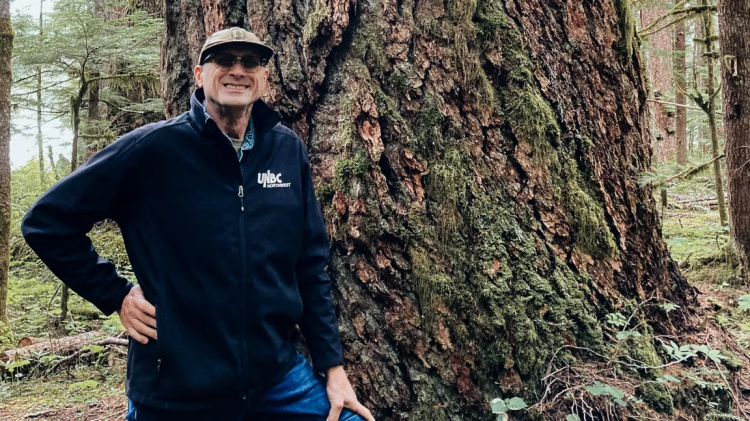
Professor Emeritus Dr. Phil Burton published his latest book Resilient Forest Management in 2025.
"Many of the perspectives and examples presented in the book are based on my experience in northern B.C.," Burton says. "Over the last 30 years of studying ecosystem disturbance and recovery in our region, I was repeatedly impressed by the ability of our forests to absorb or rapidly recover from both natural and human-caused disruptions."
At the same time, Burton witnessed how forest management responses to large-scale disturbance could undermine that natural resilience. The mountain pine beetle outbreak, which affected vast areas of forest across the province, proved to be a turning point.
"It became obvious that widespread salvage logging was short-sighted in its impacts on wildlife, watersheds and timber supplies, seriously limiting future options," he says.
Burton explored the issues around the practice in more detail in a 2008 book he co-authored, Salvage Logging and its Ecological Consequences.
Combined with the growing impacts of climate change and global trade disputes, Burton began to see that his long-standing focus on forest resilience was also applicable to the vulnerability of the forest sector itself. He tested and refined his ideas through discussions in fourth-year forest policy classes as well as conversations with graduate students and other UNBC faculty.
"I concluded that the assumptions of constancy implied by sustainable forestry needed to be replaced with a new paradigm," he says.
In plain terms, Burton says resilient forest management means planning for surprises and uncertainty rather than assuming stability.
"Resilient forest management means being prepared for disruption, being flexible and thinking in a holistic and precautionary manner," he explains.
Resilience isn't just about forests, businesses or communities bouncing back to a previous state, but may involve resistance, adjustment or even transformation.
"Diversity is the key ingredient for resilience," Burton says, pointing to the need for a diversity of tree species, forest values, forest products and markets.
He argues that an overemphasis on timber has narrowed decision-making, often at the expense of other ecosystem services such as wildlife habitat, water regulation, recreation and cultural values.
Burton is particularly concerned that current forest practices remain focused on short-term, stand-level decisions, often resulting in undesirable long-term and landscape-level impacts.
"I worry about the cumulative effects of so many stressors and disturbances to our forests, while most forest practices and the underlying regulations that govern them are narrowly focused, without consideration of the broader effects," he says.
Ultimately, he calls for a more measured approach to stewardship, one that learns from the natural complexity and resilience strategies of forest ecosystems.
"We can plan and engineer our way out of socio-ecological challenges only so far," Burton says. "With more attention to the unique ecologies and natural disturbance regimes of different forests, and recognizing the need to restore previously damaged forests, I hope that this book prompts a more ecological approach to forestry."
For more information

3333 University Way
Prince George British Columbia
Canada V2N 4Z9
www.unbc.ca