



True health equity begins when learning and care are rooted in the communities nurses serve, says Dr. Zahra Shajani, PhD, associate dean of Undergraduate Programs in the University of Calgary's Faculty of Nursing.
And that's exactly what the faculty's Rural Community Route program is doing for future nurses. The program is designed to bring high-quality nursing education to students in remote communities and bridge the gap between learning and location.
The program launched in 2021, with its first cohort of nine students beginning their studies in Wainwright, Alta. Through a partnership with Alberta Health Services (AHS), this rural pathway combines online learning with local clinical experiences, ensuring students can earn their degree without leaving home. This not only strengthens rural health care, it also builds community capacity.
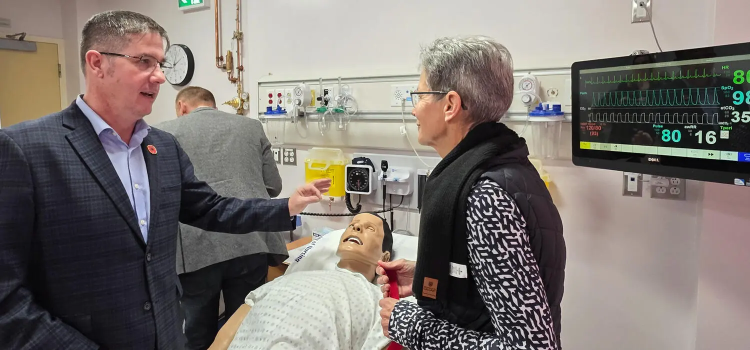
Ken Brisbin, left, simulation lead with eSIM Provincial Simulation Program, with Doreen Beckett, president of the Drayton Valley Hospital Auxiliary.
A community-based approach
The program has since expanded and now operates across multiple sites in Alberta, including Drayton Valley, Bonnyville, Wainwright, Claresholm, and Drumheller, with first admissions at Drumheller beginning in fall 2026. Students can complete theory online, with labs and clinical placements taking place in-person at designated health care sites.
Neila Moltzan is a second-year nursing student in Drayton Valley who was able to stay in her local community while upgrading to become a Registered Nurse.
"My family lives and works in the area, and it was a great way to learn while still staying at home," she says.
Not only does this program ease financial concerns for rural students, it's also reflective of two key priorities: increasing access to future-focused health-care education for students who face geographic barriers, and prioritizing community at the centre of the program, ensuring education is rooted in local needs and partnerships.
Innovative learning solutions
Recent investments, such as installing a simulation suite in Drayton Valley, allow students to practise skills in environments that mirror UCalgary's state-of-the-art clinical-simulation facilities in the city. This development, made possible through collaboration with AHS, ensures rural students receive the same hands-on training as their urban peers.
"Much of nursing education is about developing practical skills and knowledge, so ensuring our rural route students have access to training facilities and simulation suites where they can hone the skills they'll use throughout their career is key," says Dave Patterson, BN'08, MN'19, associate dean of Undergraduate Practice Education with UCalgary Nursing. "The recently opened simulation centre at Drayton Valley is an example of the high-quality educational opportunities we want to make available to nursing students across Alberta."
Navigating challenges
But rural learning, while offering great accessibility, can also pose its own challenges.
Moltzan is grateful for having the opportunity to study nursing while being able to stay home and serve her community, but not being on the main UCalgary campus and developing those in-person connections can be difficult.
"For communication with professors and the university, we can't just show up to an office; we need to email or call," she says.
Despite these hurdles, Moltzan says the program's impact extends far beyond individual students: "My community will gain safe and ethical nurses."
The Faculty of Nursing is actively creating events and initiatives to strengthen connection and engagement between Rural Community Route Program students and the main campus.
"Our responsibility is to ensure that every student can learn where they call home and return with the skills, pride and connection to transform health for their people," says Shajani.
For more information about the program, visit the UCalgary Rural Community Route website.


