In a North American first, the operator of Polytechnique Montréal's campus food services, the Association des services alimentaires de Polytechnique (ASAP), has decided to say goodbye to beef as Polytechnique strives to achieve carbon neutrality by 2050. Daring to reimagine right down to the plate.
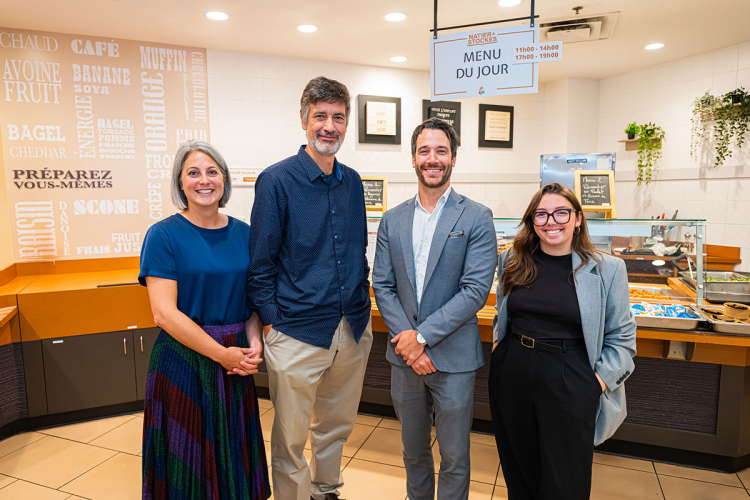
Left to right: Amélie Tanguay, Acting Director of Polytechnique's Talent, Culture, Environment and Society Department; Patrick Cigana, Director of Polytechnique's Sustainability Office; Benoît Beauséjour-Savard, President of the Association des services alimentaires de Polytechnique (ASAP); and Katherine Vézina, Chair of the Board of Directors of ASAP. (Photo: Caroline Perron and Avril Franco.)
At the beginning of the fall 2025 term, ASAP erased beef from the menu at all of its food counters. New options with a lower carbon footprint are now front and centre.
The decision, reached after canvassing the Polytechnique community, wasn't just a symbolic move. It is part of Polytechnique's determined drive for sustainability.
Beef is the carbon giant on our plates
The arithmetic is stark. Beef's carbon footprint is up to ten times that of poultry. The culprit is the methane belched out by cattle during digestion.
"We estimate that simply removing beef from the menu will reduce the carbon footprint of our food services by 50%, and decrease Polytechnique's total emissions by 1%. It's huge!" commented Patrick Cigana, Director of Polytechnique's Sustainability Office. "This change will definitely advance our carbon neutrality efforts."
"After we started displaying the carbon footprint of our meals, it became obvious that taking beef off the menu was the thing to do to make our meals more sustainable," says ASAP President Benoît Beauséjour-Savard.
More choice, lower emissions
The shift away from beef hasn't narrowed the food options at Polytechnique's cafeterias. Quite the contrary! The menus feature plant-based proteins and low-impact meats such as fish and poultry.
"Transforming people's eating habits while preserving the pleasure of eating is an exciting challenge!" adds Beauséjour-Savard. "Our team has developed recipes featuring diverse proteins, particularly plant-based ones, and local ingredients,"
In practice, it means the beef burger has been displaced by a grilled chicken burger, smoked meat poutine has given way to bacon poutine, and the submarine sandwich has been replaced by a chicken shish taouk pita. Meanwhile, the vegetarian lineup keeps growing.
North American first
With this daring move, Polytechnique Montréal breaks new ground. A handful of European universities -- Cambridge, Oxford, Lausanne -- have banned beef but no North American institution had gone this far. Until now.
In Québec, food accounts for 25% of an individual's carbon footprint. "The food industry is responsible for a significant portion of our personal carbon footprint," says Cigana. "Changing our diet is often the most impactful individual action we can take to fight climate change."
Institutions thus have an important role to play, not only through research and innovation but also their daily practices.
"In 2019, when Polytechnique Montréal committed to achieving carbon neutrality by 2050, we knew it was an ambitious goal," Cigana concluded. "To get there, we will have to make bold choices and take some significant steps. Overhauling our food offerings is part of it. If we can do that and sprinkle in the pleasure of discovery at the same time, it's a win-win."
Learn more
- Polytechnique Montréal's Sustainability Office website
For more information

2500, Chemin de Polytechnique, Bureau A-201, 2e étage
Montréal Québec
Canada H3C 3A7
www.polymtl.ca