In Canada, another child interacts with Pepper, who helps to reduce their anxiety before they go into the operating room. In Australia, a diabetic adolescent receives motivational interview coaching by a NAO social robot named Andy, to help reduce their high-sugar food and drink consumption.
These examples are not science fiction or fantasy. The first occurred as part of a research project that began at Toulouse University Hospital in 2021. The second was an initiative that launched at the Humber River Hospital in Toronto in 2018. The third occurred as part of an eight-week feasibility trial in a hospital clinic, published in 2020.
Now, global financial services firm Morgan Stanley estimates there will be one billion AI-enabled humanoid robots like Pepper and NAO, who will be in use by the year 2050, in a market worth a staggering $5 trillion. And a 2025 report from the World Economic Forum predicts that AI will radically transform health care.
How will we get from here to there? How have these robots been used in health care to date? How effective have they been, and what are their limitations?
Researchers from the Global Lab for Digital Health and AI Innovation at the University of Victoria (UVic) produced two scoping reviews during 2025 to investigate these questions, focusing specifically on uses of the Pepper robot in health care and the NAO robot in health care and education.
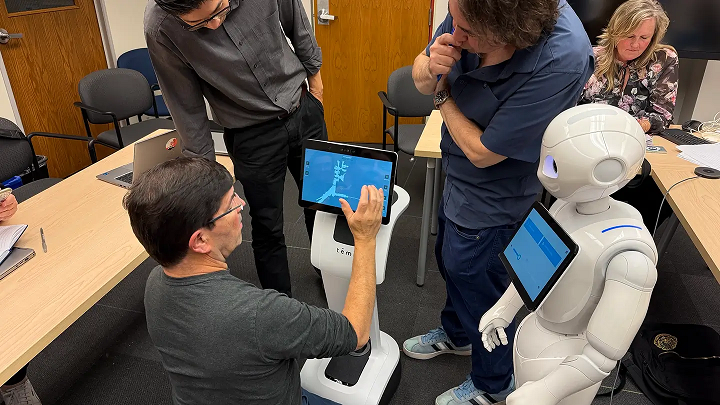
UVic researchers set up humanoid robots for healthcare applications. Credit: Simon Minshall.
Early social and empathic humanoid robots
The NAO humanoid robot was developed by Softbank Robotics (originally Aldebaran Robotics) and the first production version was released in 2008. NAO is 58-centimetres tall, can walk and speak 20 languages.
Pepper is an example of an early empathic humanoid robot, also created by Softbank Robotics in 2014. Pepper integrates advanced speech recognition with facial expression analysis, and artificial intelligence. Pepper is 121-centimetres tall and can walk, talk, dance and recognize human emotions.
"Pepper has been successfully used for dementia care, neurodevelopmental disorders and chronic illness education. It has also been used to address caregiver shortages and in cognitive stimulation therapy," says Andre Kushniruk, professor of health information science at UVic and lead author on both studies.
"NAO robots also show significant potential in health care and in education," says Elizabeth Borycki, also a professor of health information science at UVic, and co-author on both studies. "They have been shown to be effective in managing children's anxiety, and in supporting diabetic youth. Robots, when designed to be empathetic, prove to be an engaging and alternative way of supporting health and wellness."
Future research needs to consider the ethical, health care and societal implications of robots undertaking health-care activities,"
Andre Kushniruk, professor of health information science
Important considerations include ensuring robots are fair and unbiased, and that their actions and reasoning are explainable to their human users. They also must be safe to use, and their advice or help must be accurate and timely.
The possibilities of robotic empathy
Empathy is central to the potential of humanoid robots like Pepper and NAO, and of forthcoming innovations such as the Optimus robot that Tesla aims to have on the market in 2027 if these robots are to be used in care-giving and other health-care roles.
Empathy in human-robot interaction is the focus of some new work by Kushniruk, along with co-authors Seper Rohani and Borycki. The research group asks what is necessary to drive successful emotive human-robot interaction.
Their work considers empathetic relationships with robots from two perspectives: robots can be designed to express empathy to human users; they can also be designed to induce empathy from humans. It assesses key features that support these two abilities in humanoid robots.
The researchers will present their findings at the Medical Informatics Europe 2026 conference, in Genova, Italy, in May 2026.