Brock University researchers who developed an innovative immunotherapy approach are one step closer to commercializing a treatment for age-related lung disease.
Professor of Health Sciences Newman Sze has already filed a patent for the breakthrough new drug called isoDGR-mAb, an antibody he and his team designed that clears out accumulated proteins damaged by inactive lifestyles, unhealthy diets, environmental stressors and genetic factors.
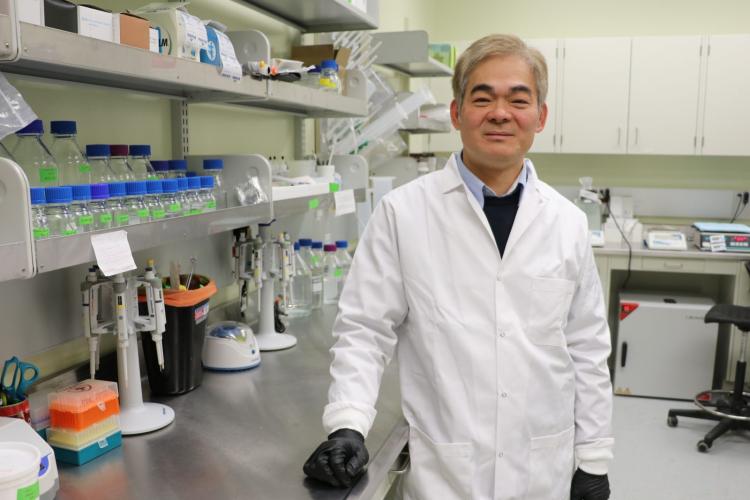
The Government of Canada has awarded Brock University researchers $2.3 million for health research, including Professor of Health Sciences and Canada Research Chair in Mechanisms of Health and Disease Newman Sze
These harmful proteins, known as isoDGR, break down normal function of healthy tissue and trigger chronic inflammation, which is associated with conditions such as cardiovascular disease, cancer, Type 2 diabetes, arthritis and Alzheimer's disease.
Sze and his group are one of three Brock teams recently awarded Canadian Institutes of Health Research (CIHR) Commercialization Project Grants totalling $2.3 million.
A team led by Assistant Professor of Health Sciences Luke Turcotte is working with Niagara Health and Ontario Health atHome to incorporate home care information into hospital discharge planning with the goal of reducing unplanned hospital readmissions among frail and medically complex older adults.
"Most discharge planning tools focus on medical diagnoses," says Turcotte. "Information about social determinants of health and caregiver well-being will help identify high-risk patients and support safer transitions home."
Also receiving funding is Assistant Professor of Psychology Paula Duarte-Guterman and her team who are investigating how sex-based features such as male and female hormones affect biological and behavioural responses to disruptions in daily rhythms.
"Mental health is deeply influenced by regular daily routines and the social environments we live in, yet much of the existing research has overlooked important differences between females and males," says the Canada Research Chair in Behavioural Neuroscience.
"Our work will help clarify how daily biological rhythms and social settings interact to shape mental health in both females and males," she says.
With his CIHR funding, Sze's research group will work on developing isoDGR-mAb for human therapeutic use.
Their initial goal is to treat idiopathic pulmonary fibrosis, a respiratory disease with no known cause. The condition affects the tissue surrounding air sacs in the lung, causing permanent scarring in the lungs, called fibrosis, that makes it increasingly difficult for people to breathe.
"Patients with this disease will typically die within three to five years," says Sze, who is Canada Research Chair in Mechanisms of Health and Disease. "At the moment, there's still no effective treatment. We hope the development of this drug will proceed smoothly so that we can give hope to patients to survive longer and improve their quality of life."
Current approaches attempt to reduce inflammation overall, but do not target the underlying molecular damage that drives chronic inflammation and fibrosis, Sze says.
Preliminary research showed isoDGR-mAb cleared damaged proteins, reduced inflammation, improved lung function and extended survival while sparing healthy tissue.
Associate Vice-President, Research Deborah O'Leary says the CIHR grants highlight Brock's capacity to deliver health research with a clear line of sight to tangible benefits.
"These projects show Brock researchers tackling urgent health challenges from moving new therapies closer to patients and strengthening supports for older adults to building a clearer understanding of mental health," she says.
St. Catharines MP Chris Bittle says a strong, effective health-care system is essential to Canadians' health and overall well-being.
"The goal of this funding is to turn innovative ideas into leading-edge knowledge, research and real-world outcomes," he said. "Through this and other projects, Brock University researchers continue to demonstrate a strong track record of advancing key areas of Canada's health-care system."