


More than a decade after it was established, UNBC's Energy Conservation Revolving Loan Fund continues to quietly power some of the University's most impactful sustainability projects, and it's still growing.
Rooted in UNBC's commitment to foster local solutions for global impact, the fund turns energy efficiency into a self-sustaining investment model that delivers results from campus to community.
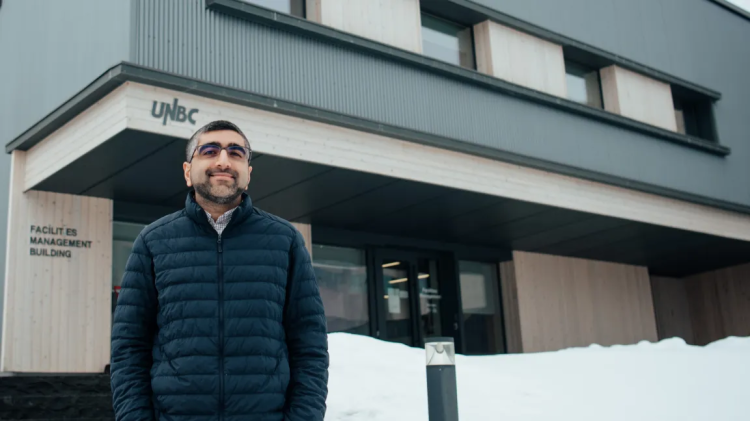
UNBC Energy Manager Sahil Dino highlights how the Energy Conservation Revolving Loan Fund supports sustainability efforts across UNBC's campuses..
The model is simple: the projects are funded up front, and the energy savings they generate are used to replenish the fund. To start, 80 per cent of the energy cost savings of a project are used to replenish the loan until the project costs have been repaid. After the loan is repaid, payments continue at 50 per cent of the energy cost savings for the lifetime of the project.
"Investing in green infrastructure is one of the most powerful climate actions UNBC can take," said UNBC Interim President and Vice-Chancellor Dr. Bill Owen. "Reinvesting energy savings into new projects turns efficiency into momentum and positions the University to lead a sustainable future."
The fund began with $250,000 in 2012. Today, it has supported more than 70 projects representing about $3 million in total spending. Its balance recently exceeded $1 million, not because of new injections of cash, but because of the savings generated by completed projects.
Additional funding sources have helped stretch the impact of the loan. Capital payments often come from the Province's Carbon Neutral Capital Program, while incentive payments, primarily from BC Hydro, offset project costs and reduce the draw down on the fund.
"The revolving loan fund gives UNBC a resilient, self-sustaining mechanism to plan and fund these projects and balance spending with annual capital priorities," says UNBC Director of Sustainable Facilities and Ancillary Service Dr. David Claus.
Over time, energy savings have added up. Cumulative electricity savings totaling more than 54.5 million kilowatt-hours, enough to power UNBC's entire electricity needs for more than 4.5 years, including the Prince George and Terrace campuses, the Quesnel River Research Centre and the Wood Innovation Research Lab.
"It's also enough electricity to power nearly 5,000 homes for a year," says UNBC Energy Manager Sahil Dino. "Or to drive an electric car about 303 million kilometres, that's like travelling from Prince George to Terrace and back more than 526,000 times."
Projects have also reduced the University's campus-wide district heating energy use by more than 100,000 gigajoules. That's roughly equivalent to more than a full year of the University's bioenergy and natural gas heating.
While lighting upgrades are among the most visible projects, the fund has supported a wide range of initiatives, from air handling unit coil cleaning and heating, ventilation and air conditioning (HVAC) optimization to free cooling for the main server room and the removal of electric baseboard heaters in residence buildings.
"Efficiency upgrades have vastly improved the quality of lighting across campus and HVAC projects have improved space comfort," Dino said. "Continuous optimization of building systems has been very successful and reduced building energy consumption by about 20 per cent on average."
The revolving loan has also created learning opportunities for students. Engineering students have worked with the Facilities Management and Capital Projects department for their capstone projects, using real campus systems as living laboratories for applied research.
"It's a great way to connect academic learning with practical implementation," Dino said.
Staff also support undergraduate and graduate research projects by providing data, site access and technical guidance.
At a University where innovation is shaped by place, the revolving loan demonstrates how practical solutions developed in the North can lead the way. The North is the future, and sustainable infrastructure is part of that future.
For more information

3333 University Way
Prince George British Columbia
Canada V2N 4Z9
www.unbc.ca