Western University is building relationships with two East African institutions to foster research, training and innovation pipelines between continents. These expanded partnerships are also forging a new model for global health innovation that starts at the grassroots - remote and underserved communities - instead of distant urban labs.
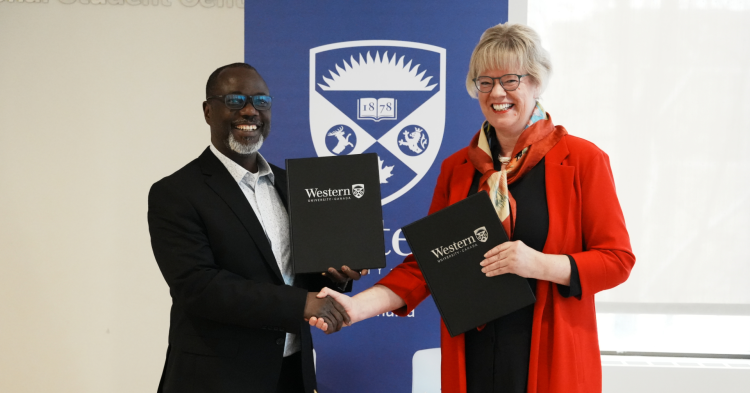
Western recently welcomed delegations from Amref International University in Kenya and Bahir Dar University in Ethiopia to strengthen partnerships that advance frugal biomedical innovation across continents. Together, they are co-developing community-driven health technologies and training programs that improve care in remote and resource-constrained communities. (L to R) Amref International University vice chancellor Joachim Osur and Western University provost and vice president (academic) Florentine Strzelczyk signed a memorandum of understanding that will create more opportunities at both universities. (Teddy Loukas/Western International)
Leaders from Amref International University (AMIU) in Kenya and Bahir Dar University in Ethiopia met with senior leaders, researchers and students at Western during recent visits to campus, formalizing collaboration rooted in reciprocal learning. The back-to-back delegations also reflect growing international interest in Western's Frugal Biomedical Innovations Program, a multi-faculty initiative led by Western's Faculty of Engineering.

Margaret Mutumba, director of Western's Frugal Biomedical Innovations Program and The Africa Institute, helps lead high-impact global partnerships, creating a durable path to solving health challenges that increasingly transcend borders. (Colleen MacDonald/Western News)
The program works with remote communities in northern Canada and low-resource communities Africa to co-develop affordable medical devices. A core principle of the program is ensuring the devices are tailored to community needs and engineered for local maintenance and sustainability.
"Western is seen as a trusted partner who is willing to be on the ground at the community level," said Margaret Mutumba, director of the Frugal Biomedical Innovations Program. "Whether it's here in Canada or with our African partners, we engage directly with communities to see what they're grappling with and then co-create solutions."
At the heart of the Frugal Biomedical Innovations Program is a rethinking of the traditional model of biomedical innovation.
"Devices designed in ideal clinical environments often fail once they're deployed because they don't match the realities on the ground. They could be incompatible with the context from electrical frequencies, to access to maintenance resources, to the way health care is delivered in their culture or environments," Mutumba said.
Instead, Western researchers work directly with communities to identify their priorities, adapt local ideas and then design technologies using locally available materials and expertise.
Strengthening global health innovation through African partnerships
The relationship between the Frugal Biomedical Innovations Program and Bahir Dar University stretches back three years, beginning with remote collaboration on multiple health initiatives. A 2024 visit to Ethiopia by Western researchers - including School of Biomedical Engineering director James Lacefield - helped strengthen those projects that paved the way for Bahir Dar students to present their research at five international conferences. The return visit from the Ethiopian delegation in December built upon the momentum and expanded collaboration beyond biomedical engineering.
"Bahir Dar is among the Frugal Biomedical Innovations Program's most engaged collaborators," Lacefield said. "They back the mission of our program by prioritizing projects that improve lives in underserved regions and grow their capacity to commercialize technology."
The connection with AMIU is about a year old and accelerating quickly, with the universities signing a memorandum of understanding (MOU) during the Kenyan delegation's visit in December 2025.
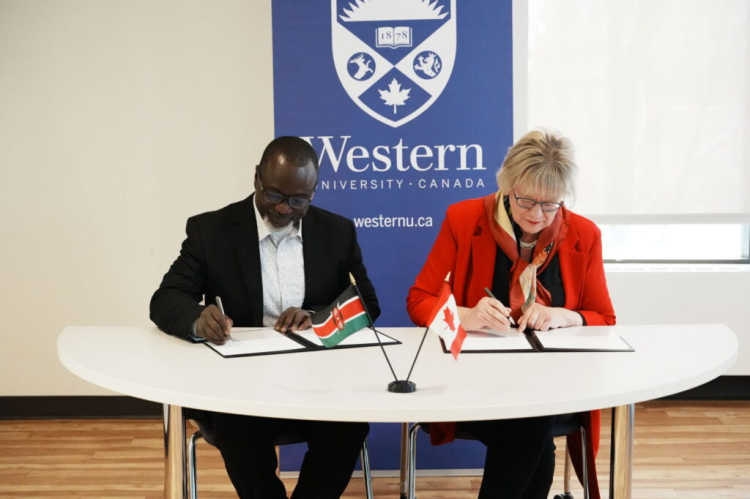
(L to R) Amref International University vice chancellor Joachim Osur and Western University provost and vice president (academic) Florentine Strzelczyk sign a memorandum of understanding that will create more opportunities at both universities. (Teddy Loukas/Western International)
"In global partnerships, in-person engagement accelerates trust and moves relationships from agreements to implementation," Mutumba said. "MOUs like the one with AMIU strengthen our position for large funding calls and build training pipelines that advance student mobility and collaborative programming."
AMIU is part of the Amref Health Africa Network, Africa's largest health development NGO, with offices in Europe, the U.S. and Canada. Through this network, AMIU works in more than 35 countries to make primary health care accessible across a wide range of communities, drawing on its expertise in large-scale training of health workers, implementing health systems in communities and nurturing innovation ecosystems. Their work extends into conflict zones where civil unrest has disrupted communities and dismantled health care systems.
"It's important to work with the people on the front lines of conflict, displacement and climate change. We can learn from them about delivering care under very difficult circumstances to prepare our own health-care practitioners who work in remote, resource-constrained communities," Mutumba said. "We also know that no one individual or single group can solve these highly complex challenges we all face ahead."
AMIU vice-chancellor, Dr. Joachim Osur, said cooperation across borders is essential to overcome these challenges.
"Our collective resilience depends on collaboration, shared learning and the ability to adapt solutions across different contexts," he said.
Academic collaborations drive community impact
Western's partnerships with AMIU and Bahir Dar University are translating into tangible opportunities for students and faculty while finding practical health-care solutions. Using the Frugal Biomedical Innovations Program's unique model of co-creation, one project between Bahir Dar University and Western tackles an urgent need in northern Ethiopia. Leveraging Bahir Dar's strengths in engineering, technology innovation and applied research translation, the project addresses a demand for 3D-printed prosthetics. In some areas of Ethiopia, civil conflict has left numerous individuals living with hand or limb loss.
"Many people in these regions work with their hands as farmers or artists, for example, so our partners emphasized the need for functional assistive devices - not cosmetic ones - that support the way they live," Mutumba said.
Community members fitted with the prosthetics have become the vocal champions for the project, she added.
"They're advocating to their local leaders to say, This academic institution is bringing real benefits to our community.' The Bahir Dar delegation met us in person to show their commitment to the collaboration and appreciation for the work our teams have been doing together."
Improving maternal health across Sub-Saharan Africa
Frugal Biomedical Innovations are aimed at building a future where health care can be delivered effectively in remote communities. In one such project, Western and AMIU are collaborating on a multi-country initiative to improve maternal health by bringing point-of-care diagnostic technologies directly into routine prenatal care across Sub-Saharan Africa.
These tools, including infectious disease testing, screening for chronic conditions like diabetes and portable ultrasound have the potential to transform how care is delivered in rural and underserved communities. Combined with frontline health worker training and digital support, this initiative aims to enable earlier detection of complications, improve timely referrals, strengthen local health systems and ultimately save and improve lives of mothers and newborns.

Western hosted the delegation from Amref International University in Kenya, including (L to R) Manjula Alles, Amref Health Africa in Canada director of programs and partnerships; Margaret Mutumba, Frugal Biomedical Innovations Program director; Joachim Osur, Amref University vice chancellor; Western University President Alan Shepard; Jim Lacefield, director of Western's School of Biomedical Engineering; Navin Singh, Amref Canada executive director and Melanie N. Katsivo, The Africa Institute associate director of programs and partnerships. (Teddy Loukas/Western International)
"In many places, even in Canada, people either may not want to deliver their babies in hospitals or they cannot access hospitals due to distance, and so we're looking at how to bring monitoring and other diagnostic evaluations closer to them. The AMIU team is demonstrating this well in the communities they serve," Mutumba said.
Western is also building capacity by co-designing curriculum with partner universities to establish advanced biomedical engineering programs and train researchers to design and commercialize technologies tailored to their contexts. In some cases, the researchers have found people in remote communities are already devising innovative solutions and benefit from the additional expertise Western can offer.
"The value of embedding communities is their wisdom and technical expertise passes to future generations, long after the research project ends," Mutumba said.
Western's expertise in entrepreneurship training, governance, artificial intelligence, intellectual property management and diversified research funding models is another strategic advantage to be shared with its international partners. Delegates from both universities explored these areas during their visits, alongside opportunities for new collaborations with other research centres such as the WesternWater Centre.
For both delegations, the draw of partnering with Western researchers extends beyond specific projects. The Africa Institute at Western, also led by Mutumba, signals long-term investment in strong international partnerships.
"We're very intentional about collaboration with our African partners, and we've created the infrastructure to nurture these relationships. Through the Frugal Biomedical Innovations Program, we're living out our commitment to equitable global partnerships."
Learn more about how Western is turning curiosity into solutions.