Climate change doesn't always arrive as drought or wildfire.
On May 28, 2021, Travis Hopcott found it in the form of an unexpected cold snap that wiped out 90 per cent of a cranberry field, a $130,000 loss in a single morning.
"If you ever wanted to see a grown man cry, that was the night," recalls the UFV alumnus (credential), a third-generation farmer who co-owns Hopcott Farms in Pitt Meadows. "With farming, you get one chance with a crop and that's it. If you mess it up, you have to wait until next year. And after something like that, it takes a couple of years for the plants to get back to where you want them, so it was pretty tough."
What could have been a devastating setback, however, became a turning point.
Needing to replace the failed system, Travis purchased a licence for a high-precision water and frost management system that is now central to the farm's sustainability strategy.
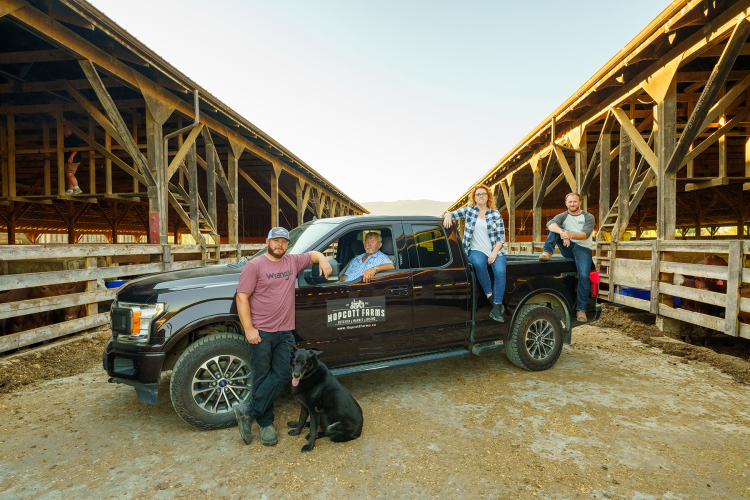
Left to right: Brad Hopcott, Bob Hopcott, Jen Hopcott, and Travis Hopcott.
Powered by solar panels, the system includes a tensiometer a soil moisture reader that communicates directly with the irrigation system.
"That reader talks to our irrigation system and makes sure the plant gets exactly how much water it needs, when it needs it," he says. "We're not overwatering or underwatering. It's the most efficient use of the water we have.
"We've seen around 10 per cent less water use, which is huge."
Healthier plants and better-quality fruit are part of the return on investment, he adds.
Travis also points to a system installed in the late 1990s that moves groundwater from one cranberry field to another. Despite their reputation, cranberry plants do not thrive in standing water.
"They don't like to get their feet their roots wet," he says.
Extensive drainage directs excess water to central tanks connected to pumps. Once those tanks reach capacity, the water is sent to a main reservoir, where it can be released or redirected to other fields.
Such systems are becoming increasingly important as the impacts of climate change intensify. While drought and heat stress are widely recognized challenges, extreme cold is also emerging as a concern.
In 2019, an unexpected cold snap cut B.C.'s cranberry yield in half.
"We'd never seen it before," says Travis. "There was no such thing as winter damage to cranberries before 2019. Now we're watching weather patterns in a way we never had to."
Travis says the connections he made while attending UFV have been critical as the farm adapts to changing conditions. He believes in staying progressive and embracing change, and regularly connects with industry contacts he first met as a student.
"UFV introducing me to people in the industry when I was a student is something I'm still benefiting from 20 years later," he says.
Travis maintains strong ties with the university and follows the work of faculty members such as Dr. Renee Prasad and Dr. Lauren Erland, director of the BERRI Lab. He says UFV stands out for its "boots on the ground" approach pairing on-farm research and producer engagement with lab and classroom work.
"It's a well-balanced approach," he says.
"Four years ago, Renee's work was critical when we had to replace 15.5 acres of one cranberry variety with another," Travis adds. "It was a big investment, about half a million dollars, and her research helped us choose from many options."
Losses like the one in 2021 are still part of farming. But today, Travis says, they are met with better tools, stronger research partnerships, and a determination to evolve.
"In this industry, standing still isn't an option," he says. "You have to keep adapting."
For more information

33844 King Road
Abbotsford British Columbia
Canada V2S 7M8
www.ufv.ca/