Three professors at Wilfrid Laurier University are being recognized for their exceptional contributions to research and student mentorship.
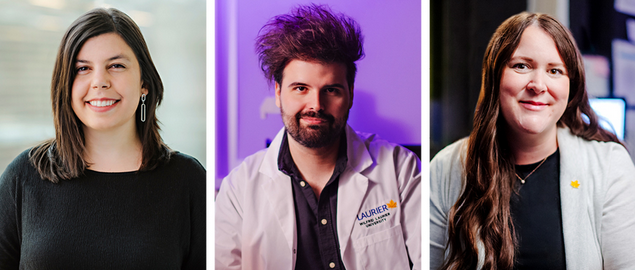
Laurier's 2026 Early Career Researcher Award winners are Laura Pin, associate professor, Political Science; Nicolas Rouleau, assistant professor, Health Sciences; and Nichole Scheerer, assistant professor, Psychology.
Each winner was nominated by their respective dean and will receive a $2,500 grant to support their research program.
"I am deeply impressed by this year's Early Career Researcher Award winners," says Jonathan Newman, vice-president: research. "Beyond their remarkable achievements, all three scholars are committed to creating the real impact' that defines Laurier research."
LAURA PIN
Pin's research on housing and homelessness helps integrate community knowledge into public policy, ensuring a diverse range of participants are included, represented and empowered.
"My goal is to support policy processes that take lived expertise seriously and lead to more equitable and effective responses to housing insecurity," says Pin.
For a recent project about municipal encampment governance, Pin assembled a community advisory team that included people with lived experience of homelessness and captured the perspectives of encampment residents. Together, they co-developed an applied framework for translating human rights principles into municipal practice, and their findings have shaped how some municipalities are approaching encampment regulation.
Pin's "Staying Home" project helped establish the Canadian Rent Bank Coalition, a coordinated policy network for eviction prevention across Canada. The follow-up initiative, "Staying Home 2.0," is supporting the development of shared data and knowledge infrastructures to expand rent bank programming nationally while advancing scholarship on the relationship between eviction prevention, rent regulation and social policy.
In her career to date, Pin has written 19 peer-reviewed publications in journals including Urban Geography, Policy and Politics and the International Journal of Housing Policy, as well as more than 15 research reports for government and community partners. She is dedicated to building public understanding and awareness, regularly translating her work into plain-language reports, editorials, public lectures and webinars. Since joining Laurier in 2021, Pin has organized six collaborative community-academic conferences and workshops, including the LISPOP Forum on Public Opinion and Housing Policy. She has contributed to policy and legal deliberations concerning housing and homelessness in Canada, including the 2023 judicial ruling that recognized a right to shelter on public lands.
Pin shares her "inclusive policymaking" approach with Laurier students. In the Master of Applied Politics Program, Pin created and teaches the class Policy Research in Action. Students learn to apply knowledge by working directly with not-for-profits, local governments and community legal clinics to co-develop responses to community expressed problems. Outside of the classroom, Pin works with and learns from community-based researchers with lived experiences of homelessness.
NICOLAS ROULEAU
As principal investigator of the Self-Organizing Units Lab (SOUL) at Laurier, Rouleau leads an interdisciplinary research group that aims to bioengineer 3D brain tissues to model neurological disease, cognition and consciousness.
"My research uses miniaturized brain tissues in a dish to study neural diseases, traumatic injuries, and the fundamental mechanisms of thought and experience," says Rouleau. "I hope to identify the basic building blocks of minds to detect and engineer conscious systems."
In 2021, Rouleau won the Bigelow Institute for Consciousness Studies' international essay competition for his paper on the continuation of consciousness beyond bodily death. Since then, his reputation as a leading voice on the science of consciousness has grown. Rouleau published a series of impactful papers, including a commissioned piece for the prestigious journal Philosophical Transactions. He recently hosted a workshop in Switzerland for 18 top consciousness researchers from around the world.
Rouleau's paper on herpes-induced Alzheimer's disease (AD) was among the first to experimentally validate the hypothesis that AD could be triggered by infection. His 3D tissue models of disease are now being used for rapid drug screening and discovery toward the eradication of AD.
In Rouleau's research lab, Laurier students learn cutting-edge neural tissue engineering techniques, including bioprinting and cell micropatterning. He also co-directs the Centre for Tissue Plasticity and Biophysics with Assistant Professor Nirosha Murugan, providing a collaborative, interdisciplinary environment for discovery. Rouleau is a member of the Natural Sciences and Engineering Council of Canada's Collaborative Research and Training Experience program committee, which manages $1.65 million in federal funding for EDI-informed STEM training innovation.
Rouleau also conducts research at Tufts University, where he is an affiliate scientist at the Allen Discovery Center and an adjunct research faculty member in the Department of Biomedical Engineering. He is co-directing a project to build autonomous living skin sensors that can detect airborne health hazards.
NICHOLE SCHEERER
Scheerer's research focuses on understanding sensory processing in both typically and atypically developing individuals, with an emphasis on how sensory differences - such as those seen in autism, ADHD and decreased sound tolerance - shape broader aspects of human development.
"I am deeply motivated by the belief that scientific research can both advance knowledge and reduce stigma, particularly around neurodevelopmental conditions that are too often misunderstood," says Scheerer.
In a recent study, Scheerer found decreased sound tolerance to be a surprisingly common issue for young people. Among a sample of 2,000 undergraduate students at Laurier, 18 per cent met the clinical cut off for misophonia, an aversion to trigger sounds that can elicit psychological distress. Seventeen per cent experienced hyperacusis, which causes individuals to perceive noises as painfully loud. Scheerer's team found decreased sound tolerance and poor social abilities were predictive of one another. They also found a strong correlation between misophonia and mental health issues, which can lead to social isolation.
"Sensory information is the primary input to our brain, so if someone processes sensory information differently, their brain is receiving different information," says Scheerer. "That is going to fundamentally alter the way that person develops and functions in their environment and how they see the world."
Since joining Laurier as a faculty member in 2022, Scheerer has published 14 peer-reviewed papers, with four more under review. She was recently invited to lead a multi-institutional team to write a Nature Reviews article on the transdiagnostic nature of decreased sound tolerance. Scheerer has served as guest editor for the journals Frontiers in Psychiatry and Frontiers in Human Neuroscience.
Scheerer collaborates with community organizations including Autism Community Training, the Pacific Autism Family Network and Big Spoon Lil Spoon to ensure her research findings inform real-world practices and advocacy.
"Training in my lab extends beyond research," says Scheerer. "I emphasize community engagement and leadership so students gain a holistic understanding of how research can serve the community."
Scheerer and her students facilitate the annual BrainWorx summer camp, which brings approximately 100 children - many of whom are neurodivergent - to Laurier's Waterloo campus for interactive, research-based programming. Over four weeks, more than 50 student volunteers provide individualized support to campers while contributing to active research projects.
Just as she prioritizes the needs and perspectives of neurodiverse individuals in her research, Scheerer showcased successful neurodivergent adults through the Empowering Neurodivergence Speaker Series in 2024/25.
"Through these interconnected efforts in research, mentorship and community engagement, I aim to advance knowledge while creating spaces - both scientific and social - that celebrate diversity and promote inclusion," says Scheerer.