Those kinds of tone beeps are ubiquitous in scientific research that involves non-speech auditory perception - and that's a problem, say Michael Schutz, a professor of music cognition and percussion in McMaster's School of the Arts, and PhD candidate Andrés Elizondo López.
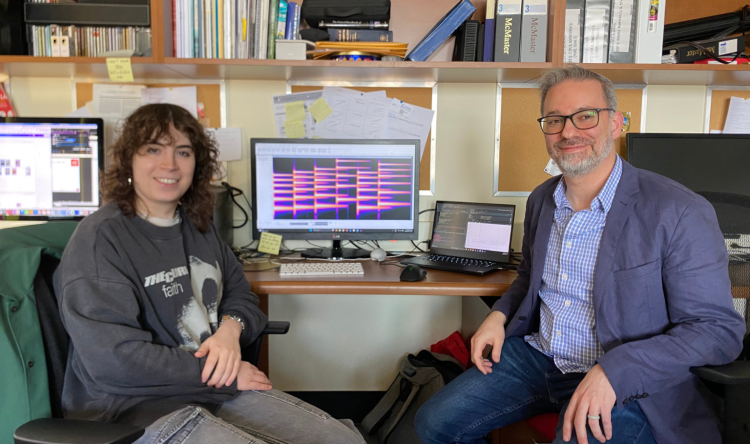
PhD candidate Andrés Elizondo López (left) and professor Michael Schutz (right).
That's because these flat tones make up just a tiny fraction of the sounds we hear every day - making the discoveries in auditory research labs hard to replicate in the "real world," where everything from dog barks, car horns and opera form a much larger part of our auditory landscape.
One of the key differences between the two types of sounds is their amplitude envelope, a measurement that describes how a sound changes over time and affects how we perceive the quality, or timbre, of the sound.
In other words, it's what enables us to tell a dial tone from a trumpet note.
Tone beeps have a very simple amplitude envelope - they start abruptly, hold without changing for an indefinite period, then stop. More complex sounds, on the other hand, have amplitude envelopes that ebb and flow in different ways, depending on the sound.
Now Schutz, who is the director of the Music Acoustics Perceptions Learning (MAPLE) Lab, and López have quantified that discrepancy between the lab and the landscape in a recent paper in Psychological Research - and they've done it with the help of more than two million YouTube videos.
Schutz's research team used a database that sorted more than two million 10-second sound clips drawn from YouTube videos into 527 groups of sounds, along with another collection of 165 common sounds, to create a comprehensive "corpus of everyday sounds," or CES.
They then compared those sounds with the stimuli used in auditory research - and found that while only 13.6 % of the sounds in the CES were similar to those simplistic lab sounds, those flat tone beeps made up almost 90% of the sounds used in auditory research.
Tone beeps are useful, says Schutz, because they're easily produced and highly controllable - an important quality in lab research. And some researchers are more interested in underlying mechanisms of auditory perception, which require sounds with specific parameters.
But it turns out that tone beeps may not be the best tools for assessing and explaining how humans perceive non-speech sounds.
"When you use the sound of something more complex, like a musical instrument, the brains' apparent capabilities change dramatically. Essentially, our responses differ markedly between real sounds and clinical, abstract tones," explains Schutz. "Our brains have not evolved to deal with beeps- which means research relying so heavily on them isn't actually giving us the insight we might think."
Schutz, a percussionist, was able to demonstrate this in his lab. While previous research conducted with tone beeps had shown that what a person sees doesn't affect how long they think a note lasts, Schutz was able to fool people into thinking a note played on the marimba was longer or shorter than it actually was simply by striking the instrument quickly or slowly with his mallets. The illusion then broke when he went back to simple beeps.
"One of the major drawbacks of relying on tone beeps - or too much on one type of sound - is that the test really only applies to that specific sound," says López. "Dr. Schutz's experiment is a prime example of how the overreliance on one type of stimulus can prevent further understanding of the world around us - so we hope that researchers take the time to recognize the most appropriate tones for their testing so there's a closer representation of the sounds we interact with day-to-day."
While Schutz and López's work has obvious implications for auditory research, the exclusive use of tone beeps affects life outside the lab as well.
Hearing aids, for example, are fit using tones with simple amplitude envelopes - but they're notoriously bad for users trying to enjoy live music. Same goes for cochlear implants.
More critical, and the subject of much of Schutz's recent research, are the flat tones used by many kinds of medical devices - those beeping, booping machines by a hospital bedside or hanging on IV poles. In this case, changing device sounds from flat tones to those with more complex amplitude envelopes can actually save lives by making the devices' sounds more detectable - resulting in faster responses - and less likely to interfere with speech comprehension.
That principle translates to other devices as well. Schutz just wrapped up a grant working with the US Navy, helping to assess and improve the sounds of navigation devices on gigantic Navy ships.
"The sound of a beep seems like the last thing you'd want to worry about when you're operating, or working in a hospital, or leading navigation on a $50 million ship, but we know of many instances of where the sound beeps led to massive problems, including preventable deaths," says Schutz.
"Think about the number of ships that are on the world's waters at any one time. Even if sounds cause problems in one in a million cases, that's not uncommon when you consider the problem from a global point of view. The same issue applies when you consider the number of medical procedures that are done in a day, or the number of patients in a hospital.
"Viewed from a musical perspective, these are entirely solvable problems."