His focus has shifted to Indigenous communities in Alberta and beyond. "I'm the first specialist to visit some of these communities," says Lee, who travels to more than a dozen remote First Nations in a year.
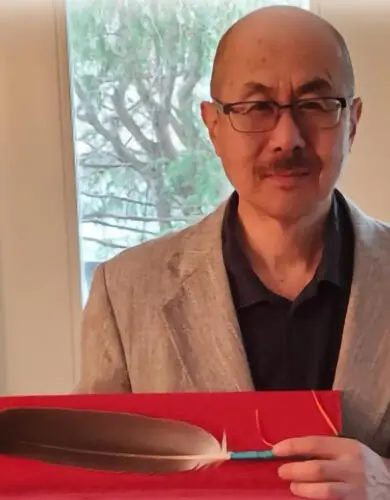
Samuel Lee with an eagle feather gifted by a patient. Photo Courtesy Samuel Lee
In many communities, patients would need to fly to Edmonton for consultation, at significant cost to the health system and hardship to families.
It inspired Lee to launch a telehealth ECHO program in 2015, initially to help treat hepatitis C.
Beyond clinical care, he visits local high schools to encourage Indigenous youth to consider careers in health care. "Indigenous people are five per cent of Canada's population, but far less than that in medicine," Lee says. "We need to change that."
Building a liver program
Lee, an emeritus member of the Snyder Institute for Chronic Diseases, has seen his share of progress since arriving in Calgary in 1988.
When he arrived, hepatology the branch of medicine focused on the diagnosis, treatment, and prevention of diseases affecting the liver and other organs was in its early stages of development in southern Alberta. Today, Calgary's liver program is one of the largest and most respected in Canada.
When Lee joined UCalgary as an assistant professor, there were no other hepatologists in the city and hepatology was not organized into a group dedicated to the delivery of research and education.
That changed in 1993, when Lee recruited Dr. Mark Swain, MD, and the two formed Calgary's first dedicated hepatology unit. From there, the program steadily expanded, adding clinicians, researchers and sub-specialists. Today, Calgary has more than a dozen hepatologists, with more than half based at the Foothills Medical Centre.
Lee credits that growth in part to positive changes in how academic research has been funded during his career.
"The researcher who spends 75 per cent of their time in the lab now gets paid the same as a doctor who is caring for patients," he says. "That protects research time and allows people to build programs that support clinical, research and academic interests."
Research was also organized by theme rather than department, encouraging multidisciplinary collaboration and enabling clinicians to work with basic science researchers to advance the study of liver disease.
"Sam is a very persuasive person. He kept encouraging me to come to Calgary and see how great it is," says Swain. "He pointed to the reputation it had as entrepreneurial, that it was more about what you bring to the table than where you come from."
Lee and Swain worked together to advocate for much-needed building infrastructure that helped advance hepatology research and develop patient-related education programs.
One of Lee's other major contributions was defining cirrhotic cardiomyopathy, a heart dysfunction seen in advanced liver disease. He organized the first diagnostic consensus criteria at the 2005 World Congress in Montreal and helped lead an updated international consensus in 2019, now considered the global standard.
Recognition by Indigenous communities
In recognition of his work, members of the Blood Tribe in southern Alberta gave Lee a Blackfoot name, Akekitsutake, meaning "Many Offerings." He also treasures an eagle feather gifted by a patient whose family he helped treat for hepatitis C.
"I've received academic awards," Lee says. "But these mean the most."