Led by Ecosystem Science and Management Associate Professor Dr. Jamie Gorrell and Glen Cartwright from the BC Trappers Association, the British Columbia Furbearer Project is creating a continuously growing archive of wildlife tissue samples to support research on animal health, genetics and environmental change. The project addresses a key challenge facing conservation science: access to high-quality biological samples.
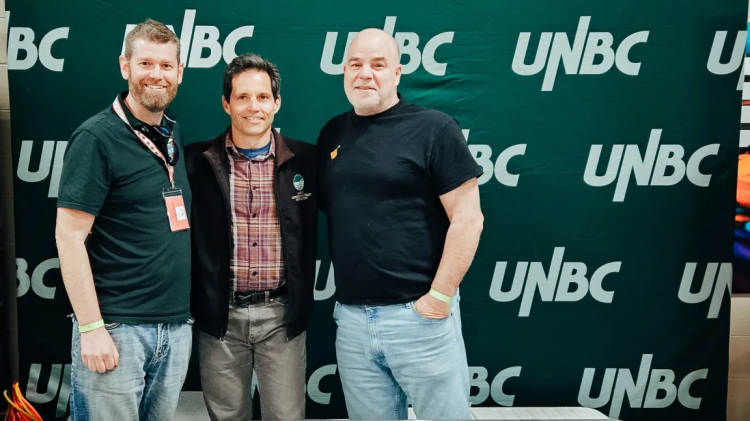
UNBC Ecosystem Science and Management Associate Professor Dr. Jamie Gorrell (left), Dan Buffet, CEO, Habitat Conservation Trust Foundation (centre) and fur trapper Glen Cartwright (right) attending the BC Trappers Association annual convention in Quesnel, B.C., to receive samples collected over the winter.
"Collecting samples for individual projects can take years," says Gorrell. "By building a shared resource now, we're creating opportunities for research that wouldn't otherwise be possible."
Trappers, First Nations and hunters across British Columbia play a central role in the effort. During the legal harvest season, participating trappers collect a small piece of thigh muscle and a section of pelt while preparing animals they have already harvested. Using sampling kits provided by the British Columbia Furbearer Project, each specimen is labelled with a barcode and logged through a custom smartphone app connected to a cloud-based database developed by UNBC Computer Science Professor Dr. Waqar Haque and his students.
"The project provided an unprecedented learning opportunity for students as they applied state-of-the-art technologies to this collaborative research initiative," says Haque. "The acquired skills resulted in instant employment offers upon graduation."
At the end of the season, samples are gathered at the annual trapping convention and transported to UNBC, where they are processed and preserved in Gorrell's lab. The result is a growing scientific resource designed for continuous collection from across the province.
"I saw a need and a space where traditional knowledge, boots on the ground and scientific research could come together to help wildlife," says fur trapper Glen Cartwright who developed this project from the start with Gorrell. "Working with the right people and a couple of years later, here we are."
Thanks to a three-year grant from the Habitat Conservation Trust Foundation, the biobank already has more than 3,000 samples from 24 species, ranging from mink and martens to beavers and bobcats.
The biobank allows researchers to analyze wildlife in ways that extend far beyond a single study. DNA can reveal how animals move across landscapes and how populations are connected, while chemical signatures help reconstruct diet. Samples can also be tested for pollutants, stress hormones, parasites and infectious diseases.
Unlike traditional museum collections, which often hold limited samples per region and cater to taxonomic studies, the British Columbia Furbearer Project is designed to collect thousands of samples annually and share materials widely for different uses. Researchers from universities, governments, Indigenous communities and non-profit organizations can request samples to support evidence-based decision-making around species conservation, environmental resilience and land use planning.
The initiative also provides hands-on learning opportunities for UNBC students. Computer science students built the project's digital infrastructure, while biology students help process and catalogue samples each summer, contributing to a multidisciplinary effort rooted at UNBC but extending across the province.
"Getting the opportunity to be involved with this project has been so impactful as I've gained valuable experiences in biology and connections that I can use to go further in this field," says biology undergraduate student Tatianna Bodenham. "This job also allowed me to work on something so much bigger than myself, and I take pride in contributing to research and a project that will help many people, both present and future."
For Gorrell, the project's greatest strength lies in collaboration.
"This is a partnership where community members are directly enabling scientific research," he says. "By collecting samples today, we're creating knowledge that will help protect wildlife and ecosystems for generations to come."
You can visit the BC Furbearer Project website at https://app.bcfp.unbc.ca/
For more information

3333 University Way
Prince George British Columbia
Canada V2N 4Z9
www.unbc.ca