The infection of pets and livestock by a large range of parasites from the single-celled Giardia to intestinal roundworms has cost farmers and pet owners billions of dollars.
Similar to the rise of antibiotic-resistant bacteria, parasites are evolving to survive treatments that were once highly effective. Drug-resistant parasites have been a problem for livestock producers for a number of years, but has more recently emerged as an issue for our pets.

John Gilleard, fourth from left, and his team at Gilleard Labs. Photo Courtesy John Gilleard
Responding to this, new research from the University of Calgary Faculty of Veterinary Medicine (UCVM) is challenging the long-standing "treat early and treat often" approach and could reshape how veterinarians manage parasite infections in the future by focusing more on diagnostics and less on medication.
A Natural Sciences and Engineering Research Council of Canada (NSERC) Alliance Grant, in partnership with Antech Diagnostics, will bring $1.6 million of research funding to help shift parasite control away from routine drug use towards more evidence-based, diagnostic-driven care.
Dr. John Gilleard, PhD, with UCVM and his group are teaming up with Antech, a USA-based global veterinary diagnostics company and Canadian subsidiary Biovet.
"This partnership is a fantastic opportunity to transition discoveries made in the lab into real-world diagnostic tests, by pairing cutting-edge research with practical development, validation and deployment," says Gilleard.
The growing problem with drug-resistant parasites
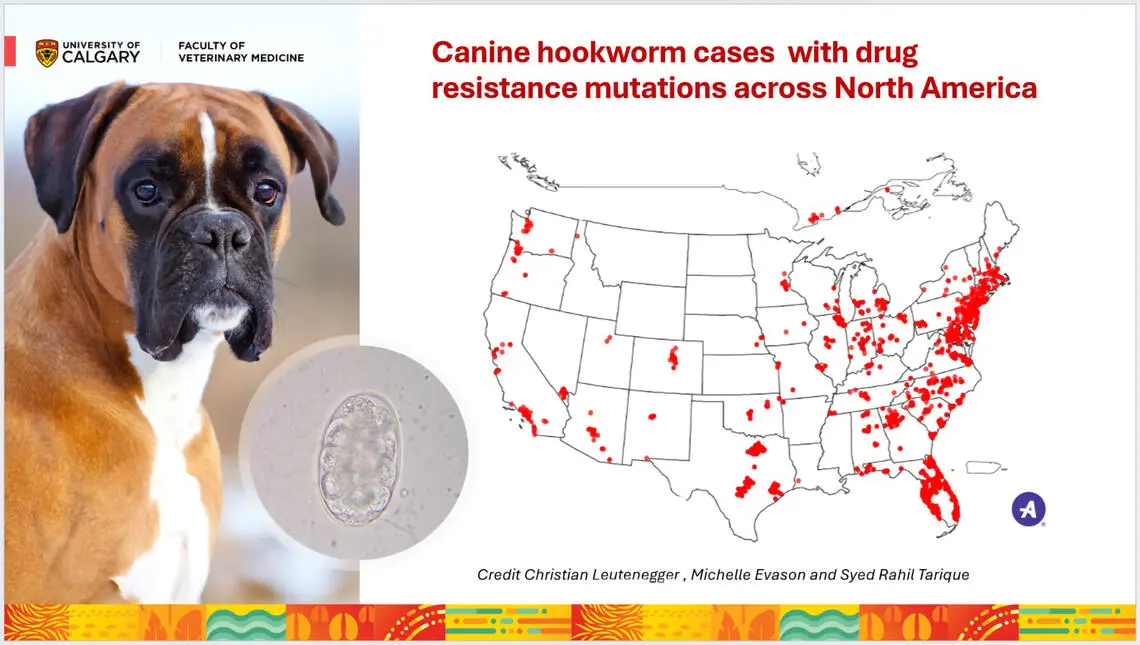
Canine hookworm cases with drug resistance mutations across North America. Photo Courtesy Christian Leutenegger, Michelle Evason and Syed Rahil Tarique
Drug-resistant parasites are a growing concern, says Gilleard.
"The more we use anti-parasitic drugs, the more we select for resistant parasites reducing the effectiveness of the treatments that we rely on," he says.
There are also growing concerns about environmental impacts.
"These compounds don't just disappear," Gilleard explains. "They can move through watersheds and ecosystems, where they may have unintended consequences impacting the biodiversity of organisms from insects to fish."
Using genomics to shift toward diagnostics guided treatments
In response, researchers and clinicians are beginning to rethink the "treat first" model. Instead, the idea is to use diagnostics to guide treatment decisions and so reduce overall drug use.
At the heart of the research program is the use of advanced genomic tools to better understand parasites and their response to drug treatments.
The team is working to identify genetic markers associated with drug resistance by analyzing parasite DNA. Using next-generation sequencing, researchers can compare susceptible and resistant strains to pinpoint mutations that signal whether a treatment is likely to work.
"If we can identify those genetic differences, we can develop diagnostic tests that tell us whether a parasite is resistant and then choose the most effective drug," says Dr. Elizabeth Redman, PhD, a postdoctoral research associate at UCVM. "Genetic markers are also powerful surveillance tools to help catch drug resistance at a much earlier stage."
From discovery to real-world impact
"Antech is committed to making molecular diagnostics accessible, affordable and practical for routine use, in order to provide veterinarians with the information they need to choose the best treatment and control options, says Dr. Christian Leutenegger, PhD, DVM, vice-president of research and development, Reference Laboratory Assay Development, at Antech.
Leutenegger led the development of KeyScreen GI Parasite PCR, a molecular diagnostic test panel that detects DNA for 20 different parasites in canine and feline fecal samples. The test has been used millions of times since its launch in 2022 and already includes some canine hookworm drug-resistance markers as a direct result of previous research and collaborations with Gilleard's group. Work is underway to make the same technology available to cattle production in the near future.
"By expanding our collaborations with the University of Calgary team, we aim to integrate further genomic discoveries into these fast and affordable diagnostic platforms, both to detect parasites and determine their resistance to specific drugs," says Leutenegger. "
Toward a more-sustainable future
Beyond improving clinical outcomes, the research has broader One Health implications impacting animal health, public health and environmental sustainability.
"Responsible drug use is an important part of veterinary clinical care, and we need to get ahead of drug resistance and not just react to it," says Dr. Michelle Evason, DVM, global firector, Veterinary Clinical Education, with Antech. "The shift from routine treatment to evidence-based control is not just beneficial, but necessary."