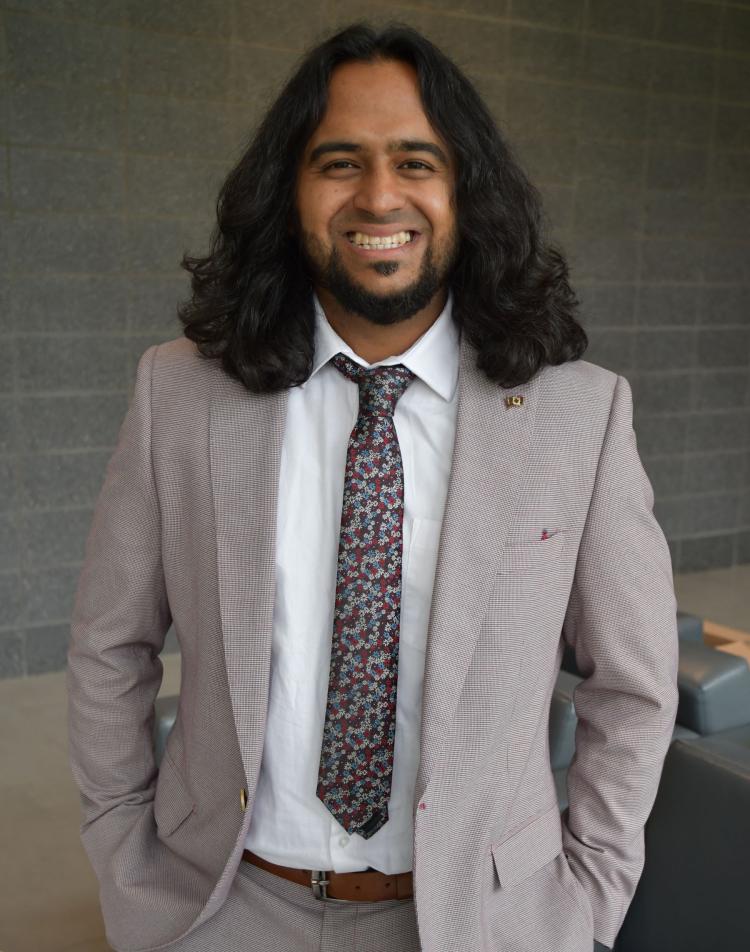
Project brainchild Dr. Mustafa Siddiqui to present findings and how they're prompting curriculum change at upcoming Big Thinking Summit in Edmonton, June 9-11
In the wake of a recent Gallup poll showing the use of AI for academic purposes skyrocketing among university students, a recent pilot project at University of Toronto (U of T) Mississauga has opened students' eyes to the benefits of a tech-free classroom.
In fact, following the exercise - an analog Back to the 90s class - 80% of students queried said they would be open to seeing technology booted from up to a quarter of classes in a semester's course. They cited fewer distractions, better in-class focus, and ability to more quickly grasp concepts in a screenless environment as some of the key reasons.
"In today's world where students rely on their technological devices and artificial intelligence (AI), the feedback was both unexpected and refreshing," said project brainchild Dr. Mustafa Siddiqui, an assistant professor at the U of T Mississauga Institute for the Study of University Pedagogy.
As a result of the positive response, a group of language and writing studies professors at U of T Mississauga are now planning to incorporate occasional tech-free classes in their curricula for the upcoming school year as part of a larger study, he said.
Siddiqui will present the findings of the pilot project at the upcoming Big Thinking Summit: Inflection Point, a national academic gathering focused on the humanities and social sciences, taking place June 9 to 11 in Edmonton.
Organized by the Federation for the Humanities and Social Sciences, the Big Thinking Summit: Inflection Point brings together scholars, policymakers, community leaders, and institutional partners to examine the urgent questions shaping Canada's future. Featuring keynote conversations, research presentations, evidence-focused sessions, and networking events, it is designed to advance the role of humanities and social sciences knowledge in public life.
At the event, Siddiqui will share how the idea for the Back to the 90s project was spurred by what he has found in recent years to be "lazier thinking" by students. "After the AI boom, I noticed that ideas were repeating, with many students choosing similar topics for assignments and writing essays in a similar fashion to the point that their creativity and uniqueness in writing style and content were vanishing," he explained.
He said he has also found students to be more distracted and less connected with their peers, with some playing games on their phones or online shopping on their laptops during class.
Introducing a tech-free class in two of his courses this past semester as a way to encourage the 40 participating students to generate ideas using human intelligence and boost their interaction with each other, Siddiqui enlisted the help of his pupils to turn back the educational clock.
With pen, paper and notebooks in hand, many students opted to wear '90s threads, as did Siddiqui. He brought in hard copies of books, handed out photocopies, and wrote on a whiteboard in place of PowerPoint presentations. Playing on the theme, items such as a Sony Discman, newspapers, analog watches, and glass coke bottles could be spotted around the room.
"The moment I started talking, I saw students taking out their paper, notebooks, pencils and pens," Siddiqui said. "It was the first time this happened in my class and I was elated."
The result? A survey completed by students from the two classes found that in the analog environment, 87% said they interacted more with peers, 83% indicated they paid closer attention to class discussions, and 70% found that handwritten notes helped them better process ideas. Almost two-thirds (63%) of students said they felt more focused without screens, while 60% said the screenless environment enabled them to better understand class material.
From the professor's point of view, Siddiqui observed that student creativity and engagement was significantly higher. Interestingly, so were student mistakes - an outcome he was pleased to see.
"When using AI, many students tend to check their responses before handing in assignments," he said. "Without technology, most students performed better, and once they corrected their work themselves, they seemed to better understand concepts and tasks," he said.
Is there a place for AI in writing and language arts courses? For Siddiqui, it's best used as a proofreading tool once an assignment is completed rather than for idea generation and writing support.
He specified that students with accessibility needs are an exception. Those in his class registered with the university's accessibility service, for example, were permitted to use their devices during this exercise.
The Big Thinking Summit: Inflection Point is sponsored by the Social Sciences and Humanities Research Council of Canada, University of Alberta, University Affairs, Alberta Post Secondary Network, Canada Foundation for Innovation, Sage Journals, Pierre Elliott Trudeau Foundation, Universities Canada and Athabasca University Faculty of Humanities and Social Sciences.
Registration is open to the public, with one-day and three-day passes available. Visit www.federationhss.ca/big-thinking-summit-2026 to register and access the program of events.
For more information

200 - 141 Laurier Avenue West
Ottawa Ontario
Canada K1P 5J3
www.federationhss.ca