Anglers have partnered with the Adult Salmon Diet Program and submit stomachs from adult Chinook and coho salmon they catch to advance scientific understanding of the role that salmon play as predators in the ocean. Credit: Steve Veloso, Island Pursuit Sport Fishing.
A partnership between University of Victoria (UVic) and Pacific Salmon Foundation (PSF) scientists and recreational anglers in British Columbia is exploring the diet of adult Chinook salmon and helping us better understand the food chain in the Salish Sea.
The Adult Salmon Diet Program, led by UVic biologist and Liber Ero Chair for Fisheries Research Francis Juanes and PSF biologist Will Duguid, is a citizen science initiative that analyzes the stomach contents of adult Chinook salmon caught by recreational anglers. Since 2017, more than 250 recreational anglers have submitted the guts of their catches and researchers have analyzed more than 7,000 salmon stomachs to date.
"Recreational anglers often have knowledge about the sea that fisheries scientists are unaware of," says Juanes. "The Adult Salmon Diet Program is a way to transform anglers' observations into scientific data that can be used by resource managers and conservationists."
Most recently, Juanes and his team, led by PhD student Wesley Greentree, used the data collected from the Adult Salmon Diet Program to dive into what Chinook salmon eat in the Salish Sea. Their findings were recently published in Fisheries Oceanography.

Wesley Greentree, UVic PhD student and Pacific Salmon Foundation Mitacs fellow, examines stomach contents from a Pacific Salmon Foundation and UVic study on juvenile salmon stomachs. Credit: Rick Hackinen, Brightfish Charters.
What do Chinook salmon eat in the Salish Sea?
By analyzing the stomach contents of salmon, Greentree was able to identify what adult Chinook salmon are eating and identify regional diet differences. He found that, year-round, Pacific herring are the most important prey species for adult Chinook salmon throughout the Salish Sea. Anchovy were often found in stomachs collected near Howe Sound and Pacific sand lance were important in Victoria and Sidney.
Greentree also found seasonal differences in diet, with Chinook salmon consuming a higher diversity of prey in the winter as compared to the summer. Crustaceans became a more important food source in the winter in Sooke, and lanternfish became more common in the stomachs of salmon in Campbell River and Victoria.
"The boundaries that we found between different fish communities align closely with oceanographic features that divide the Salish Sea," Greentree says. "For example, we suspect anchovy are taking advantage of freshwater from the Fraser and Squamish rivers flowing into the Strait of Georgia, and that strong tides near Campbell River and Victoria are pulling lanternfish closer to the surface, where salmon can eat them."
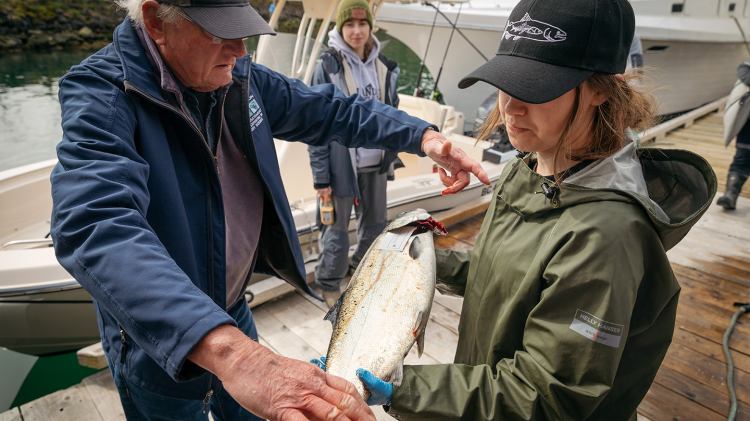
A member of the Sidney Anglers Association provides their catch to Emma Polard, former UVic research technician and current Master of Science in Marine Biological Resources student. Credit: Scotty Manufacturing Ltd.
Why Chinook salmon diet matters for the Salish Sea ecosystem
Projects like the Adult Salmon Diet Program provide critical information for fisheries scientists. Many of the fish that make up the Chinook salmon diet, such as herring, anchovy and sand lance, are also consumed by larger predators, such as whales, seals, birds and other marine mammals. These smaller fish, often called forage fish, are a key part of the marine food web in the Salish Sea, and a better understanding of their regional differences can support decisions like designating protected areas.
Greentree's findings provide a baseline for Salish Sea ecosystem health. Other researchers, including UVic graduate student Nathanael Tabert, are beginning to use data from the program to identify ecosystem shifts. Tabert is using salmon stomach contents to study how ocean food chains have changed since the 1920s. Changes to salmon diet may be an early signal of larger changes to come.
"As ocean conditions continue to shift due to climate change, it is likely that forage fish populations will also shift," says Tabert. "By continuing to collect diet data year after year, we can monitor these changes and understand how they are impacting salmon populations."
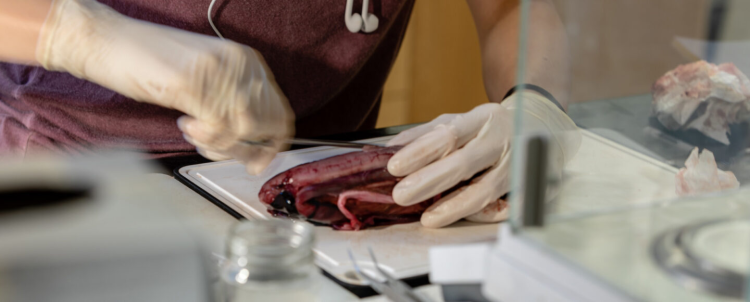
Katie Innes dissects a salmon stomach submitted by a recreational angler. Credit: RA Works Media.
How anglers are helping scientists study salmon
The Adult Salmon Diet Program was started by then-PhD student Will Duguid in 2017. Duguid had previously worked as a fishing guide in Campbell River (famously known as the salmon capital of the world), and recognized the vast amount of knowledge anglers held. He used his connections in the recreational angler community to develop the program and now, anglers can submit the stomachs and intestines of their catch to scientists through tackle shops and other drop-off locations in BC like Sechelt, Delta and Powell River. The anglers also share data such as catch date, location and salmon size.
Back in the lab, the stomach contents are identified, enumerated and weighed by scientists. Sometimes identification is easy, as the prey are in almost perfect shape. Other times, the team must sort through a pile of digested mush to find bones and other hard body parts with shapes that are unique to different types of fish, squid, crabs and other prey.
"The Adult Salmon Diet Program facilitates widespread sampling throughout the Salish Sea year-round," says Greentree. "Conventional surveys of salmon prey species can be difficult and expensive. Working with anglers allows us to more easily and inexpensively gain a comprehensive look at what salmon eat in different areas and throughout the seasons."
Anglers sampled salmon on 808 different days between April 2017 and March 2022 (the study period), representing 44 per cent of all days when salmon fishing was permitted.
"The Adult Salmon Diet Program is fascinating to me. I'm glad to help out with the research and as a long-time fishing guide it feels good to contribute to the knowledge base of the fish that have been good to me and the fishing community," says Rick Hackinen, owner of Brightfish Charters in Campbell River and long-time contributor to the study.
Anglers interested in participating in the Adult Salmon Diet Program can email uvicsalmondiet@gmail.com to receive a free sampling kit.
The Adult Salmon Diet Program is funded by the Pacific Salmon Foundation, along with contributions from Fisheries and Oceans Canada, World Wildlife Fund Canada, Comox Valley Project Watershed Society, AP Tackleworks, Island Fisherman Magazine, and Islander Precision Reels. Greentree's research was also supported by Mitacs and the Natural Sciences and Engineering Research Council (NSERC).
UVic is here for what matters including ocean research. Explore how UVic is working to support our communities.