Scientists from the University of Calgary are playing an important role in the next big mission to study the space environment.
The SMILE (Solar wind Magnetosphere Ionosphere Link Explorer) mission, jointly run by the European Space Agency and the Chinese Academy of Sciences, launches from Europe's Spaceport in French Guiana around 9:52 p.m., MT, on May 18. (Watch SMILE's launch live here.)
The 130-million-euro satellite will launch aboard a 34.8-metre-tall Vega-C rocket to an altitude of 121,000 km above the North Pole, and is expected to orbit for at least three years. It the first satellite to make extensive, detailed observations of Earth's magnetic field.
SMILE will use four science instruments to study how Earth responds to the solar wind from the sun. That will help researchers better understand space weather and its potential impacts on satellites, power grids, communications and aviation.
The mission is being supported by researchers at UCalgary, who designed and still operate a continent-wide network of ground-based cameras known as all-sky imagers (ASIs). The imagers will help connect observations made in space with those made from the ground, giving scientists a more complete picture of the Earth's interaction with the sun.
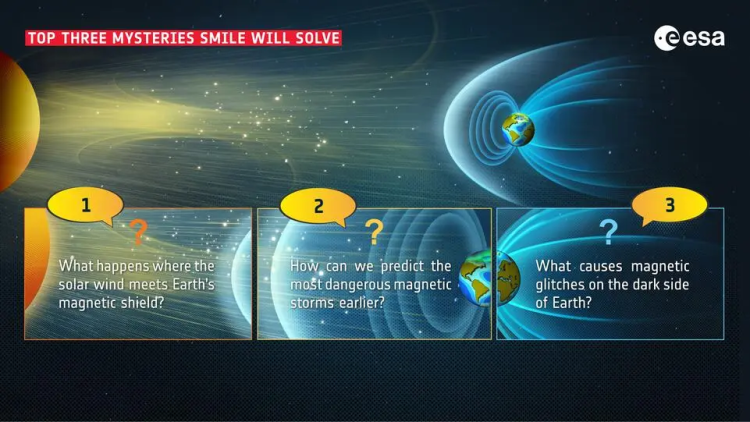
Three pop-out boxes indicate the top three questions that SMILE seeks to solve, with close-up images of the relevant part of the Sun-Earth connection. Photo Credit: European Space Agency (ESA)
"It's a big deal for us," says Dr. Eric Donovan, PhD, a professor in the Faculty of Science, who works with associate professor Dr. Emma Spanswick, BSc'02, MSc'04, PhD'09, on UCalgary's SMILE project. "We have been involved in the mission since its inception. We were part of the proposing team."
Many of the 20 ground-based cameras are in Canada's high-latitude northern regions to monitor aurora and other space-weather phenomena. They provide real-time data feeds, including a new data viewer, for researchers, as well as the public.
Because of the country's unique location near the pole, Canada plays a key role in observing space weather, which is most active at high latitudes. This also means Canada is more strongly affected by space weather events such as solar storms.
Data collected will support the mission's scientific goals and be shared with the international scientific community.
The UCalgary imagers received funding from the Canadian Space Agency.