Since joining York University in 2018, the Freud Lab - led by Faculty of Health Associate Professor Erez Freud and in collaboration with the Department of Psychology and the Centre for Vision Research - has focused on how the brain supports object recognition and interaction. Drawing on neuroimaging, neuropsychological research, developmental studies and motion-tracking technology, the group explores how people perceive the world and act within it.
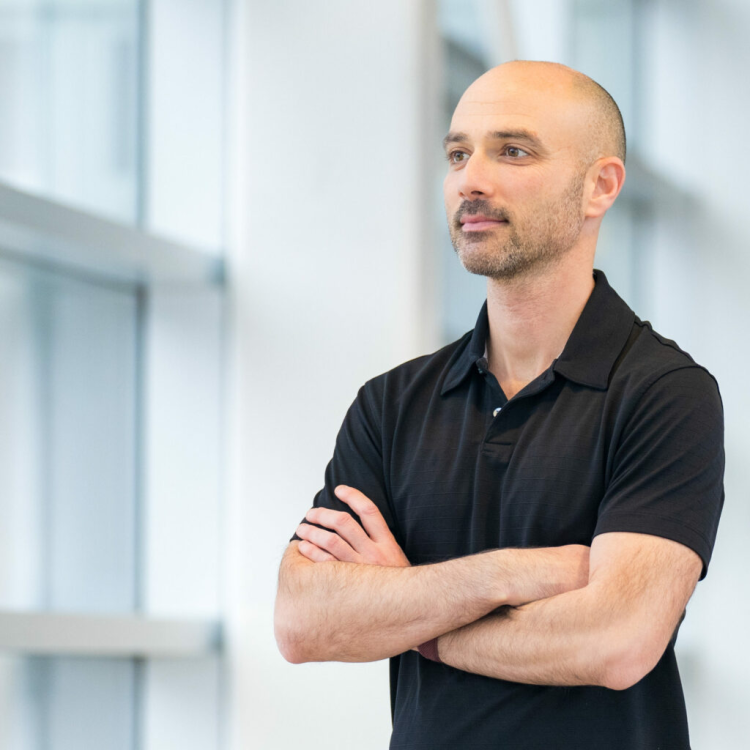
Erez Freud
In recent years, the lab has focused on autism, using movement and perception to better understand how people with autism engage with their surroundings.
Over the last six years, the Freud Lab has collaborated with the University of Haifa to collect detailed motion data from autistic participants, using motion-tracking cameras and machine-learning tools. Among the group's successes was a 2025 study that drew wide attention for showing that differences in how grasping and moving objects could be used to distinguish participants with and without autism with a high degree of accuracy.
That work now serves as a foundation for the lab's next phase as it is expanding how, where and with whom its data is collected. "The idea is to try to expand and to reach out to different educational and clinical institutions in order to help us reach more children and young adults with autism," Freud says.
Through new clinical- and community-based collaborations, the goal is to extend the lab's autism studies beyond a single context, while also increasing the number and diversity of participants involved. In doing so, it can broaden both the scope of the data and the questions it can help answer.
Among those efforts is a new collaboration with Autism Therapy & Training, a Vaughan-based clinic that works directly with children with autism and their families. It has also partnered with the Summit Center for Education, Research and Training based at Montreal's Summit School in Ville Saint-Laurent, a multidisciplinary centre serving more than 600 neurodivergent learners between the ages of five and 21.
Working in clinical and educational settings allows the Freud Lab to study autism in ways that more closely reflect everyday life. Places like Autism Therapy & Training and the Summit School are not controlled study environments, but active spaces where children learn, play and receive support as part of their daily routines.
For researchers, that means observing behaviour as it naturally unfolds in classrooms, therapy rooms and shared activities. Freud and his team are pursuing this work through the use of advanced technologies, in service of a central question that runs through the lab's efforts: why people with autism often move differently and what those differences reflect at a neural level.
Previously, much of the group's work relied on tightly controlled experiments that required participants to perform specific, constrained motions - often with tracking markers attached to their fingers. Now, the lab is turning to a tool called Athena, a marker-free motion-tracking system developed in collaboration with Jonathan Michaels, an assistant professor in the Faculty of Health.
Athena uses a synchronized array of multiple video cameras to capture motor behaviour from multiple angles at once. Those video streams are aligned in time and analyzed using machine-learning methods that identify and label different parts of the body, allowing researchers to track and quantify motion in three-dimensional space. For the Freud Lab, that makes it possible to measure how participants move - such as which hand they use, how quickly and efficiently they complete tasks and how consistent their movements are - without constraining natural behaviour.
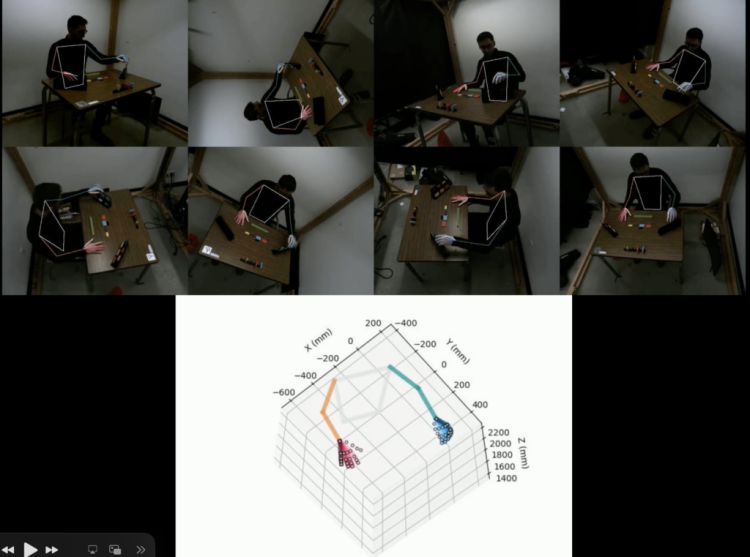
A screenshot of how Athena identifies, labels and tracks body movement.
The approach makes it well-suited for work with children with autism; it allows them to engage in familiar, low-pressure activities, like building Lego models, while the system quietly records information about how they move.
For Freud, these everyday interactions offer enhanced insights into behaviour and lead to more meaningful questions about autism. "The goal," Freud says, "is to try and understand what is different about the autistic brain and the autistic representations."
The findings also point toward a more applied objective: identifying reliable motor patterns that could be used to develop more objective tools for earlier identification. "In autism and other neurodevelopmental disorders, we know that early treatment and early intervention are crucially important," he says, noting that earlier identification can help ensure support is provided at a stage when development is more flexible and interventions may have greater impact.
For Freud, that applied focus is central to his research and reflects an ongoing concern with how scientific work might translate beyond the lab - how insights about perception, movement and the brain can ultimately help people with autism, their families and the professionals who support them.
"I see my role as a cognitive neuroscientist as fundamentally about understanding the human mind and brain and how that can meaningfully promote the well-being of a broader community," he says. "When it comes to working with individuals with autism and their families, that responsibility feels especially significant."