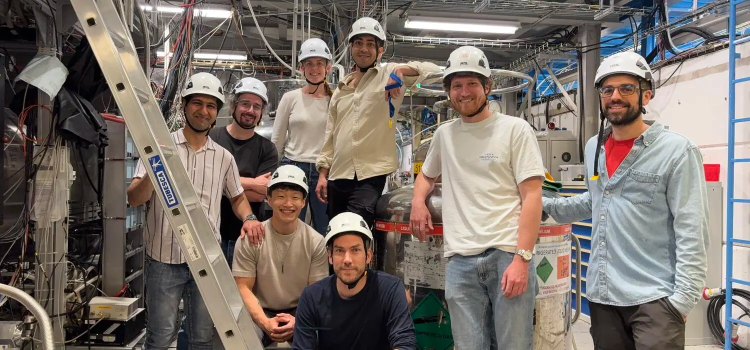
The University of Calgary research team exploring the world of hydrogen and antihydrogen. Back row, from left: Pouya Heidari, Reece Stefanyshyn, Abbygale Swadling, Filobateer Ghaly, Sean Wilson, and Alberto Jesus Uribe Jimenez. Front row: Jay Suh, left, and Timothy Friesen. Photo Courtesy: Jay Suh
The team, led by Dr. Timothy Friesen, an associate professor of physics and astronomy in the Faculty of Science, reached their conclusion by measuring and comparing the spectrum of hydrogen to its antimatter counterpart antihydrogen.
At the precision achieved in this new measurement, Friesen and the international group found that the symmetry between hydrogen and antihydrogen predicted by current theory holds. A different outcome would've broken how we see and understand the universe, he explains.
"If we found even a miniscule difference, it would break our current understanding of physics and it's something we need to investigate," says Friesen, MSc'07, PhD'14.
"Fairly core in our theoretical models is the symmetry between matter and antimatter, and if that symmetry is broken there would be a huge impact on how we construct those theories and how we think about our absolute laws in physics."
According to the laws of physics, matter and antimatter should mirror each other, the only difference being their charge. However, when matter and antimatter meet, they destroy each other. This leads to one of the great mysteries of the universe, because after the Big Bang everything would have been annihilated if there were equal amounts of matter and antimatter. Since the universe is made almost entirely of matter, there must be a tiny hidden difference between the two.
The measurements were performed by ALPHA, an international collaboration of approximately 60 scientists operating at the CERN laboratory near Geneva, Switzerland. It includes Friesen and Dr. Robert Thompson, PhD, a physics professor and UCalgary's deputy vice-president (research).
In this measurement, the scientists were looking at a property called the hyperfine splitting, a small energy difference that arises because the antiproton and antielectron (positron) behave like tiny interacting magnets. In matter hydrogen, the size of the splitting is known extremely well and so measuring it in antihydrogen is an attractive way to search for any potential difference between matter and antimatter.
"We know the hydrogen atom extremely well, so we're looking at antihydrogen as precisely as we can in search of any potential differences," says Friesen.
This is the second time researchers have measured this property of antihydrogen. The first time was in 2017, and this time the testing was 100 times better.
It marks a step towards being able to test antihydrogen to the same level of precision that hydrogen is currently evaluated at.
"This is a big step towards potentially understanding the mystery," says Friesen.
Antihydrogen is very difficult to produce and contain, so the researchers had to build a containment system that created a vacuum similar to outer space and uses strong superconducting magnets to ensure the antimatter atoms do not contact the walls of the container.
The next steps will be to continue refining the precision of the testing. Friesen says the next major milestone will be measuring properties of antihydrogen at the same level of precision as hydrogen.
"At that point, we'll have to start improving the measurement of both hydrogen and antihydrogen," he says.
The results of this new measurement are published this week in the journal Nature.