The Canadian Coast Guard is exploring a new generation of clean energy technologies to displace its existing diesel generators with support from three University of Victoria (UVic)-based research institutes as part of a new project announced last month.
The project is the first of a series of "innovation challenges" coming out of the BC Marine Energy and Decarbonzation Hub, a collaboration between Accelerating Community Energy Transformation (ACET), Pacific Regional Institute for Marine Energy Discovery (PRIMED) and the Institute for Integrated Energy Systems (IESVic) with the Center for Ocean Applied Sustainable Technologies (COAST).
In April, the group announced details of four companies that will receive funding through the Innovate BC Integrated Marketplace program, along with lab space and technical support from ACET researchers, to develop and test tailored solutions that advance the Coast Guard's goal to electrify its operations in remote coastal areas of B.C.
"Through this [innovation] challenge, we're tapping into BC's innovation and technology sector and cutting-edge solutions developed right here at home," states Ravi Kahlon, Minister of Jobs and Economic Growth.
Although it's still early days, this signals a sea change in the province's marine renewable energy sector, which has long relied on expertise, equipment and project experience imported from the US, UK and Europe.
"As demand for renewable energy grows and people look for homegrown solutions from local experts they can trust, UVic has three decades of marine energy expertise to draw from," says Lisa Kalynchuk, the University's vice president of research and innovation. "Through the BC Marine Energy and Decarbonization Hub, we're proud to contribute solutions that reduce diesel dependence, strengthen our ocean economy and empower coastal industries, operators and communities across the province."
Decades in the making
PRIMED co-director Brad Buckham stands with a wave-energy monitoring buoy in Hot Spring Cove, near Ucluelet. Credit: PRIMED.
Since the early 2000s, UVic researchers have worked closely with provincial and regional partners to advance marine renewable energy in B.C.
A leading figure behind this push is Brad Buckham, professor and chair of UVic's department of mechanical engineering, whose early work focused on understanding wave-energy potential off Vancouver Island through the West Coast Wave Initiative (WCWI).
The initiative brought together researchers, industry and government partners to gather some of the first long-term wave and tidal resource data on Canada's west coast.
"We thought of the broad gaps of knowledge foundations that people need like resource assessments, wave energy modeling, coastal engineering work and deploying wave monitoring buoys," Buckham recalls. "While working with agencies like Natural Resources Canada, Western Economic Development and BC Ministry of Energy and Climate Solutions, we began building trust by showing we can do good work and mobilize knowledge in a way that people can use it."
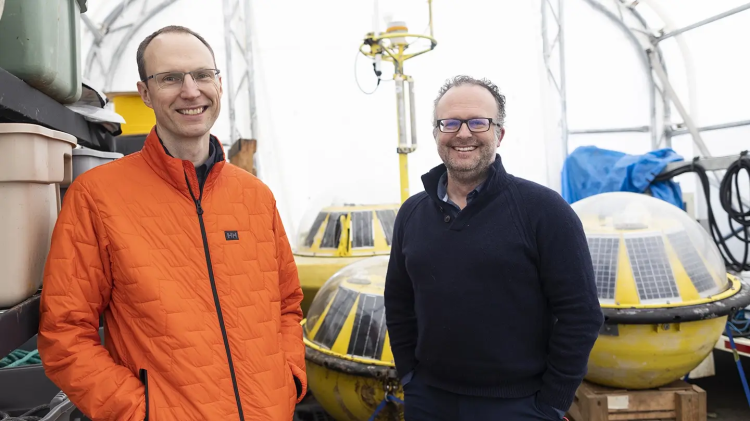
PRIMED co-founders Curran Crawford (left) and Brad Buckham (right). Credit: PRIMED.
More than a decade and many projects later, Buckham found himself in good company at IESVic with another colleague from mechanical engineering, professor Curran Crawford, who specialized in tidal and wind energy systems and had been working as a consultant on rotor design and optimization.
The two began collaborating on offshore wind energy projects and PRIMED was born shortly after, with Buckham and Crawford co-directing.
"PRIMED is a team of researchers, engineers and facilitators that sits between the communities trying to adopt marine energy technology, the regulators overseeing the space that technology works in, and the technology providers that are trying to make those devices work better." Buckham explains. "This is a unique approach within Canada for ocean renewable energy. Our work gives communities a real opportunity to meaningfully engage in the transformation of their energy systems."
The team's first project was with the Hesquiaht First Nation, analyzing how a small hydroelectric plant could work within the community's existing energy system and whether the addition of tidal power could help end their reliance on diesel fuel.
Their research lab has since grown into a team of 13 full-time employees with 15 marine resource monitoring buoys currently collecting data along the west coast and a slate of projects from the Quatsino Narrows to Haida Gwaii on the go.
Now an independent division of ACET specializing in marine renewable energy, PRIMED's recent milestones include playing a formative role in the creation of Canada's Marine Energy Atlas, and receiving a $1 million grant from TD Bank Group to support the Mowachaht/Muchalaht First Nation's effort to re-occupy the ancestral village site from which it was displaced by harnessing the power of waves.
"In the early years for Brad and me, our focus was more of a pure engineering optimization approach that was curiosity-driven. We still get excited talking about the fundamental physics modeling and design stuff," Crawford shares. "But for both of us, working with coastal communities was a gateway to a whole realm of learning about what this technology can do for people by integrating it into existing energy systems."
This whole-system approach is something the two co-founders acknowledge came from their long-standing membership in IESVic, which first housed WCWI and then PRIMED. The interdisciplinary research centre was also foundational for ACET, created in 2023.
"You have to understand the ocean, mechanical systems, electrical controls, grid integration," says Bryson Robertson, IESVic's new director. "But you also have to understand communities, policy and perception. That's systems thinking."
Primed for growth
The role of marine renewable energy in helping Canada reach its net-zero goals is primed for significant growth, according to Crawford.
"Different technologies will play a different role at different scales and in different places, but there are many unharnessed terawatts of power along Canadian coastlines," he says. "Assuming it's done correctly in collaboration with communities, I would expect to see Canada deploying larger-scale wave, tidal and offshore wind platforms over the next five to 10 years."
To get there, much work needs to be done to bring these nascent technologies to market, integrate them into existing power grids and demonstrate their value for and harmony with communities if implemented properly, which are key priorities for the BC Marine Energy and Decarbonization Hub.
"The projects the hub supports aren't just about eliminating diesel use they're about materializing benefits for people: economic development, community resilience, environmental sustainability," says Buckham.
"In this regard, the hub isn't as focused on changing habits as it is on creating new opportunities. It's a strong example of how university research and innovation translates into jobs and companies that make a difference for communities."
Research undertaken through the BC Marine Energy and Decarbonization Hub is funded in part by the Canada First Research Excellence Fund, as part of the University of Victoria-led Accelerating Community Energy Transformation (ACET) Initiative.