For more than a decade, Memorial University's 6for6 program has empowered rural physicians in Newfoundland and Labrador to lead research rooted in their communities' needs.
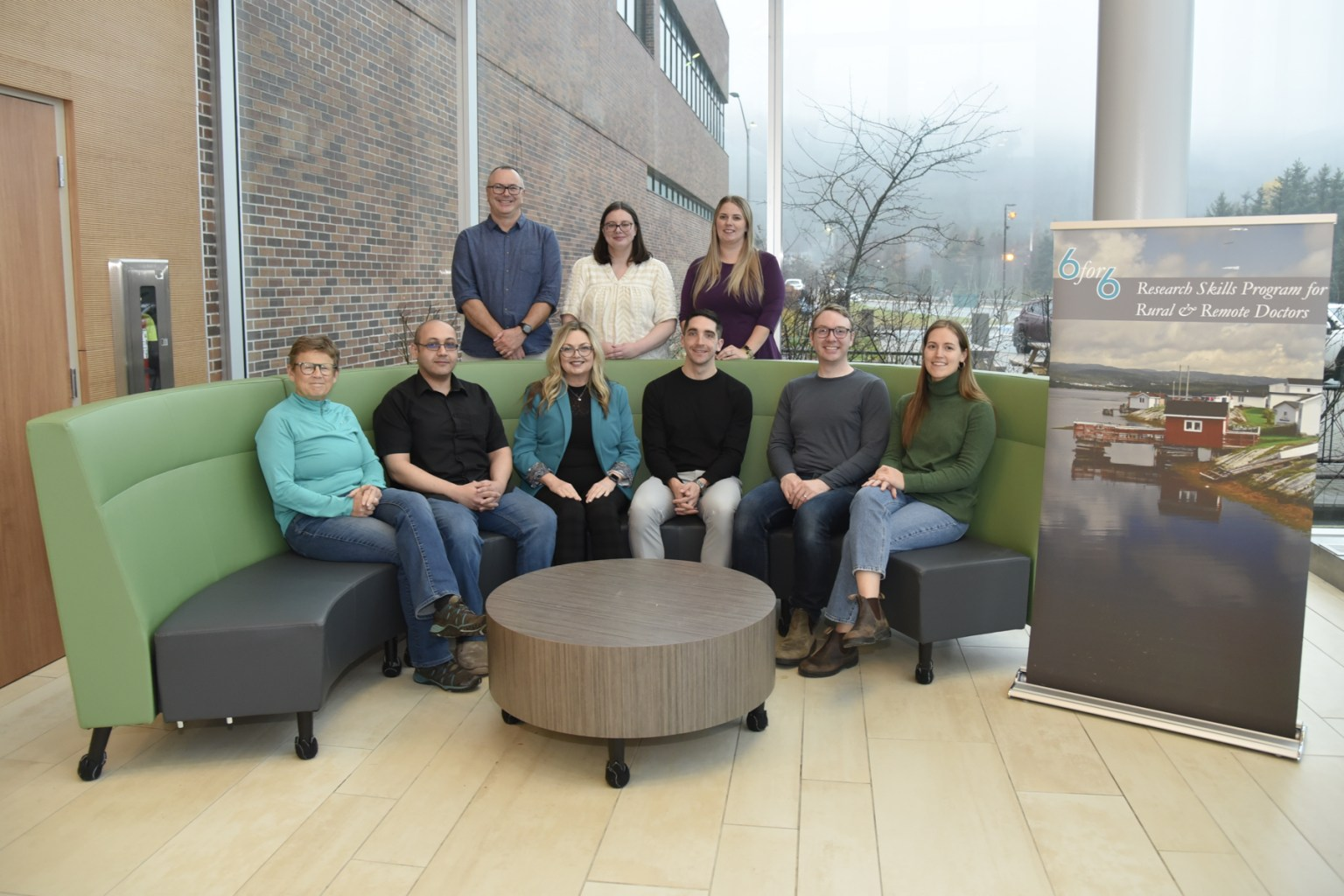
From left, back row, are Dr. David Schmidt, Emily Hussey and Kendra Devine. From left, bottom row, are Dr. Cheri Bethune, Dr. Elhamy Samak, Dr. Wendy Graham, Dr. Robbie McCarthy, Dr. Cody O'Brien, and Dr. Amy Powell. Not pictured: Dr. Shabnam Asghari, Dr. Cian O'Morain and Dr. Lorena Power. Photo: Submitted
It began as an experiment to help faculty members develop their skills. It has since grown into a nationally recognized model.
As its name indicates, 6for6 provides six rural and remote physicians with access to a research skills development program.
"Faculty development programs often struggle with getting faculty to come in and learn skills beyond their clinical skills," said Dr. Cheri Bethune, one of the program's co-principal investigators and a professor in the Faculty of Medicine.
Supporting rural doctors
When faculty development sessions on topics such as writing for publication received little uptake, the team began looking more closely at what faculty, especially rural physicians, wanted most.
Dr. Wendy Graham, a rural physician, points out that many faculty development offerings were designed for campus-based faculty and did not reach distributed clinicians, helping to shift the focus toward supporting rural physicians in research.
"They all had interesting research ideas, because they are very close to the community in rural medicine," said Dr. Bethune. "They had questions they needed answered and were interested in gaining the skills to do it. That was the birth of 6for6."
Early support was not guaranteed, the team notes, as rural research is sometimes undervalued and the idea initially faced questions about whether dedicated investment would have a meaningful impact.
The dean of Medicine at the time, however, strongly supported rural health research and provided pilot funding for the team to develop and test the model. The early investment helped establish 6for6, which is now supported through Faculty of Medicine's operational funding.
Responding to local needs
With pilot support in place, the group researched similar programs and selected an initial group of six rural physicians in 2014.
Over the next year, they would spend six weekends together refining their research questions, building proposals and developing the skills to carry it forward. Since then, the program, which ran annually for years, has switched to a biennial offering to allow for longer support for participants between cohorts.
"Physicians come to us with an idea grounded in their community's needs." Dr. Shabnam Asghari
Dr. Shabnam Asghari is the director of the Centre for Rural Health Studies, a Faculty of Medicine unit that conducts research involving rural health care services in Canada. She is also a professor in the faculty and a co-principal investigator for 6for6 and the principal investigator for Rural 360.
Rural360 builds on this work by supporting rural health improvement and research ideas that rural physicians, researchers, learners and communities bring to the conversation.
It helps teams develop and advance projects that respond to local needs, from research and implementation to community-led interventions.
International Grenfell Association funding helped establish the initiative and to support work in northern Newfoundland and coastal Labrador. It has since expanded through additional partnerships.
"Physicians come to us with an idea grounded in their community's needs," said Dr. Asghari. "We help them turn it into a researchable question and a fully developed proposal, and then support them in bringing it to life, whether through research, an intervention or implementation."
She notes that research produced in urban academic settings does not always translate well to rural environments.
"Through this program, rural physicians generate evidence that is locally grounded and directly relevant to the people they serve," she said.
The program's research projects have been diverse: from group medical visits for Indigenous patients with diabetes and their families in Labrador to community-driven investigations into arsenic in well water in Notre Dame Bay.
"All but one of our 45 rural physicians have remained in rural practice." Dr. Cheri Bethune
6for6 and Rural360 also provide an opportunity for Memorial learners to be matched with rural physicians to assist them with their projects or develop their own ideas and learn more about rural research.
This, in turn, creates a new generation of rural researchers with an understanding of rural health.
Antidote to burnout
Anna Walsh, a graduate student in the Faculty of Medicine, became involved with 6for6 during her undergraduate studies.
What started as volunteer work evolved into summer work terms, internships and publications.
"I worked on a number of projects with different physicians, everything from licking envelopes for mail-in surveys to doing methodology and research design," she said. "I'm in my PhD now, but it was cool to be on my own learning journey with research, but also alongside and supporting someone else who was on their own journey."
Port-aux-Basques physician Dr. Wendy Graham, who is also a 6for6 co-principal investigator and a professor in the Faculty of Medicine, says the program gives rural doctors a voice for their communities.
"As a rural doctor and as an academic, I can very much relate to participants in the program," she said. "I think over the years, some people have not gone into family medicine because they are also interested in research and think it's one or the other."
The 6for6 program allows physicians to do both.
"We're not trying to take physicians away from rural communities and attract them to the city or university," said Dr. Bethune. "We really feel there's a very important knock-on effect of this program, offering almost an antidote to burnout during a very difficult time for rural practice and rural communities. All but one of our 45 rural physicians have remained in rural practice."
For more information

230 Elizabeth Avenue
St. John's Newfoundland
Canada A1C 5S7
www.mun.ca