From the campus of the University of Saskatchewan (USask) to the battlefields of Afghanistan, Chief Evan Taypotat brought a lifetime of lessons learned to his role of serving as leader of Kahkewistahaw First Nation.
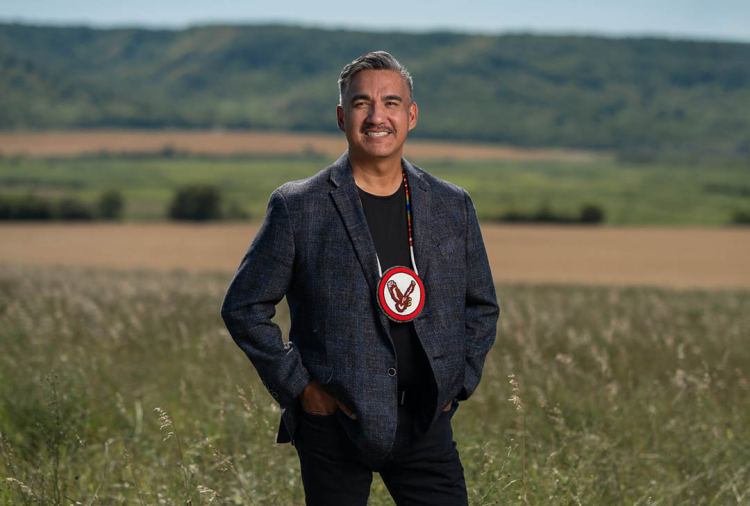
University of Saskatchewan College of Education alumnus Evan Taypotat went on to serve as both principal of the community school and as chief of Kahkewistahaw First Nation. (Photo: Submitted)
Born in a snowstorm in January of 1979 to his teenaged mother Iris, Taypotat was raised by his aunt Beatrice and uncle Denton George of Ochapowace First Nation, who instilled in him the values and work ethic and sense of service that drives him to this day.
"They provided structure in my life where some young men and some young women from my First Nation at the time didn't have structure," he said. "And the outcome for me was very good. Denton taught me all of the things that a chief does, so I owe a lot to my late uncle Denton. He showed me the way, he got me involved in sports, he paid for my fees and bought my skates and because of it, I came out the other side on the positive end. Whereas some of the people I grew up with came out on the negative side and are either incarcerated or have passed on to the spirit world."
Like many Prairie teenagers, Taypotat spent a lot of formative years at the rink, from minor hockey right up to the junior ranks. At that point, he fulfilled the promise he made to his mother to attend university.
"It was her rule during my junior hockey days, she said when you turn 20, I want you to apply for university somewhere," he said. "So when I turned 20, I applied to four of them; University of Calgary, University of Alberta, University of Regina, and University of Saskatchewan. And U of S was the first one to accept me, so that made my decision easy."
The university quickly became home for Taypotat, who became a regular at Huskie games and at social engagements while developing a love of learning and a passion for teaching in the Indian Teacher Education Program (ITEP).
"The University of Saskatchewan in the early 2000s was just finding its way in terms of Indigenous recognition, but we had the ITEP program, so for a young guy like myself coming from a First Nation, being in a classroom with fellow First Nation people made me feel more comfortable on campus," he said. "It's a place where young people find their way, and for me, having friends who were Indigenous and making friends who were not Indigenous through the various classes, the campus felt at home for me. So the University of Saskatchewan was very good for me."
After graduating from USask with a Bachelor of Education degree in 2005, Taypotat quickly moved into another classroom, this time as a teacher for two years at Chief Kahkewistahaw Community School in southeastern Saskatchewan. But he also felt a call to serve after placing top of his class when he was a teenager in the Bold Eagle program, a Canadian Armed Forces summer training initiative for Indigenous youth.
"The army was always in the back of my mind, and in 2007 after two years of teaching, my mother and I went for a walk in the spring and I said I was thinking of joining the army," Taypotat said. "And my mom said, Well son, you have no kids, you have no partner, no fiancée, no wife: go now if you are ever going to go.' So I applied literally that day When I went to the recruiting office, I said what is the toughest job you have? And they said because you have a university degree, that would make the infantry officer program a good choice. So I said let's do that."
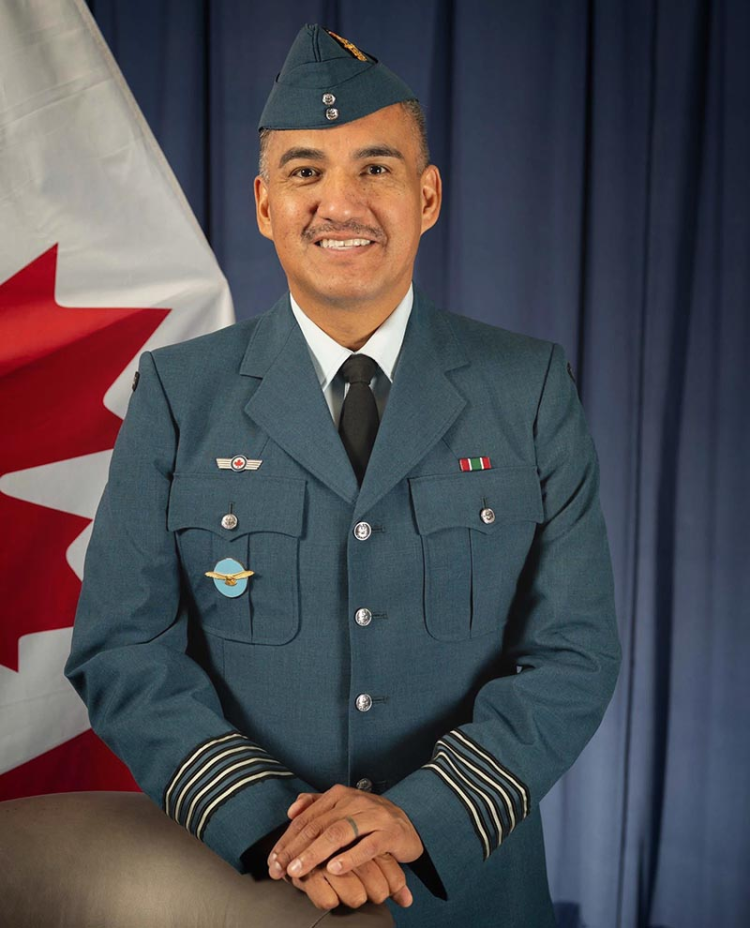
Captain Evan Taypotat served five years with the Canadian Armed Forces. (Photo: Submitted)
Taypotat underwent intensive officer training as he joined the Princess Patricia's Canadian Light Infantry, before deploying to Afghanistan in 2011 during Canada's 13-year mission from 2001 to 2014, in which 40,000 soldiers served and 165 Canadians were killed, and more than 2,000 injured and wounded.
"First and foremost I am a proud First Nations man and I understand that Canada hasn't always been nice to my people, but I still took up arms and put myself in harms' way for my country," said Taypotat, one of six living military veterans on the Kahkewistahaw First Nation. "And when you go into the military and you find yourself in a trench with a guy like Colin from Nova Scotia, who ends up becoming one of your really good friends, you realize that we as Canadians are not all that different after all, aside from our skin colour and maybe our religious beliefs. Canadians are Canadians."
Taypotat spent five years in the Canadian Armed Forces, learning battle-tested leadership lessons and experiences that have helped shape his leadership style.
"You realize the magnitude of the responsibility of being an infantry officer because you are a commander and you are leading men and women in battle and when the bullets start flying it's your job to make the plan and lead," he said. "We did all of our training scenarios, so when we got over there we were a well-oiled machine and everybody did their job very well. Having done that tour of duty in 2011, I certainly grew a respect for what we have in Canada. So Afghanistan was a really good learning experience for me and I took those lessons home to my people."
One of the most important lessons was his perspective on service and sacrifice, and his personal relationship with Corporal Brock Blaszczyk who was severely injured by an improvised explosive device (IED) blast in Afghanistan in 2010 that took his left leg and almost cost him his life, but couldn't kill his spirit. Taypotat brought that story home to youth in his 2015 Think Indigenous presentation at USask.
"I brought him on stage and the message was, You think you are having a bad day? This guy had a bad day,'" Taypotat said. "He barely survived, but here he is with a smile on his face and still enjoying life. Today Corporal Brock is our brother, and those are some of the things that you take with you when you are done (in the military)."
After five years of service in the Canadian Armed Forces, Taypotat retired at the rank of captain on August 24, 2012, five years to the day that he had joining the military. He returned home to serve his First Nation, first as principal of Chief Kahkewistahaw Community School and now for the past decade as Chief of Kahkewistahaw First Nation.
"In 2012 I was at a crossroads in my life after Afghanistan, and I say that with respect to all those we lost over there and those who came home with injuries, both physical and mental," Taypotat said. "I had been following things back home and our school had become a place that wasn't safe for students or staff any more. The principal was stepping aside and there was no one lined up to be the principal, so I reached out to the chief at the time and said I was interested in coming home, if the job was available. So I put in my release from the army and I literally drove home that day and started as the principal the next, and the rest is history."
Among the projects Taypotat helped advance was a Memorandum of Understanding signed by USask's College of Education and ITEP to bring the Bachelor of Education curriculum to Kahkewistahaw First Nation. A 2016 CBC Saskatchewan Future 40 winner, Taypotat has also become a lifelong learner, earning his Master of Education Administration in 2018 while serving as principal, as well as completing Harvard Business School certificates in 2019 and 2023, and his Master of Business Administration (MBA) through Simon Fraser University in 2025 while serving as Chief.
The courses helped him advance development on Kahkewistahaw First Nation and create a Saskatchewan success story, and his dedication to lifelong learning is also a tribute to the trials and tribulations of all those who came before him.
"Our Elders sacrificed so much for us during the real difficult times of the '60s, '70s, '80s to give people like myself the opportunity to be in these educational positions," said Taypotat, who also serves as the honorary colonel of the Moose Jaw-based Canadian Forces Snowbirds demonstration squadron. "It would be doing an injustice if I didn't take these opportunities afforded to me through their efforts, because our Elders went through tough times as Canadians You realize you have to better yourself for your First Nation and those courses made me a better leader in a lot of ways, from project management to negotiations to business."
Now serving as Chief since 2017, Taypotat also enjoys the opportunity to work with his mother Iris, who is one of the counsellors on the First Nation.
"It is really neat going to work with your mother every day," he said. "In the political field it can be tough at times, but even though we disagree on some things, we remind ourselves that we are mother and son."
Taypotat has also embraced parenthood, helping raise his daughter Beatrice and his stepsons Cooper and Tate with his wife Megaen. With 36 per cent of the members of his First Nation aged 18 and under, Taypotat knows the future is in the hands of the youth of the First Nation, something that guides all of the decisions the chief and the council make.
"When I sit back and make decisions guided by the council, I always ask myself, Is this something good for Bea's future and for the future of any child from our First Nation?' Youth are definitely at the forefront of our future and you have to invest where you see the future and we see our future in our youth," he said. "So everything we do is based upon ensuring the table is set for them to succeed."
For that to happen, Taypotat said post-secondary institutions like USask need to continue the progress that has been achieved through Indigenous initiatives at the university.
"I see a lot of these academic institutions creating space for First Nations people and that is really important to us," he said. "But at the same time, as a guy who has been there and done it, we have to continue that high standard for our people and challenge them in a respectful way. So it is important to keep creating that space because Western academia wasn't always designed for Indigenous people. We were never at the forefront of anyone's thoughts, but now that we are creating those spaces, it's important to keep moving that momentum forward."
For more information

105 Administration Place
Saskatoon Saskatchewan
Canada S7N 5A2
www.usask.ca