

A web of partnerships building good energy in the upper Skeena region of BC is a feature of the local ecosystem, not a bug. (Though surely the insects contribute, too.)
Community-centred energy efforts in the region thrive on trust-based, reciprocal relationships that are specific to the place, time, resources and problems at hand.
Enter the Community Energy Champion Mentorship program a collaboration between Skeena Watershed Conversation Coalition-based Skeena Energy Solutions and the University of Victoria (UVic)-led Accelerating Community Energy Transformation (ACET) Power for People project stage right.
"This mentorship program is about building local capacity to grow and further sustainable energy-related initiatives in the Upper Skeena region," explains Ari Orrantia, the program's first mentee. "One of the main goals is to build more local collaboration and cohesion between communities towards more of a shared vision for what the energy future of this place can look like."
Conceived by Skeena Energy Solutions program director Derek Ingram and now co-directed with Power for People co-lead and University of Northern British Columbia Associate Professor Sinead Earley, the mentorship is the first project to emerge from the northern regional energy dialogues, which Sinead led with UVic researchers Tamara Krawchenko and Kara Shaw in 2025.
"We heard from people in the upper Skeena region that sustaining community-oriented energy leadership is a major challenge," Sinead explains. "Derek suggested that we use this mentorship he'd envisioned as a pilot to support that leadership and create tools that can be shared with other northern communities that are struggling with similar challenges."
And the Community Energy Champion Mentorship program was born.
Making the right connections
Today Ari is hard at work in Gitanmaax learning the ins and outs of energy efficiency audits from Richard Joseph, an energy advisor from the neighbouring Wet'suwet'en Nation community of Hagwilget that has been hired by the Gitanmaax First Nation to assess their community's housing through the Partners in Indigenous Energy Efficiency and Resilience (PIEER) program.
The mentee sets up a blower door test, which tells him and Richard how many times per hour the house completely replenishes its air. An energy efficient home measures 3 ACH50, which means the house's air has leaked out and been replaced only three times per hour during the test. This home measures 11 ACH50.
"I've done a couple of those tests with Richard, which has helped me get a better sense of some of the ways that homes are lacking in energy efficiency and how they could be improved," Ari says. "It's a completely different level of understanding when you get to see something versus when you're only told about it. You get a much more intimate understanding of what's going on."
The opportunity to learn from Richard came from a connection with Derek, with whom Richard worked on a community energy and emissions plan for Sik-E-Dakh several years ago. For Richard, this was also an opportunity for some help in the field.
"I had Ari measure the houses, measure the windows, set up the blower door tests, measure the insulation," he explains. "He was my left-hand guy, keeping the process moving."
About one month prior, Richard also brought Ari to a presentation on home energy retrofits for Tl'azt'en First Nation members taking a carpentry course through the Energy Efficiency Mentorship program, offered by the Fraser Basin Council.
"After the presentation, I got to hear some of the housing challenges people experience there on reserve, and the barriers to fixing those problems," Ari shares. "That's part of why the carpentry program existed so they could have skills locally to fix houses and they're not just waiting on contractors to come and do it. They now have the ability to do it themselves."
Sinead adds that this is exactly the type of education that she and Derek wanted Ari to receive when they designed the mentorship's curriculum.
"We wanted the mentee to get those hands-on, technical skills and spend time with the people working on these small, localized projects," she says. "It's a different way of thinking of Community Energy 101.'"
Next Ari will visit partners in Witset, Kispiox (Anspayaxw), Sik-E-Dakh and Wilp Luutkuziiwus in preparation for updates to the Skeena Energy Solutions 2023 Upper Skeena regional energy plan a clear-eyed assessment of participating community energy use, greenhouse gas emissions, potential efficiency upgrades and clean energy opportunities that aims to advance actions and goals related to sustainability, affordability and energy security.
For Ari, this collection of experiences and the relationships that come from them will be invaluable.
"A big thing I'm learning is how all these different communities relate to each other and how these energy systems interconnect," he shares. "We try to do work that's guided by local values and that addresses local problems, so those conversations that develop an understanding of local values, histories and issues really are at the centre of what we're trying to do."
Learning from local leaders
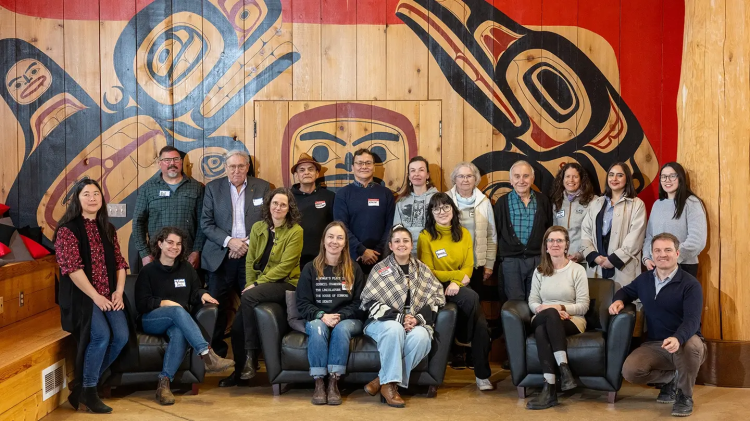
A group photo from the regional dialogue in Terrace, BC, on March 10, 2025. Derek Ingram stands on the upper left in the top row; Sinead Earley sits below, second from the right. Credit: Aaron Whitfield, Red Bike Media.
When Derek participated in one of the 14 northern regional energy dialogues, which convened communities and First Nations across northern British Columbia to start conversations about local interests, needs and gaps in support for energy innovation, he articulated the complexity of the challenges facing the region.
"There's expensive power, lack of security because of disruptions in the supply chain, black and brown outs all the time. But one of the bigger problems is that people live in aged-out, really poorly built homes. And what do you do with that? You're not fixing the problem if you get cheaper power or renewable energy in if you still have poor homes," he explains.
Richard points out that this is and has been a major problem for First Nations in the Skeena watershed for decades.
"Houses weren't built that well back in those days. My dad was a chief in our band and I remember him saying the tradespeople would say close enough for an Indian house.' We just had to suck it up and accept that," he recalls. "So, the houses weren't built well and this is the result of it. No insulation around windows, poor insulation in the attic. The attitude was just be happy we're here to do the work.'"
As extreme weather events grow over time, so too does the burden of this historical injustice for the Nations, which inherit all the new problems that come with the old houses. This puts their communities increasingly at risk, motivating a growing wave of interest in energy efficiency and resiliency projects.
"A lot of people on the lower mainland succumbed to the heat dome event [in 2021]. So, the bands see that and see the impact on their communities," Richard says. "When you think in those terms, the health and wellness of having a heat pump installed is a pretty big driver for getting them on board with the process."
Programs that support energy efficiency assessments, upgrades and retrofits do exist, though some unwittingly create more barriers for the applicants: eligibility requirements for installation professionals that squeeze out local tradespeople, unnecessarily complicated fine print that sows confusion and complicates the process, and itemized spending limits that leave bands to foot the other half of prohibitively expensive bills.
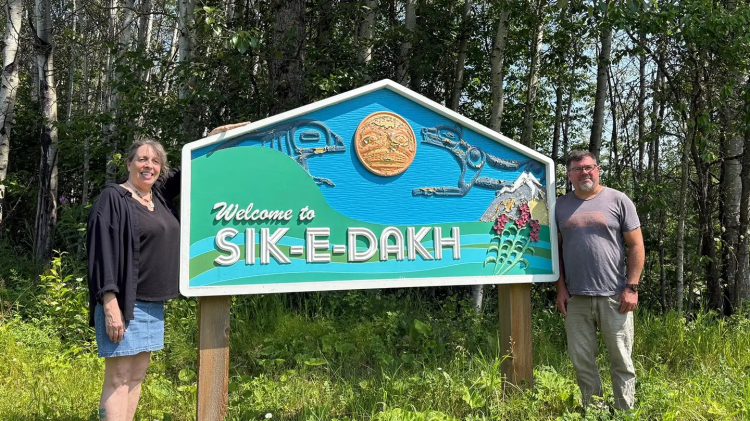
Velma Sutherland (left) stands for a rare photo with Derek Ingram (left). Photo submitted.
Still, progress is being made. In Sik-E-Dakh, the band has already installed cold climate heat pumps in 60 per cent of their houses, equipped 20 per cent with solar and battery backup systems, upgraded an average of 10 houses per year with energy efficiency retrofits, and introduced requirements for all new homes and band buildings to meet or exceed BC Energy Step Code Level 3 standards, which ensure high energy efficiency and performance.
"As energy costs continue to rise, power outages become more frequent and employment opportunities remain limited, the need to strengthen local energy resilience has become increasingly clear," says Velma Sutherland, the Sik-E-Dakh band administrator. "Rather than viewing these challenges as barriers, the community has embraced them as an opportunity to build a stronger, more self-reliant future for generations to come."
Across the upper Skeena, leaders like Velma who turns community ambition into action and Richard who advocates for more accessible support programs, educates others on best practices, and makes time to pass on expertise to the next generation are making an impact.
So, who better to learn from for an emerging community energy champion like Ari?
Guided by principle
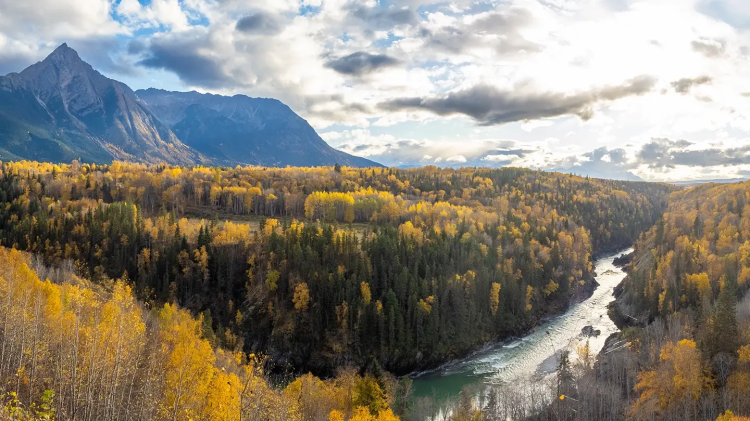
The Wedzin Kwah, also known as Bulkley River-a major tributary of the Skeena River. Credit: Walter Joseph.
The first time Sinead and Derek sat down to discuss the mentorship curriculum, they started by writing out the principles and values they wanted the mentee to follow.
"We wanted that to be the first thing that the mentee saw when they started. There's this level of integrity we want to uphold in terms of how we do research and how we work with the communities that we're working in and for," Sinead explains.
One overarching principle they embedded in the mentorship design is the Gitxsan philosophy of Gwalx Yee'insxw, a Gitxsanimx concept translated as, "We have received a full basket, and it is our responsibility to pass a full basket on." These teachings were gifted to the Skeena Watershed Conservation Coalition by Gitxsan Hereditary Chiefs.
In this spirit, Ari always contributes while he learns. For his capstone project, what he learns will also be translated into a free "energy champion handbook" for others to follow and adapt according to their own place, time, resources and problems at hand.
"In so many small communities you have leaders that have been trying to move the mark on localized energy systems, all confronted with very a similar challenge: they can't do it alone," Sinead says. "The intention of the handbook is to increase that people-power and formalize this leadership capacity to throw more support towards small renewable energy production."
One of these leaders, she notes, is Derek, who has championed community-centred energy solutions in the watershed for years with minimal resources and a deep spirit of reciprocity.
With Ari, Sinead, Velma, Richard and many others, he shares hard-earned knowledge and gains support for his mission to build a shared vision of energy security, affordability and sustainability among the communities of the upper Skeena.
"When I started working in this region in 2008, there was a lot of excitement around renewable energy, but some of the technologies being introduced weren't ready for widespread community use, which understandably created a lot of distrust," says Derek. "Today we're approaching things differently by helping communities make informed decisions based on today's realities and not the promises of the past. Though there are a lot of different opinions, there is a mutual love for the land, so we've been gaining momentum. If we have good partnerships, we can do great work."
The Community Energy Champion Mentorship program was designed with support from Natural Resources Canada.
Implementation of the mentorship and research conducted through the Power for People project is supported in part by the Canada First Research Excellence Fund, as part of the University of Victoria-led Accelerating Community Energy Transformation (ACET) Initiative.