Congratulations to team G-00SE, whose project "Ariadne" won the 2026 Airbus Fly Your Ideas Challenge. The interdisciplinary five-person team consists of Manya Singla (Computer Science); Mahati Tadepalli (Computer Science/Business Administration); Norah Miriam Shibu (Computer Science); Manasa Srivatsan (Geography and Aviation) and Aaisha Pathan (Computer Science).
The annual Fly Your Ideas Challenge is "designed to inspire the next generation to pioneer sustainable aerospace and shape a safer, more connected world." University students submit proposals to Airbus and then work directly with industry experts to solve real-life challenges.
"Seeing the all-female, 100 per cent Canadian team Ariadne win Fly Your Ideas 2026 is truly inspiring. It speaks to the exceptional talent coming out of Canadian universities while celebrating both diversity and academic excellence", says Katia Bédard, Head of Talent Acquisition and Employer Marketing for Airbus in Canada. "Our partnership with the University of Waterloo spanning both recruitment and R&D allows us to build genuine pathways for the bold minds who will shape the future of our industry."
More than 1,900 students from 60 countries competed in the contest over several months, with the winners being chosen to attend the Farnborough International Airshow from July 20 to 24 in the United Kingdom. The three finalist teams are all offered exclusive internship opportunities with Airbus as well.
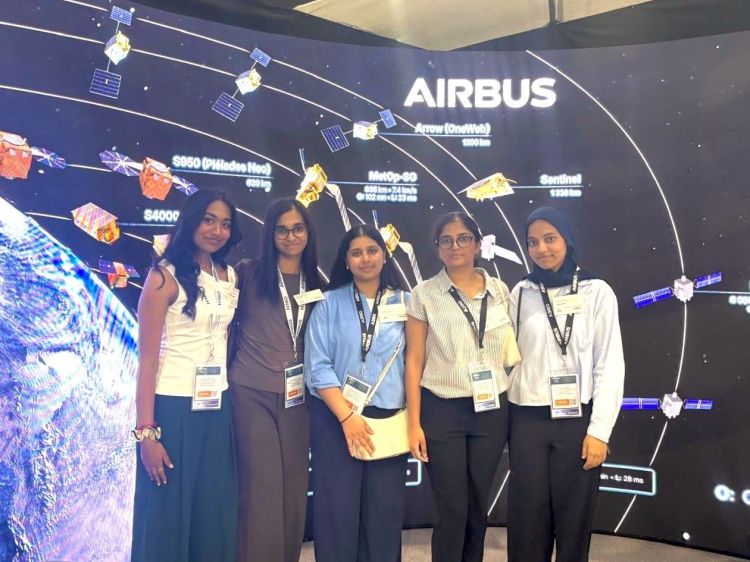
From left to right: Manasa Srivatsan, Norah Miriam Shibu, Mahati Tadepalli, Manya Singla and Aaisha Pathan.
"Seeing our work recognized after months of dedication, hard work, and perseverance made the achievement even more meaningful," Singla says. "While winning was an unforgettable moment, what we will remember most is everything we learned along the way: the teamwork, the curiosity, the resilience, and the people who supported us throughout the journey."
The team first learned about the upcoming competition through social media, and were excited by the opportunity to get involved in a project more sustained than a hackathon, with "the potential to make a real-world impact ... this contest stood out as a way to address persisting problems that have no wide-scale solution," Tadepalli says.
Their project, Ariadne, addresses the increasingly serious issue of GPS spoofing, in which malicious actors intentionally mislead aircraft, leading to deviations from flight paths and conflicted airspace. Many existing solutions require expensive hardware upgrades or new infrastructure, so the team set out to address the problem entirely using software. They created a software-based navigation framework that protects aircraft against GPS spoofing by continuously cross-checking GPS data with inertial reference systems and terrain-referenced navigation.
If GPS data begins to diverge beyond an acceptable threshold, Ariadne progressively reduces its trust in GPS and instead relies on terrain-corrected inertial navigation. It also cryptographically authenticates Air Traffic Control reroute messages to prevent malicious instructions from being accepted. "Because the framework operates entirely at the navigation-logic level," Shibu explains, "it requires no certified hardware modifications, making deployment through a software update possible."
The contest followed an iterative design model: along with more than 360 teams around the world, the members of G-00SE submitted a written proposal outlining their initial idea. Their proposal was one of 66 that were chosen to advance to the next round. They then spent several months working with a mentor from Airbus and other industry experts to refine their solution, build a working prototype, and create a video pitch. From there, they were chosen as one of three finalist teams who received one-on-one coaching then presented their solution to an international jury.
The team members note, however, that most of the work happened outside of these formal consultation and coaching sessions. "Our process was really collaborative," Srivatsan says. "Most of the project came together through late-night video calls and brainstorming sessions around our living rooms, where we'd spend hours throwing ideas at each other and intentionally trying to find loopholes in our own design. Those conversations ended up shaping some of our biggest design decisions and made the final solution that much stronger."
"This is a phenomenal achievement by an outstanding team of UWaterloo students, whose Ariadne framework offers a practical, software-based approach to protecting aircraft from GPS spoofing," says Dr. David Del Rey Fernandez, Associate Professor of Applied Mathematics and the Pratt & Whitney Canada Chair in Industrial Artificial Intelligence. "Their success in the Airbus Fly Your Ideas Challenge highlights not only the strength of Waterloo students, but also the power of interdisciplinary teams to deliver deployable solutions to urgent industry challenges."
The team members are particularly grateful to their Airbus mentor, Antonio Carrasco Reinosa, "whose encouragement, guidance, and belief in our team never wavered from the very beginning." They are also grateful to Stephen Ko, a Methods Analyst at Bombardier Aerospace; Dr. Nomair Naeem, Associate Professor of Computer Science; and the entire Fly Your Ideas team. "This experience has left a lasting impact on us," Pathan says, "and we are excited to carry these lessons into our future careers."
"For me, this win is especially exciting because it reflects something we believe strongly at Waterloo: amazing things can happen when aviation connects with other disciplines," says Dr. Suzanne Kearns, Founding Director of the Waterloo Institute for Sustainable Aeronautics. "Some of the most creative, practical, and transformative ideas for the future of aerospace will come from bringing new perspectives, technologies, and solutions into aviation."