

Four master's students from France with a shared interest in the chemistry of health and pharmaceuticals are studying in Dr. Tabitha Wood's lab at the University of Winnipeg this summer.
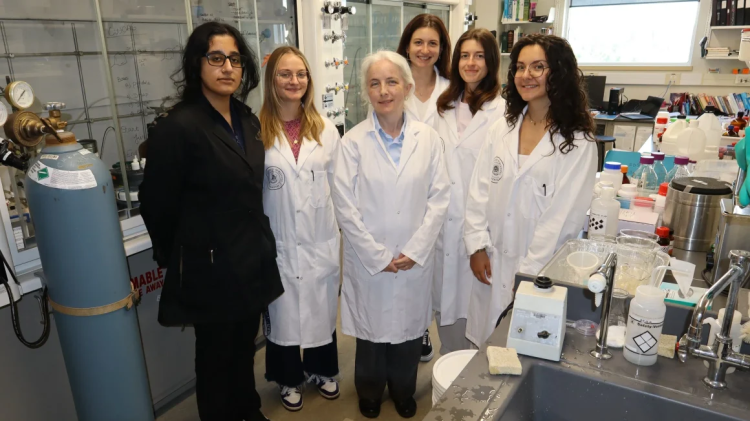
From left: Ruby Gosal (MSc student and research assistant to Dr. Wood), Charlyne Werlin, Dr. Tabitha Wood, Amélie Jarousse, Ema Corby, and Alicia Portal in a UWinnipeg chemistry lab.
Alicia Portal, Amélie Jarousse, Charlyne Werlin, and Ema Corby are Visiting Graduate Fellows from Clermont Auvergne INP, a polytechnic institute in Aubière, France.
Completing a 17-week lab research internship abroad is a second-year requirement of their master's degree program in chemical engineering. The students arrived at UWinnipeg in May and will head home in September to continue to their studies.
Dr. Wood fully includes us in the life of the laboratory.
Charlyne Werlin
"They're really fantastic chemists," said Dr. Wood, Associate Professor of Chemistry and UWinnipeg's Dean of Science. "They really add to our research programs and increase our capacity to supervise undergraduate students, while contributing to the student community and providing awesome cultural exchange."
Each of the four students are working on a different pharmaceutical research project that involves making new molecules with proposed therapeutic effects. Each project targets a different protein for the proposed treatment of various ailments (cancer, pain, bacterial infection, and infertility).
Two of the four projects are related to a project Dr. Wood is part of called the , an open-source virtual drug discovery resource created by a consortium of Canadian academic laboratories.
The students' research projects also intersect with the research of Ruby Gosal, a MSc Bioscience student and UWinnipeg's Winner of Three-Minute Thesis (3MT) competition in 2025.
Other research collaborators include UWinnipeg faculty members Dr. Josh Hollett (Chemistry), Dr. Anuraag Shrivastav (Biology), and Dr. Paul Holloway (Biology).
All four students said their summer internship is deepening their skills and boosting their and confidence in the lab. It's also improving their English and providing an opportunity to collaborate with researchers from different cultures an essential skill for today's engineers, who work in increasingly global scientific and industrial environments.
The students gather for a research meeting with Dr. Wood.
"English is very important because it's the international language of science," Ema explained.
"Experiencing research abroad gives us a broader perspective on chemistry," Charlyne added, "and shows us how scientists from different backgrounds collaborate to solve scientific challenges."
All four students also appreciated Dr. Wood's lab environment.
"We're encouraged to think for ourselves, ask questions, and be careful in our experiments," Ema said. "It is a very pleasant place to work."
Amélie agreed, saying, "I really appreciate how welcoming and supportive everyone in the lab has been. It made it easy to settle in, ask questions, and learn new things."
"Dr. Wood fully includes us in the life of the laboratory," Charlyne added. "She gives us the opportunity to participate in different group activities, such as celebrations, scientific presentations, and outreach activities, including chemistry workshops for children as part of Science Adventure Camp."
Meet the students
Ema Corby
Ema has studied the chemistry of food, cosmetics, and pharmaceuticals. The latter is her favourite.
"I like that chemistry can help develop new medicines and improve peoples' health," she said.
Ema and Ruby are synthesizing a small FSHR agonist molecule, which could be useful in future fertility treatments for women.
"Even if this molecule is not used as a medicine today, this project allows us to work like real researchers," Ema said. "We had to study the literature, choose a synthesis pathway, and solve problems together."
Looking ahead, she wants to work in pharmaceutical production.
"This internship helps me better understand organic chemistry, reaction mechanisms, and laboratory work," she said. "These skills will be very useful in my future career."
Charlyne Werlin
Charlyne is drawn to organic chemistry projects that contribute to the development of practical pharmaceutical solutions.
"I especially enjoy the methodological aspects of organic chemistry, such as reaction optimization, purification, and product analysis," Charlyne said.
Her project focuses on the synthesis of small molecules capable of inhibiting the USP5 protein, which plays an important role in recycling proteins inside cells.
"However, when its activity is altered, it can contribute to the development of certain diseases, including some cancers," Charlyne said. "We're seeking to create small molecules capable of blocking its action when it malfunctions. This type of research, if successful, could lead to new treatments in the future."
Charlyne said her experience at UWinnipeg will be an asset as she enters the final year of her engineering degree.
"It's allowing me to become more independent in the laboratory, and gain a better understanding of the scientific process, from literature review to the development of a synthetic method," she said.
Amélie Jarousse
Amélie enjoys seeing how small changes in a molecule can completely change its properties or biological activity.
"I enjoy the problem-solving side of organic synthesis figuring out why a reaction worked (or didn't!) and finding ways to improve it."
Amélie is working on synthesizing and characterizing small organic molecules that could potentially inhibit the bacterial protein FtsZ, which is an important target for developing new antibiotics.
"Since this is my first experience in an academic research lab, I'm learning a lot not only about organic synthesis but also about how research projects are carried out from start to finish," she said. "When I return to France, I'll be able to apply these new skills in my engineering program, and I think they'll be valuable for my future career in the pharmaceutical or cosmetics industry."
She is enjoying the chance to be involved in every step of the project, from running reactions to analyzing final compounds.
"Every day is a little different, which keeps things interesting."
Alicia Portal
Alicia is interested in developing treatments for new diseases.
"I find it fascinating to understand how organic chemistry can lead to innovations that improve people's health and quality of life," she said.
Alicia is synthesizing small molecules that could become selective inhibitors of an enzyme called hNMT2.
"This enzyme is considered a promising target for the treatment of metastatic triple-negative breast cancer," she explained.
She said the internship has helped her better understand the long process of developing molecules for use in future medical treatments.
"It is very rewarding to see a project progress step-by-step and to know that our research could contribute to future cancer treatments," Alicia said. "I've gained a much deeper appreciation of the time, precision, and teamwork required in scientific research."
Exploring Manitoba and beyond
No internship abroad would be complete without a little sightseeing. The students have many locales on their list, from Winnipeg's museums, sporting events, and amenities like Assiniboine Park and The Forks, to rural Manitoba and its many beaches and provincial parks.
The students are also planning to visit Ontario and Quebec, take in the scenery of Banff, Lake Louise, and Vancouver Island.
Charlyne enjoyed the Canada Day celebrations at Princess Auto Stadium, and the local culinary scene. Amelie likes walking around Winnipeg to get a feel for its different neighbourhoods. Alicia attended the Winnipeg Folk Festival and Folklorama, while Ema will visit some Canadian relatives.
"My favourite part of Canada is the people," Ema said. "Everyone has been very kind and welcoming."